On this page
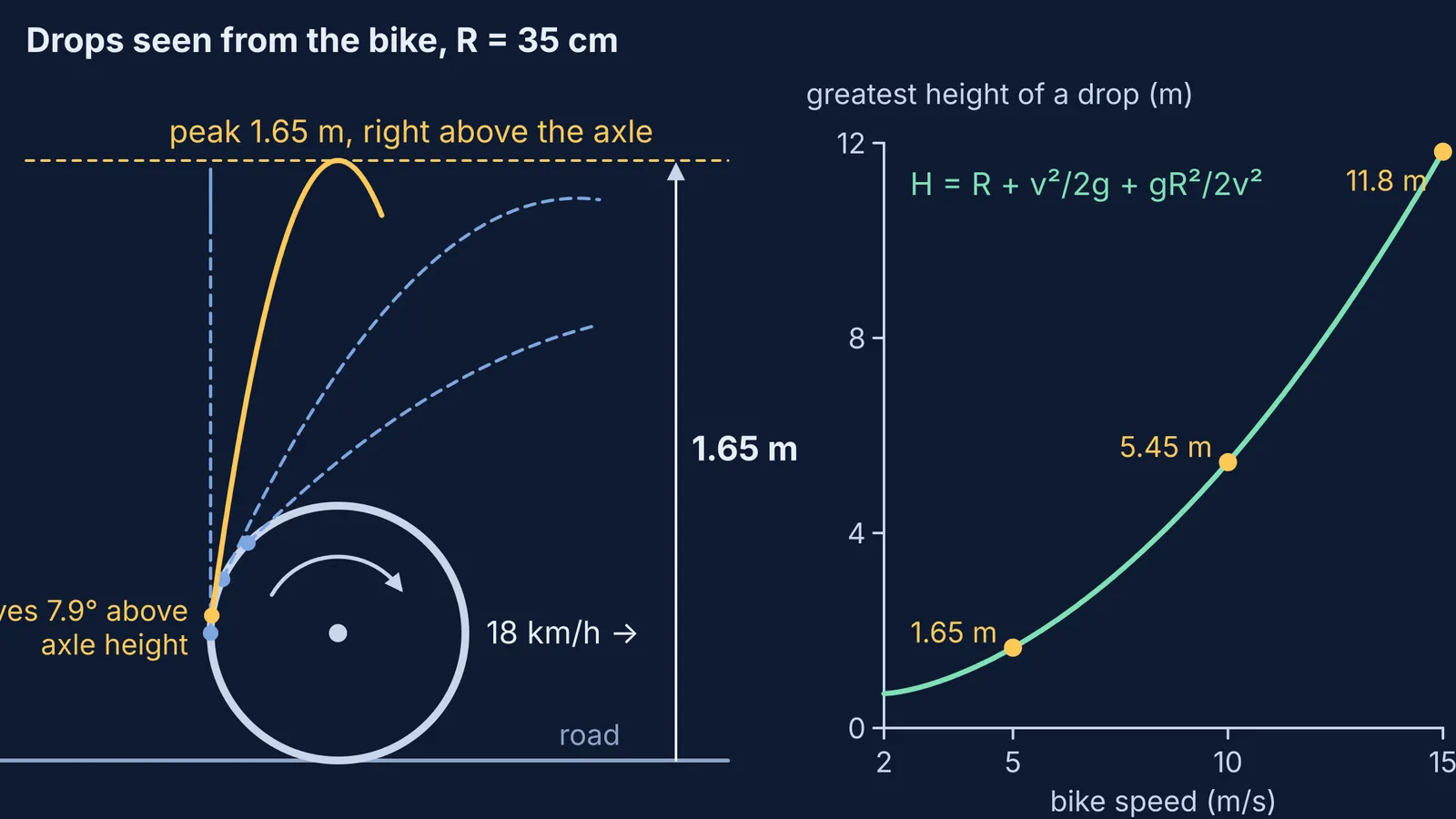
Ride a bicycle without a mudguard through a wet patch and you get a brown stripe from the saddle up your back. The mud did not come from the top of the tyre, where the rubber moves fastest. It came from the back of the wheel, close to the height of the axle. Rolling motion and one projectile formula explain both where it leaves and how high it can go: for a 35 cm wheel at 18 km/h, up to 1.65 m above the road.
Fermi News has already covered why mud leaves a tyre along a tangent and the cycloid traced by a point on the rim. This post adds the height.
How fast does each point on a rolling tyre move?
A wheel of radius R rolling without slipping at speed v turns at ω = v/R. The velocity of any point on the rim is the velocity of the centre plus the velocity due to the spin: v_point = v_cm + ω × r.
Measure a rim point by its angle θ above the horizontal line through the axle, on the back half of the wheel. The bike moves forward and the wheel turns so that the top goes forward, which means the back of the rim moves up. Working out ω × r gives the point's velocity relative to the axle as v sin θ forward and v cos θ upward. Adding v_cm, the ground sees:
forward speed v(1 + sin θ)
upward speed v cos θ
height above the road R(1 + sin θ)
Check: at the top (θ = 90°) the speed is 2v and horizontal; at axle height on the back (θ = 0) it is v forward and v upward.
There is a shortcut. The bike moves at a steady speed, so the rider's frame is inertial. In that frame the wheel just spins on a fixed axle, every rim point moves at v along the tangent, and the upward part on the back half is v cos θ. Heights are the same in both frames.
Which drop of mud rises highest?
A drop that lets go at angle θ starts at height R(1 + sin θ) and rises a further (v cos θ)²/2g. Its greatest height is
H(θ) = R(1 + sin θ) + v² cos² θ / 2g
Leaving higher up gives a head start, but the upward speed v cos θ falls as θ grows. Set dH/dθ = 0:
R cos θ − (v²/g) sin θ cos θ = 0, so sin θ = gR/v²
Put this back in and use cos² θ = 1 − sin² θ:
H = R + v²/2g + gR²/2v²
This works only if gR/v² is less than 1, that is v > √(gR). Below that speed no rim point moves upward fast enough to beat the top of the wheel, and the most any mud reaches is 2R, the tyre's own height.
Worked example: a 35 cm wheel at 18 km/h
Take R = 0.35 m (a road or hybrid bike wheel, illustrative), v = 18 km/h = 5.0 m/s and g = 9.81 m/s².
Check the condition: √(gR) = √(9.81 × 0.35) = 1.85 m/s. Since 5.0 m/s is larger, the formula applies.
Find the launch point: sin θ = gR/v² = 3.434/25 = 0.137, so θ = 7.9°. The drop leaves just above axle height on the back of the wheel.
Launch height: R(1 + sin θ) = 0.35 × 1.137 = 0.40 m.
Upward speed: v cos θ = 5.0 × 0.991 = 4.95 m/s.
Extra rise: (4.95)²/(2 × 9.81) = 1.25 m.
Greatest height: 0.40 + 1.25 = 1.65 m. The formula gives the same: 0.35 + 1.274 + 0.024 = 1.65 m.
The drop takes 4.95/9.81 = 0.50 s to reach the top.
Notice how flat the maximum is. A drop leaving exactly at axle height reaches R + v²/2g = 1.62 m, only 2.4 cm lower.
Why does the mud end up on the rider's back?
Look at the drop in the bike's frame. Relative to the axle it moves forward at v sin θ = 0.69 m/s while it climbs for 0.50 s, so it drifts forward 0.35 m. It started 0.35 m behind the axle (R cos θ). So the highest drop peaks directly above the rear axle.
This is not a coincidence of the numbers. The forward drift is (v sin θ)(v cos θ)/g, and with sin θ = gR/v² that equals R cos θ for any speed and any wheel. Drops from higher up the back of the wheel lean further forward. In the bike's frame, the mud from the back upper quarter of the rear tyre rises and drifts forward, towards the seat post, the saddle and the rider's back. That is the stripe. A rear mudguard works by catching this spray before it gets clear of the tyre.
How does the height change with speed?
For the same 0.35 m wheel:
2 m/s (a walking pace): about 0.70 m, barely above the top of the tyre, from 59° above axle height
5 m/s (18 km/h): 1.65 m, from 7.9°
10 m/s (36 km/h): 5.45 m, from 2.0°
15 m/s (54 km/h): 11.8 m, from 0.9°
At high speed the gR²/2v² term becomes tiny and H approaches R + v²/2g: the mud leaves almost exactly at axle height, moving straight up at the bike's speed. Doubling the speed roughly quadruples the rise, as for any ball thrown upward.
What does the formula leave out?
The answer is an upper limit, not a prediction for every drop.
Grip. Mud only leaves when the wheel cannot supply the centripetal force v²/R that keeps it on the rim. At 5.0 m/s that is 71 m/s², about 7.3 times g, and sticky clay may hold on past the launch point found above.
Air drag. Small drops slow down quickly in air, so the higher speeds in the list overstate real heights.
The frame of the bike. The seat stays, mudguard and rider get in the way before many drops reach their peak.
This is a JEE Advanced style problem in three steps: velocity of a rim point from v_cm + ω × r, then a projectile, then a maximum. Variants ask for the launch angle on the wheel, or the speed below which no mud clears the top of the tyre. For step-by-step working on rolling-motion problems, try the Fermi Problem Library, whose solver explains the reasoning. For a full plan, Fermi Test Prep offers personalised preparation for JEE Main & Advanced with an AI tutor, adaptive mocks and a study plan that updates based on mastery.
Quick checklist
Rim point on a rolling wheel: v_cm + ω × r, with ωR = v.
On the back half, upward speed v cos θ at height R(1 + sin θ).
Highest drop: sin θ = gR/v², H = R + v²/2g + gR²/2v².
Needs v > √(gR); otherwise the most is 2R.
The highest drop peaks right above the axle, in the bike's frame.
Treat the result as a no-drag upper limit.