On this page
Most results in Moving Charges and Magnetism are built, not stated. Here are five derivations that NCERT Chapter 4 (Reprint 2026-27) works out. For answer layout and revision, see our Moving Charges and Magnetism Class 12 board exam guide.
Which derivations does NCERT Chapter 4 work through?
The CBSE Class XII Physics curriculum for 2026-27 lists the force on a moving charge in a uniform magnetic field, the Biot-Savart law applied to a circular loop, Ampère's law for a long straight wire, the force between parallel currents, the torque on a current loop and the moving coil galvanometer. It limits the straight solenoid to "only qualitative treatment", so we skip its formula.
Radius and frequency in a magnetic field: r = mv/qB
Setup: a charge q of mass m enters a uniform field B with velocity v perpendicular to B.
The force q(v × B) is perpendicular to v, so it does no work and the speed stays fixed.
A constant-size force qvB at right angles to the motion is centripetal, so the path is a circle.
Set mv²/r = qvB and cancel one v: r = mv/(qB).
Angular frequency ω = v/r = qB/m, so the frequency ν = qB/(2πm) and the period T = 2πm/(qB).
If v has a component v∥ along B, that part is untouched and the path becomes a helix of pitch p = v∥T = 2πmv∥/(qB).
Result: r = mv/qB, and ν = qB/2πm does not depend on speed.
Where students slip: using the full speed instead of only the perpendicular component for the radius of a helix.
Field on the axis of a circular loop: B = μ0IR²/2(x² + R²)^(3/2)
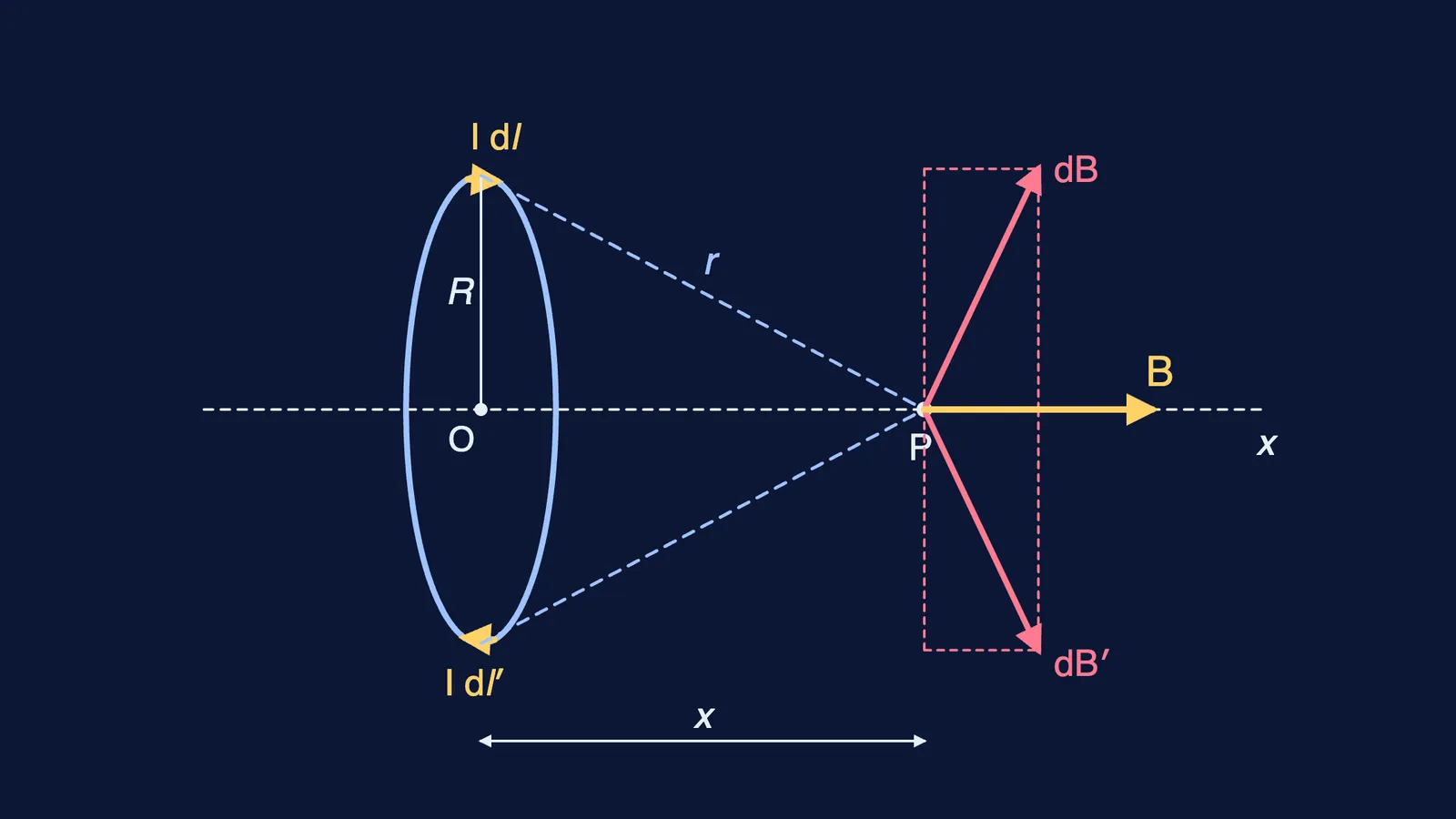
Setup: a loop of radius R carries steady current I; P is on its axis, distance x from centre O.
Take a small element dl of the loop. The line r from dl to P has length √(x² + R²).
dl is perpendicular to r, so |dl × r| = r dl, and Biot-Savart gives dB = (μ0/4π) I dl/(x² + R²).
dB is perpendicular to r. Split it into dBx along the axis and dB⊥ across it.
The diametrically opposite element gives an equal, opposite dB⊥, so the across-axis parts cancel.
Only dBx = dB cos θ survives, where cos θ = R/√(x² + R²).
Add over the loop: the dl values sum to 2πR, giving B = μ0IR²/[2(x² + R²)^(3/2)].
Put x = 0 for the centre: B = μ0I/2R.
Result: B = μ0IR²/2(x² + R²)^(3/2) along the axis, and μ0I/2R at the centre.
Where students slip: writing cos θ = x/√(x² + R²). θ is the angle between dB and the axis, so cos θ = R/r.
Field of a long straight wire from Ampère's law: B = μ0I/2πr
Setup: an infinitely long straight wire carries current I; find B at distance r.
Ampère's circuital law: the line integral of B · dl around a closed loop equals μ0 times the current it encloses.
Choose a circle of radius r centred on the wire as the Amperian loop. By symmetry B is tangential and the same size everywhere on it.
The integral becomes B × 2πr.
Set B × 2πr = μ0I and solve.
Result: B = μ0I/2πr, along circles around the wire.
Where students slip: skipping step 2. Symmetry is what lets B come outside the integral, so say it.
Force between two parallel currents: f = μ0IaIb/2πd
Setup: long parallel wires a and b, distance d apart, carry currents Ia and Ib the same way (NCERT Section 4.8).
Wire a sets up a field Ba = μ0Ia/(2πd) at every point of wire b.
A length L of wire b feels force F = IbLBa, because Ba is perpendicular to the wire.
Substitute: F = μ0IaIbL/(2πd), so the force per unit length is f = μ0IaIb/(2πd).
The same steps give an equal, opposite force on a (Newton's third law).
With 1 A in each wire, 1 m apart, f = 2 × 10⁻⁷ N per metre. NCERT uses this to define the ampere.
Result: f = μ0IaIb/2πd; wires carrying current the same way pull together, and opposite currents push apart.
Where students slip: borrowing the electrostatics rule. Two same-sign charges push apart, but two same-direction currents pull together.
Torque on a current loop: τ = m × B, and the galvanometer
Setup: a rectangular loop with sides a and b carries current I in a uniform field B; its area vector makes angle θ with B.
The forces on the two sides of length a are equal, opposite and in one line, so they cancel.
The sides of length b stay perpendicular to B as the loop turns, so each feels a force IbB, equal and opposite but not in line: a couple.
Each force acts at lever arm (a/2) sin θ, so τ = 2 × IbB × (a/2) sin θ = IabB sin θ = IAB sin θ.
With magnetic moment m = IA (NIA for N turns), τ = m × B.
In a moving coil galvanometer the radial field makes sin θ = 1, so τ = NIAB. A spring of constant k balances it: kφ = NIAB.
Result: τ = NIAB sin θ; for a galvanometer φ = (NAB/k)I, and current sensitivity φ/I = NAB/k.
Where students slip: taking θ as the angle between the plane of the loop and B. NCERT measures θ from the normal, so the torque is largest when the plane is parallel to B.
How should you practise these derivations?
Draw and label the figure first, including every angle.
Write the reason in each step: "perpendicular components cancel by symmetry", "B tangential and constant on the loop".
Check the limits: x = 0 in the loop formula gives μ0I/2R; θ = 0 in the torque gives zero.
Redo each derivation from a blank page, then try the Class 12 moving charges and magnetism case study questions to use the results.
If the cancelling field components are hard to picture, the Fermi Simulation Lab has interactive simulations for the ideas that are easier to see than to read.