On this page
Motion in a Plane is Chapter 3 of the NCERT Class 11 Physics textbook, Part I (reprint 2026-27), and the CBSE Class XI Physics syllabus for 2026-27 covers vectors, projectile motion and uniform circular motion in it. The terms below follow NCERT's usage, in SI units. For a full walkthrough of the chapter and a revision plan, see our Motion in a Plane Class 11 chapter guide.
What is the difference between a scalar and a vector?
Scalar: a quantity that has size only, so a number with its unit says everything about it. Example: mass (kg), temperature (K), distance (m).
Vector: a quantity with magnitude (its size, never negative) and direction that adds by the triangle or parallelogram law. Example: displacement, velocity, force.
Position vector (r): the arrow from a chosen origin to the object, in m.
Displacement (Δr): the straight arrow from start to finish, Δr = r′ − r, whatever the route. Don't confuse with: path length, the distance along the route, which is never less than the size of the displacement.
Equal vectors: same magnitude and same direction, wherever they are drawn.
Null (zero) vector: a vector of zero magnitude, so it has no definite direction. Example: the displacement of a ball caught where it was thrown.
Multiplying by a real number: λA is λ times as long as A; it points the same way if λ is positive and the opposite way if λ is negative.
How do you add, resolve and multiply vectors?
Triangle (head-to-tail) method: put the tail of B on the head of A; the arrow from the tail of A to the head of B is the resultant R = A + B.
Parallelogram method: draw A and B from one point and complete the parallelogram; its diagonal from that point is the same resultant.
Vector subtraction: A − B means A + (−B), where −B is B reversed.
Unit vector: a vector of size 1, with no unit or dimension, used only to point out a direction; î, ĵ and k̂ point along the x-, y- and z-axes.
Resolution: splitting a vector into parts along chosen directions that add back to it.
Rectangular components: Ax = A cos θ and Ay = A sin θ, so A = Ax î + Ay ĵ. To add vectors analytically, add matching components: Rx = Ax + Bx. Example: NCERT Example 3.1 combines rain at 35 m/s with wind at 12 m/s into about 37 m/s, about 19° from the vertical. Don't confuse with: Ax î, which is a vector, while Ax is just a number that can be negative.
Scalar (dot) product: A·B = AB cos θ, a scalar; NCERT teaches it in Chapter 5.
Vector (cross) product: A × B has magnitude AB sin θ and is perpendicular to both, by the right-hand rule; NCERT teaches it in Chapter 6. Don't confuse with: the dot product, which is commutative, while A × B = −B × A.
How are velocity and acceleration defined in a plane?
Average velocity: displacement divided by time, Δr/Δt, in m/s. Don't confuse with: average speed, path length divided by time, which is never less than it.
Instantaneous velocity: v = dr/dt, always along the tangent to the path.
Acceleration: a = dv/dt, in m/s². In a plane, v and a can be at any angle from 0° to 180°. Example: in NCERT Example 3.4, v = 3.0 î + 4.0t ĵ m/s, so a = 4.0 m/s² along y.
Constant acceleration: v = v0 + at and r = r0 + v0t + ½at², which split into independent motions along x and y.
What are the key terms in projectile motion?
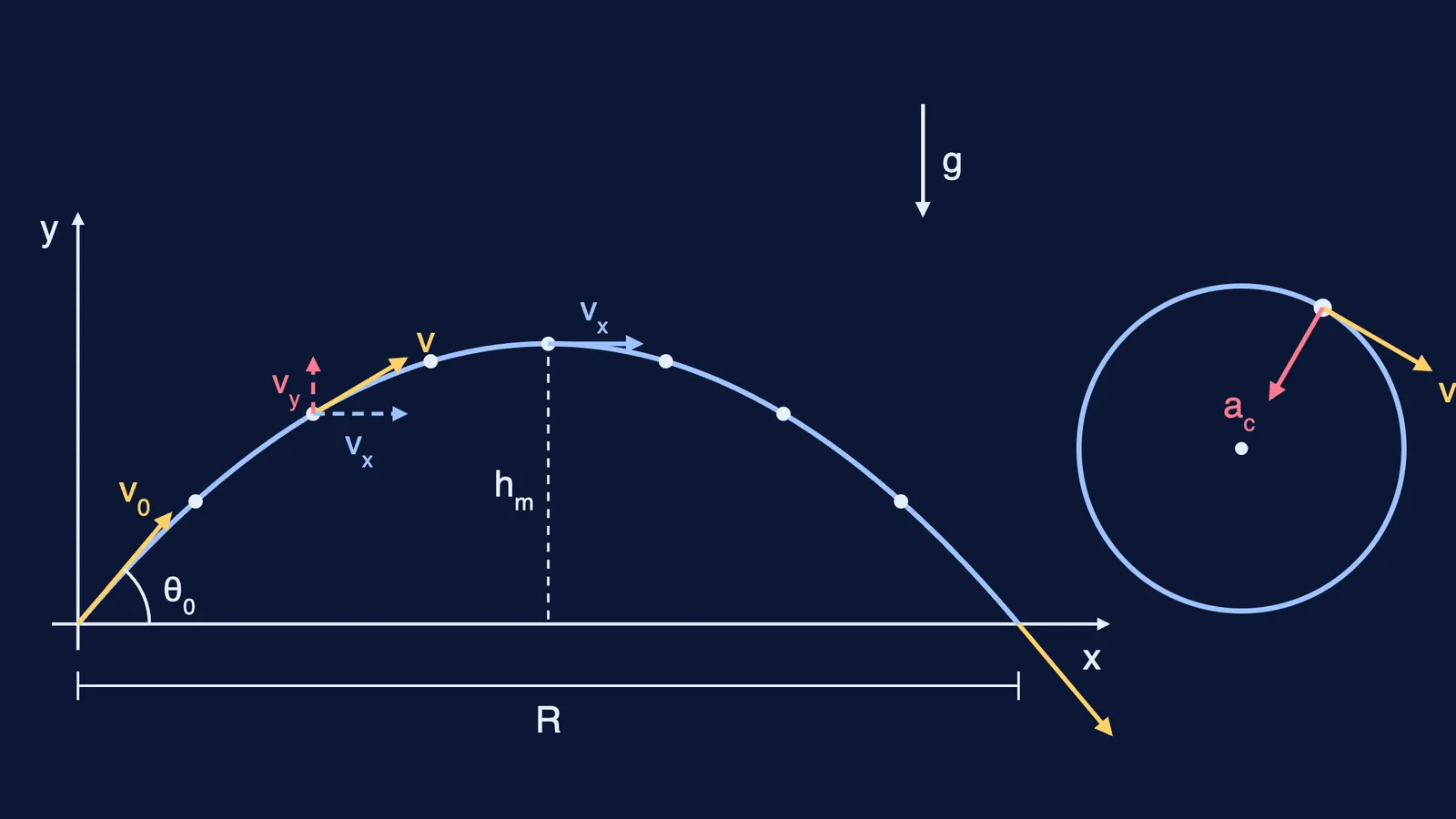
Projectile: anything that, once launched at speed v0 and angle θ0 above the horizontal, moves under gravity alone (air resistance ignored). Example: a thrown cricket ball.
Trajectory: its path, a parabola.
Velocity components: vx = v0 cos θ0 never changes; vy = v0 sin θ0 − gt, with g = 9.8 m/s². At the top vy = 0 but vx is not.
Time of flight (Tf): total time in the air back to launch level, Tf = 2v0 sin θ0/g, twice the time to the top.
Maximum height (hm): hm = (v0 sin θ0)²/2g.
Horizontal range (R): R = v0² sin 2θ0/g, largest (v0²/g) at 45°. Example: NCERT Example 3.8 throws a ball at 28 m/s, 30° up: hm = 10.0 m, Tf = 2.9 s, R = 69 m. Don't confuse with: maximum height, which keeps growing towards 90°.
What is uniform circular motion?
Uniform circular motion: motion on a circle at constant speed; the direction keeps changing, so the object accelerates.
Centripetal acceleration (ac): ac = v²/R = ω²R, always towards the centre; constant in size but not direction. Don't confuse with: constant acceleration, whose equations do not apply here.
Angular speed (ω): the angle the radius turns through per second, ω = Δθ/Δt, in rad/s; the linear speed is v = Rω.
Time period (T) and frequency (ν): time for one revolution (s) and revolutions per second (Hz); ν = 1/T and ω = 2πν. Example: NCERT Example 3.9: 7 revolutions in 100 s on a 12 cm circle gives ω = 0.44 rad/s and ac = 2.3 cm/s².
Relative velocity in two dimensions is not listed: the 2026-27 reprint has no section on it and the CBSE 2026-27 syllabus does not name it; only a Points to Ponder note gives v12 = v1 − v2.
How to learn these terms
Learn pairs together: distance and displacement, speed and velocity, Ax and Ax î, dot and cross product. Our post on common vector errors in physics shows the usual slips.
Draw each vector term as an arrow, including a vector split into Ax and Ay.
Sketch one projectile path and label v0, θ0, vx, vy, hm and R with their formulas.
For circular motion, draw v along the tangent and ac towards the centre at three points.
If instantaneous velocity feels shaky, revise our Motion in a Straight Line Class 11 guide first. For any single idea, the Fermi Concept Library has its own lesson and its place in the concept map.