On this page
Money and Banking is Chapter 3 of NCERT's Introductory Macroeconomics. Here is the chapter as the 2026-27 syllabus lists it, with worked examples.
What does the Money and Banking chapter cover for 2026-27?
The CBSE Economics curriculum for 2026-27 prints the marks for Unit 2, Money and Banking, as 06 out of the 40 for Part A, Introductory Macroeconomics. It lists the meaning and functions of money; money supply; money creation by banks; and the RBI as bank of issue, government's bank and bankers' bank, with credit control through Bank Rate, CRR, SLR, repo and reverse repo rates, open market operations and margin requirement.
The current NCERT chapter (Reprint 2026-27) also covers the demand for money (Section 3.2.1 and Box 3.1, which includes the liquidity trap). The Unit 2 syllabus list does not name it, so focus on the parts above.
What are the functions of money?
NCERT defines money as the commonly accepted medium of exchange, and starts from barter, which needs a double coincidence of wants (NCERT, Section 3.1). NCERT describes three functions:
Medium of exchange. No need to find someone who wants exactly what you have.
Unit of account. Every price is in rupees, so a phone and a bicycle can be compared directly.
Store of value. Money does not rot, so you can save now and spend later, if prices stay fairly stable.
The sample paper also uses the labels standard of deferred payments (repaying a loan in fixed instalments) and measure of value.
How is money supply measured: M1, M2, M3 and M4?
NCERT gives RBI's four measures (NCERT):
M1 = CU + DD, where CU is notes and coins with the public and DD is the public's net demand deposits at commercial banks
M2 = M1 + savings deposits at post office savings banks
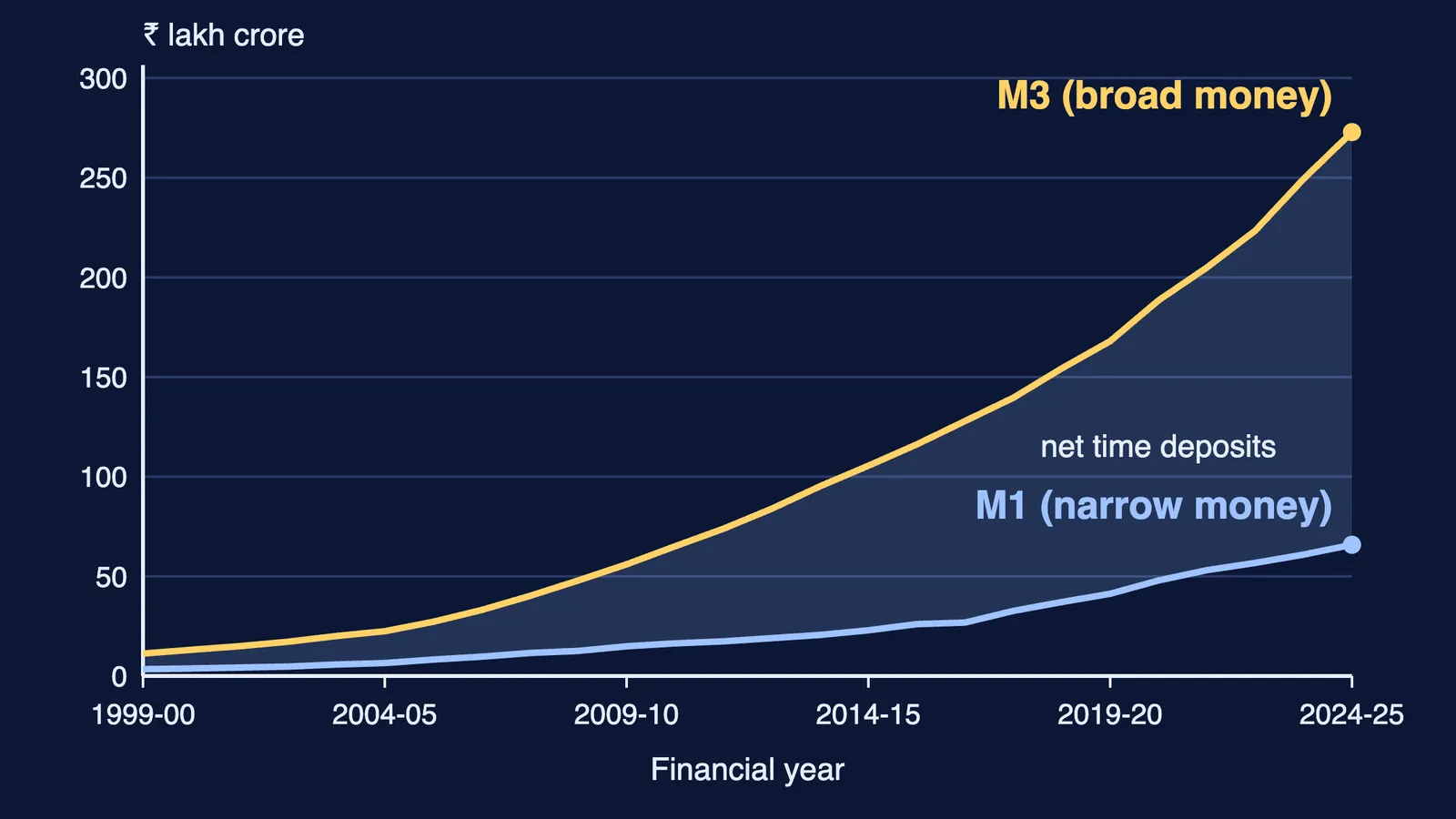
M3 = M1 + commercial banks' net time deposits
M4 = M3 + all deposits with post office savings bodies, leaving out National Savings Certificates
M1 and M2 are narrow money, M3 and M4 broad money; liquidity falls from M1 to M4. "Net" excludes interbank deposits.
Worked example (₹ crore, invented). Currency with the public 1,200; public's demand deposits 900; interbank deposits 150; net time deposits 2,400; post office savings bank deposits 80; all post office deposits excluding NSCs (including the 80) 300.
M1 = 1,200 + 900 = 2,100. The 150 is excluded.
M2 = 2,100 + 80 = 2,180.
M3 = 2,100 + 2,400 = 4,500.
M4 = 4,500 + 300 = 4,800.
The hero chart plots NCERT's Appendix 3.2: M3 rose from about ₹11.2 lakh crore in 1999-2000 to about ₹272.9 lakh crore in 2024-25 (NCERT, citing RBI's Handbook of Statistics on Indian Economy 2024-25).
How does the RBI control credit?
With no cash held by the public, the money multiplier is 1/CRR (NCERT, Section 3.3). For a round-by-round version, see our credit creation worked numerical for Class 12.
The RBI alone issues currency notes, banks for the government, holds banks' reserves and is lender of last resort (NCERT). Its tools are quantitative (CRR, Bank Rate and open market operations, which come as outright deals or repo and reverse repo) or qualitative (moral suasion, margin requirement). NCERT mentions SLR, which the syllabus also lists, only briefly: besides CRR, banks must hold some reserves in liquid form, and that ratio is the SLR.
To reduce money supply, the RBI can raise the Bank Rate or the CRR, or sell government securities. Cutting them, or buying securities, does the opposite.
CRR example (invented figures). Deposits are ₹50,000 crore and the CRR rises from 4% to 5%. Required reserves rise from ₹2,000 crore to ₹2,500 crore, so banks have ₹500 crore less to lend in the first round; the multiplier falls from 25 to 20.
Margin example (invented figures). A margin is the share of a security's market value that a bank must not lend against; an RBI master circular on loans and advances (2014) sets minimum margins on loans against shares as a percentage of market value. On shares worth ₹1,00,000, a 25% margin caps the loan at ₹75,000; a 40% margin caps it at ₹60,000, so credit tightens.
How is Money and Banking asked in the board exam?
In the CBSE 2026-27 sample paper, the unit's marks come as two 1-mark MCQs (M1; functions of money) and a 4-mark question with internal choice: an RBI function from a case, or CRR and the effect of changing it. A 3-mark part of a 6-mark income-and-employment question links an RBI open market purchase to aggregate demand. The marking scheme gives 1 mark for naming the function or the reason for the step, and the rest for explaining the chain.
Our own practice questions:
(1 mark) Which measure of money supply is the most liquid?
(3 marks) Currency with the public is ₹800 crore, net demand deposits ₹700 crore, interbank deposits ₹100 crore and net time deposits ₹1,500 crore. Find M1 and M3.
(4 marks) Explain how a sale of government securities by the RBI affects bank lending.
Answers: M1; ₹1,500 crore and ₹3,000 crore; bank reserves fall, so lending and money supply fall.
Next: government budget and deficits. Unsure where to start? Fermi's AI tutor can work out what you already know and build a plan for the session.