On this page
Mineral and Energy Resources is Chapter 5 of NCERT's Class 12 book India: People and Economy (NCERT, Reprint 2026-27). In the CBSE 2026-27 Geography curriculum, Unit III (Chapters 3 to 6) carries 10 marks together, with no separate figure for this chapter. Map work, worth 5 marks across the book, names 19 mines and refineries from this chapter.
What are minerals, and where are India's mineral belts?
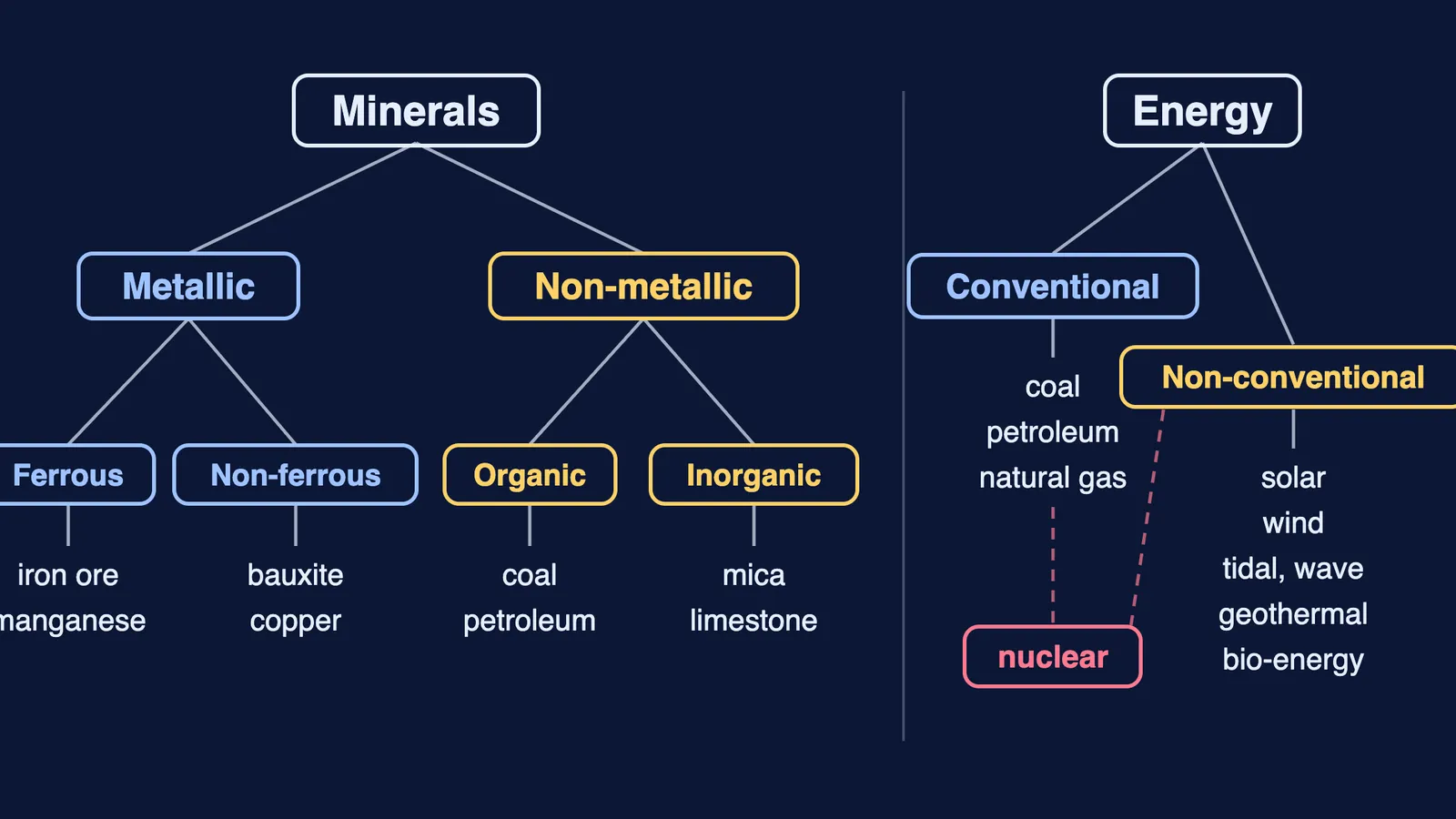
In NCERT's definition, a mineral occurs naturally, can be organic or inorganic in origin, and has fixed chemical and physical properties (NCERT, Chapter 5). The classification:
Metallic: ferrous (with iron: iron ore, manganese) and non-ferrous (such as bauxite and copper).
Non-metallic: organic, the mineral fuels coal and petroleum; and inorganic, such as mica and limestone.
Minerals are unevenly spread, good-quality ores are scarcer than poor ones, and all are exhaustible.
Most major minerals lie east of a line joining Mangaluru and Kanpur. The Damodar, Sone, Mahanadi and Godavari valleys hold over 97 per cent of the coal reserves. Minerals cluster in three broad belts, plus a minor Himalayan belt:
North-eastern plateau: Chhotanagpur, Odisha plateau, West Bengal, parts of Chhattisgarh; iron ore, coal, manganese, bauxite, mica.
South-western plateau: Karnataka, Goa, Tamil Nadu uplands, Kerala; high-grade iron ore, manganese, bauxite; no coal except Neyveli lignite.
North-western: the Aravali in Rajasthan and part of Gujarat; copper, zinc, building stones.
Where are iron ore, manganese, bauxite, copper and mica found?
From the NCERT chapter:
Iron ore: India has Asia's largest reserve, mainly haematite and magnetite. About 95 per cent of reserves lie in eight states: Andhra Pradesh, Chhattisgarh, Goa, Jharkhand, Karnataka, Odisha, Tamil Nadu and Telangana.
Manganese: used to smelt iron ore and make ferro alloys. Madhya Pradesh and Odisha lead.
Bauxite: the ore of aluminium, found with laterite. Odisha is the largest producer.
Copper: vital to the electrical industry. Mainly Singhbhum (Jharkhand), Balaghat (Madhya Pradesh), and Jhunjhunu and Alwar (Rajasthan).
Mica: Jharkhand's high-quality belt runs about 150 km in the lower Hazaribagh plateau; Nellore in Andhra Pradesh gives the best quality.
The curriculum's 19 map items (CBSE 2026-27), spellings corrected where noted:
Iron ore: Mayurbhanj, Bailadila, Ratnagiri, Ballari (printed Bellary).
Manganese: Balaghat, Shivamogga (printed Shimoga).
Copper: Hazaribagh, Singhbhum, Khetri (printed Khetari).
Bauxite: Katni, Bilaspur, Koraput.
Coal: Jharia, Bokaro, Raniganj, Neyveli.
Oil refineries: Mathura, Jamnagar (printed Jamnager), Barauni.
Ballari, Shivamogga and Jamnagar follow NCERT; Khetri, not in NCERT, follows Hindustan Copper.
What are conventional and non-conventional sources of energy?
NCERT's energy introduction calls coal, petroleum, natural gas and nuclear energy minerals conventional and exhaustible (NCERT, Chapter 5).
Coal: about 80 per cent is bituminous, non-coking grade. Jharia is the largest field, then Raniganj, both in the Damodar Valley.
Petroleum: until the Oil and Natural Gas Commission was formed in 1956, Digboi in Assam was the only producing region; planned exploration followed. Mumbai High, 160 km off Mumbai, was found in 1973 and produced from 1976. Digboi is a field-based refinery and Barauni a market-based one.
Natural gas: mainly Mumbai High and the Cambay basin, plus the Krishna-Godavari basin.
NCERT's non-conventional section covers:
Nuclear: uranium in Dharwar rocks and the Singhbhum copper belt; thorium from monazite beach sands of Kerala and Tamil Nadu. Plants include Tarapur, Rawatbhata, Kalpakkam, Narora, Kaiga and Kakarapara.
Solar: greatest potential in Gujarat and Rajasthan.
Wind: favourable in Rajasthan, Gujarat, Maharashtra and Karnataka.
Tidal and wave: large potential on the west coast, not yet used.
Geothermal: a plant at Manikaran, Himachal Pradesh.
Bio-energy: from farm residues and waste, as at Okhla in Delhi.
How can mineral resources be conserved?
NCERT's four measures (NCERT, Chapter 5) make a ready 3-mark answer:
Develop solar, wind, wave and geothermal energy to replace exhaustible sources.
Recycle scrap metal, especially copper, lead and zinc, where India's reserves are meagre.
Use substitutes for scarce metals.
Cut exports of strategic and scarce minerals so reserves last longer.
How should you practise this chapter for the board exam?
The 2026-27 sample paper has 1-mark MCQs, 3-mark answers of 80 to 100 words, 5-mark answers of 120 to 150 words and an India map question. Its map question includes a Tamil Nadu coal mine, the Bailadila iron-ore mines and a Gujarat refinery; the marking scheme answers are Neyveli, Bailadila (Chhattisgarh) and Jamnagar. Try these questions we wrote:
(1 mark) Is bauxite ferrous or non-ferrous? Why?
(3 marks) Distinguish field-based from market-based refineries, with one example each.
(3 marks) Why does the north-eastern plateau suit iron and steel plants?
(5 marks) Compare the potential of solar, wind and tidal energy in India.
(Map) Mark Jharia, Koraput and Balaghat.
See also our guides to primary activities and land resources and agriculture.
If you do not know where to start, Fermi's AI tutor can work out what you already know and build a plan for the session.