On this page
Microbial Cell Culture and its Applications opens Unit VI of the CBSE Biotechnology (045) curriculum for 2026-27. We found no official PDF of the prescribed book, CBSE's A Text Book of Biotechnology Class XII, so this guide follows the curriculum's topic list and uses NCERT Biotechnology XII as the reference: Chapter 6, Microbial Culture and Chapter 10, Bioprocessing and Biomanufacturing, both marked Reprint 2025-26.
How many marks does this chapter carry in 2026-27?
The 2026-27 curriculum gives 30 of 70 theory marks to Unit VI (Cell Culture and Genetic Manipulation). This chapter shares them with Plant Cell Culture and Animal Cell Culture; CBSE prints no separate chapter figure.
The curriculum lists nutrition, culture methods, growth kinetics, product isolation, strain improvement and applications. Our Microbes in Human Welfare Class 12 guide covers what microbes make for us in core Biology; this elective asks how you grow them, count them and pull a product out of the broth.
What do microbes need, and how are they cultured?
NCERT sorts microbes by carbon and energy source: heterotrophs take organic carbon, autotrophs fix carbon dioxide, and chemo- or photo- names the energy source. A medium supplies carbon, nitrogen, phosphorus, sulphur, growth factors and water, plus anti-foams when stirring makes the broth froth.
NCERT classifies media three ways:
By composition: synthetic (every chemical known, such as M9 for *E. coli*) or complex (peptone, yeast or beef extract).
By consistency: liquid broth, solid (1.0 to 2.0% agar) or semi-solid (0.5% agar).
By function: selective (a cellulose-only medium picks out cellulose digesters), differential (blood agar separates haemolytic from non-haemolytic bacteria) and enrichment.
An autoclave reaches 121°C at 15 psi; membrane filters of 0.2 to 0.45 μm clear heat-sensitive solutions; UV works best at 260 nm (NCERT Chapter 6). A pure culture then comes from the streak, pour or spread plate method.
How do you calculate specific growth rate and doubling time?
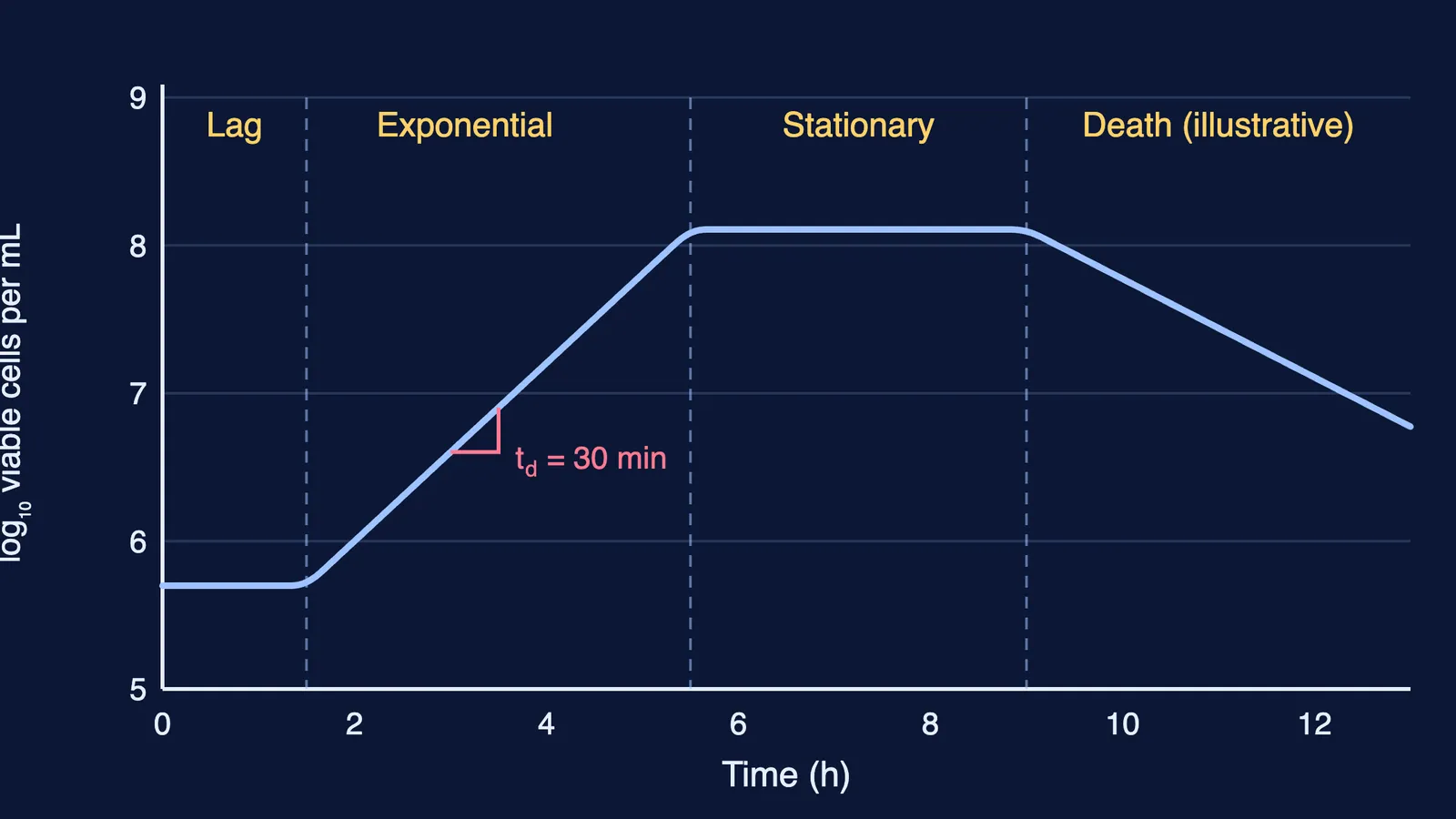
A plot of log viable cells against time shows four phases: lag, exponential, stationary and death. For the exponential phase NCERT gives μ = 2.303 (log Xt − log X0) / t and td = 0.693 / μ (NCERT Chapter 6). A cross-check is td = t / n, where n is the number of generations.
Worked example (our numbers). A broth holds 5 × 10⁵ cells/mL at the start of exponential growth and 8 × 10⁶ cells/mL two hours later.
log Xt − log X0 = log 16 = 1.204
μ = 2.303 × 1.204 / 2 = 1.386 h⁻¹
td = 0.693 / 1.386 = 0.500 h, or 30 min
Check: 16 = 2⁴, so n = 4 and td = 2 h / 4 = 30 min.
Reaching 1.28 × 10⁸ cells/mL from the start needs 256-fold growth, 8 generations: 4 hours.
We checked each step by hand and in Python; the graph above plots this culture.
How are microbial products isolated?
NCERT Chapter 10 covers upstream work (media, sterilisation, a healthy log-phase inoculum) and three modes: batch, fed-batch (nutrients added, nothing removed, so residual substrate stays low) and continuous (fresh medium in, used medium out, at steady state). The 2026-27 marking scheme adds that a turbidostat keeps cell concentration constant.
Downstream steps depend on where the product sits (NCERT Chapter 10):
Solid-liquid separation by filtration or centrifugation.
Cell disruption, only for intracellular products: bead mills, high-pressure homogenisers, ultrasonication, chemicals, osmotic shock or enzymes.
Recovery by liquid-liquid extraction (extract versus raffinate) or adsorption.
Purification by precipitation, chromatography or membranes: microfiltration covers 0.1 to 10 µm, ultrafiltration 0.01 to 0.1 µm.
What counts as strain isolation and improvement?
NCERT has no separate section on this. For isolation, its tools are a selective medium and a pure-culture method. For improvement, Chapter 10 gives examples: mutants of *Corynebacterium glutamicum* for glutamic acid and lysine, and high-yielding strains for vitamin B12. The 2026-27 marking scheme also accepts a transgene introduced by recombinant DNA technology as strain improvement. For rDNA basics, see our Biotechnology principles and processes guide.
Practice questions
The CBSE 2026-27 sample paper uses 1-mark MCQs, 2- and 3-mark short answers, 4-mark case-based and 5-mark long answers. Our labels follow those types; the questions are ours.
(1 mark) Which medium isolates cellulose-digesting soil bacteria? (a) nutrient broth (b) blood agar (c) a medium with cellulose as the sole carbon source (d) potato dextrose agar
(2 marks) In exponential growth a culture rises from 3 × 10⁴ to 2.4 × 10⁵ cells/mL in 120 minutes. Find the generations and the doubling time.
(3 marks) One product is secreted; another stays inside the cell. Outline the downstream steps for each.
(4 marks, case-based) A lab seeds a fermenter from a refrigerated slant and sees a long lag. Explain why, and list three properties of a good inoculum.
(5 marks) Compare batch, fed-batch and continuous modes, sketching substrate concentration against time for each.
Answers: Q1 (c). Q2: 3 generations, doubling time 40 min.
Not sure where to begin tonight? Fermi's AI tutor works out what you already know and builds a plan for the session.