On this page
If a NEET question shows you a gland cell and asks how it secretes, it is really asking one thing: how much of the cell leaves along with the product? Learn that one idea and the three names stop blurring together.
All three terms describe exocrine glands. An exocrine gland is one whose secretions leave through a duct that opens, directly or indirectly, to the external environment (OpenStax Anatomy and Physiology 2e, section 4.2). If you want to brush up on how these differ from hormone-making glands first, read our explainer on the difference between endocrine and exocrine glands.
What is the difference between merocrine, apocrine and holocrine glands?
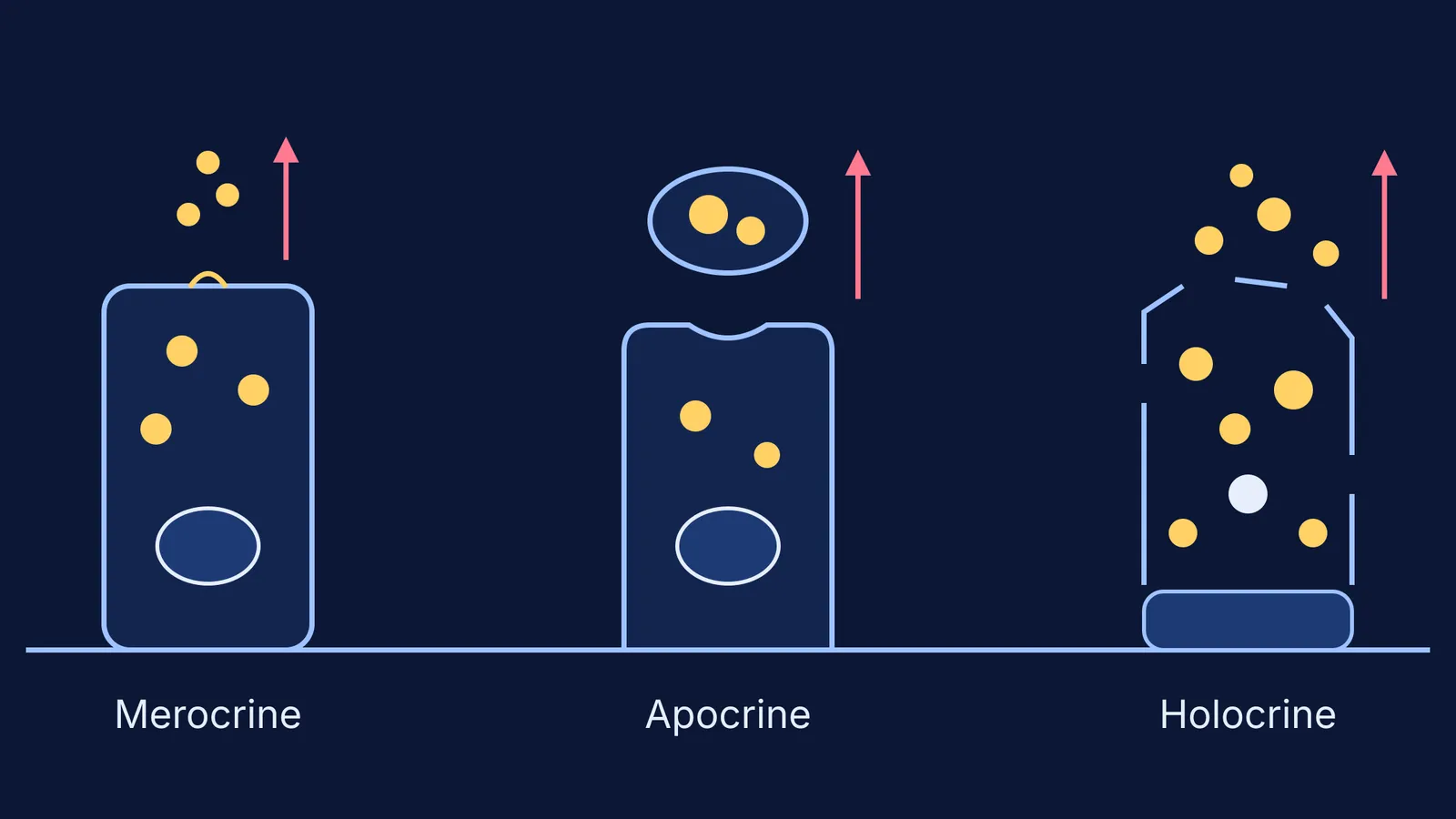
The three modes are graded by how much of the cell is lost, from none to all of it. The OpenStax textbook puts it this way:
Merocrine: the product is packed into vesicles that move to the top (apical) surface and are released by exocytosis. The cell stays intact. OpenStax calls this the most common type of exocrine secretion.
Apocrine: the product gathers at the top of the cell, and that top portion pinches off along with it. The rest of the cell survives and keeps working.
Holocrine: the cell fills up with product and then bursts, so the whole cell becomes part of the secretion. New cells from the surrounding tissue replace the ones that are lost.
Which glands are merocrine, apocrine and holocrine?
These are the standard textbook examples:
Merocrine: eccrine sweat glands. OpenStax lists eccrine sweat glands, and glands that release watery mucus containing the glycoprotein mucin, as merocrine (section 4.2). Eccrine glands cover the skin but are especially dense on the palms, the soles and the forehead. They make watery sweat that is mostly water, with some salt (section 5.2).
Apocrine: the mammary gland. A 2023 review by F. B. Peter Wooding in the Journal of Dairy Research describes milk fat release as apocrine secretion. Each fat droplet leaves the cell wrapped in a membrane, and in 3-8% of milk fat globules that wrapping also carries a crescent of cytoplasm (Wooding 2023). The same review notes that the mammary gland is thought to have evolved from an apocrine skin gland. To see where the milk-making cells sit, read our guide to mammary gland structure.
Holocrine: sebaceous glands. OpenStax names the sebaceous glands, which make the oil on skin and hair, as holocrine (section 4.2). That oil is sebum, a mixture of lipids, and its secretion is stimulated by hormones, many of which do not become active until puberty (section 5.2).
Why are some sweat glands called apocrine?
The armpit and genital area have a second kind of sweat gland, the apocrine sweat gland. OpenStax classifies these as apocrine. They release organic substances that local bacteria break down, and that is what causes body odour (section 4.2). Their release is under both nervous and hormonal control (section 5.2). So your skin uses all three modes.
Is there an easy memory trick?
Read the prefixes as how much of the cell goes. Only the last one is the real Greek meaning; the first two are memory hooks.
Mero = 'merely the product'. Only the vesicle contents leave. Think of sweat on your forehead on a Chennai afternoon.
Apo = 'apex'. The tip of the cell goes with the product. Think of a fat droplet in milk leaving with a wrap of membrane.
Holo = 'whole'. The whole cell goes. Think of the oil glands that get busier around puberty.
Then lock in the examples with one line: Sweat stays, Milk pinches, Sebum bursts. It runs in the same order as the modes, from the least cell loss to the most.
How do you answer a gland-secretion question in the exam?
Use this three-step check on any match-the-column or diagram question:
Find the product. Is it watery (sweat, mucus), fat-rich (milk fat) or oily and full of cell debris (sebum)?
Look at the cell in the figure. Are vesicles fusing at an intact top surface? Is a cap budding off? Is the whole cell breaking apart?
Match the result to a mode: intact means merocrine, cap lost means apocrine, cell destroyed means holocrine.
Worked example. 'A gland cell accumulates lipid, ruptures and is replaced by new cells from the surrounding tissue. Identify the mode and an example.' Step 1: the product is lipid. Step 2: the cell ruptures. Step 3: holocrine, as in the sebaceous gland. An easy slip is to skip step 2: see lipid, think of milk and pick apocrine.
If the bigger picture of epithelial tissue is still shaky, the Fermi Concept Library has a lesson for every concept in biology, each with its place in the map, so you can see how glandular epithelium fits in. Then revise the main epithelium types and where they are found and try explaining each mode in three lines without notes.