On this page
Telling a male frog from a female comes up in Class 11 frog morphology and in NEET-UG-style statement questions. NCERT's chapter Structural Organisation in Animals says: "Frogs exhibit sexual dimorphism. Male frogs can be distinguished by the presence of sound producing vocal sacs and also a copulatory pad on the first digit of the fore limbs which are absent in female frogs."
How do you identify a male and female frog?
Use this four-step check, in order. The textbook facts come from the NCERT Class 11 chapter.
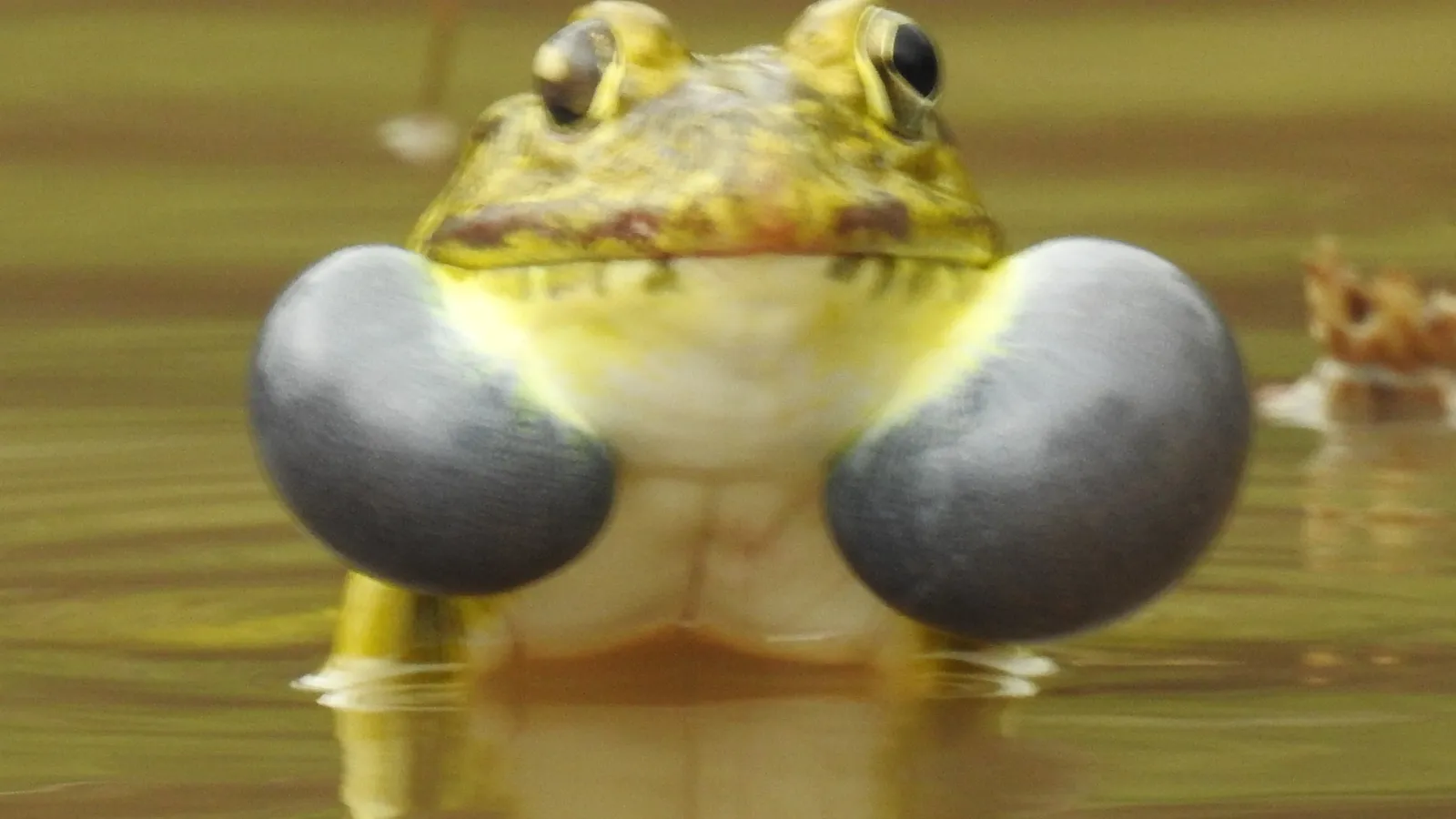
Look at the throat. A calling male puffs out a vocal sac under the chin or at the sides of the mouth. Females do not have one.
Look at the forelimbs. Each forelimb ends in four digits. On a male, the first digit (the one in the thumb position) carries a thickened patch of skin, the copulatory pad, also called the nuptial pad.
Use both signs together. A deflated vocal sac is easy to miss, so a quiet male can look like a female from the front. Check the thumbs before you decide.
Use behaviour if you can see it. The frog that is calling is male. In a mating pair, the frog on top doing the clasping is the male.
Why step 3 matters: a 2025 survey in the Bulletin of the American Museum of Natural History, which classified the vocal sacs of 4,358 frog and toad species, found that vocal sacs are absent in 18% of anurans. So outside the textbook frog, "no vocal sac" does not prove you are looking at a female.
What does the vocal sac do during breeding?
Vocal sacs are inflatable, elastic chambers present in adult males of most frogs and toads, according to Elias-Costa and Faivovich's survey of vocal sac evolution. A single, round vocal sac is the most common shape, seen in 63% of known species. Some frogs, including the Indian bullfrog in the photo above, have a pair.
The sac helps a male call more often. A study of túngara frogs by Pauly, Bernal, Rand and Ryan (2006) found that the vocal sac captures air and reinflates the lungs. That lets the male call again without refilling his lungs by throat pumping, which took 26 to 51 pumps and at least 4.4 seconds. With the sac doing the refilling, the typical gap between calls was about 1.7 seconds. In phonotaxis tests, females preferred the shorter gap and faster call rate.
For the seasonal side of the story, read why frogs croak so much in the rainy season.
What does the copulatory pad do?
The nuptial pad is a male feature, usually on the first finger. All nuptial pads share specialised mucous glands in the deeper (dermal) layer of the skin, according to a study of nuptial pads across frog families by Luna, McDiarmid and Faivovich (2018).
Its main suggested job is grip. During amplexus, the male mounts the female's back and presses his forearms under her armpits to hold her tightly. A 2024 study in the journal Animals describes amplexus this way, and notes that nuptial pads are widely believed to strengthen the male's grip. The study also says amplexus is essential for coordinating egg deposition and sperm release. That timing matters, because NCERT notes that fertilisation in frogs is external and takes place in water, and a mature female can lay 2,500 to 3,000 ova at a time.
Pad size and colour also seem linked to mating success. In a study of wild common frogs, Orton and colleagues (2023) put eight males and two females in each tub and watched who paired up. Males in amplexus had longer nuptial pads than males that did not pair, and 91% of winning males in Devon and 89% in Scotland had a longer and/or darker pad than the losers. The same paper notes that the pad's development is driven by androgens, the male hormones closely linked with breeding.
In both sexes, gametes leave through the cloaca. Why a frog has one opening for waste and gametes is covered in why a frog has a cloaca, not separate openings.
How should you write this in an exam?
For a two- or three-mark question such as "How will you distinguish a male frog from a female?", a clear answer covers these points:
Frogs show sexual dimorphism.
Males have sound-producing vocal sacs, used for the mating call. Females lack them.
Males have a copulatory (nuptial) pad on the first digit of each forelimb, which is thought to help them grip the female during amplexus. Females lack it.
Fertilisation is external, in water.
Two easy slips to avoid: putting the pad on the hind limb, and not saying which digit. Write "first digit of the forelimb" every time.
The same "list the signs, then give the function" method works for other NCERT animals. Our checklist for identifying male and female cockroaches uses it too. If terms like sexual dimorphism, amplexus or external fertilisation still feel shaky, the Fermi Concept Library has a lesson for each concept in biology, with its place in the wider map.