On this page
If you are revising the Animal Kingdom chapter for NEET or your Class 11 exam, one line in the Arthropoda section is easy to memorise and easy to get wrong: Living fossil – Limulus (King crab). The NCERT Class 11 Biology textbook, Chapter 4 lists it after the honey bee, silkworm, lac insect, mosquitoes and locust. Here is what that line means, why the word crab misleads, and how to write it in an answer.
Why is Limulus called a living fossil?
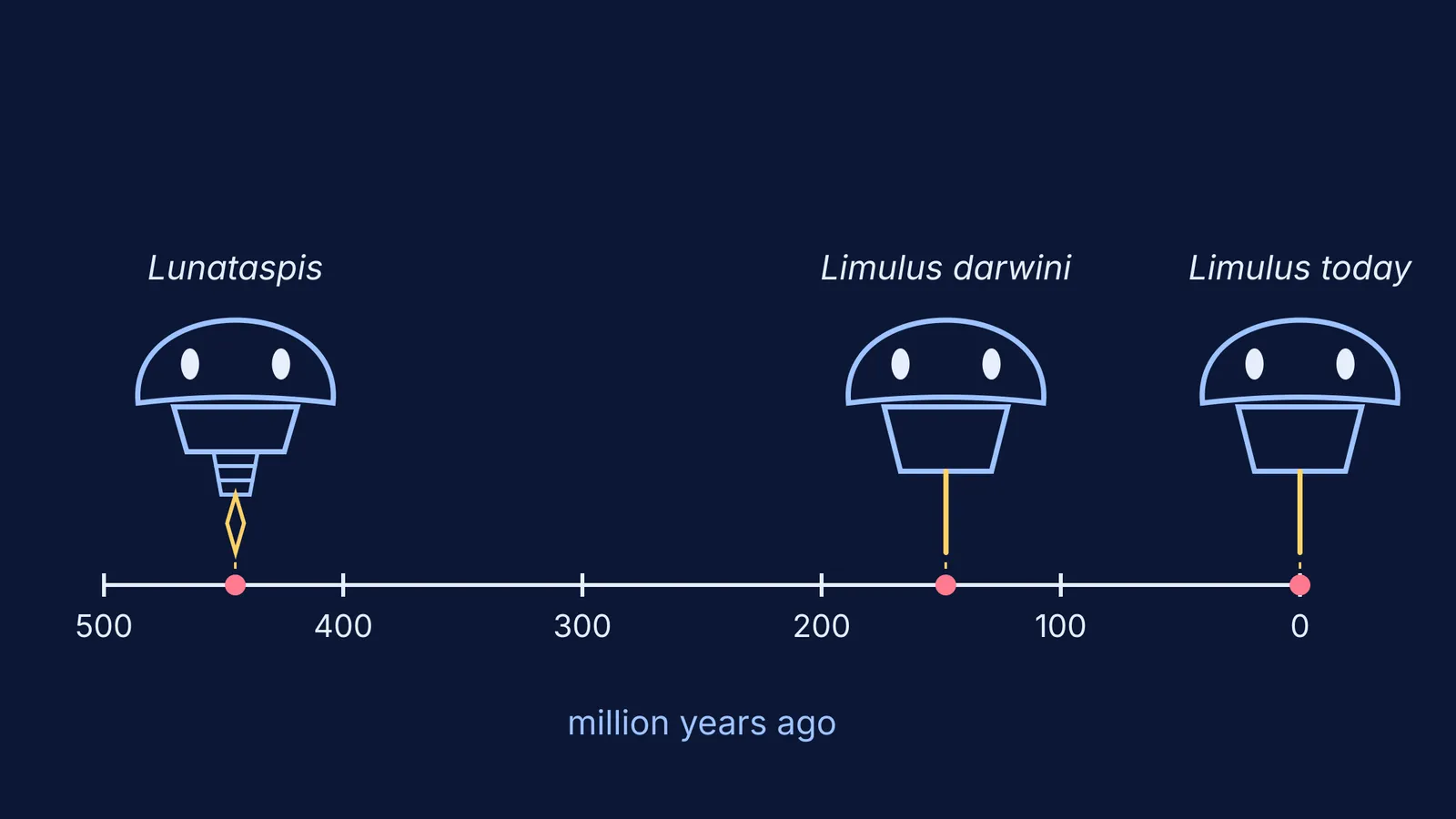
A living fossil is a living species whose body form has stayed almost the same across a very long stretch of the fossil record. Limulus fits because its group, the horseshoe crabs, is very old and has kept one body plan.
Horseshoe crab fossils go back at least 445 million years: *Lunataspis aurora*, described in 2008 as the oldest known horseshoe crab, comes from Late Ordovician rocks in Manitoba, Canada (Rudkin, Young and Nowlan, Palaeontology, 2008).
Its authors describe that fossil as strikingly similar to the living group of horseshoe crabs, so the basic body plan was in place very early.
The genus Limulus itself goes back about 148 million years: *Limulus darwini*, from Late Jurassic rocks in central Poland, shows no important differences in body form from young Atlantic horseshoe crabs alive today (Kin and Błażejowski, PLoS ONE, 2014).
The 2014 paper adds a useful nuance. Its authors suggest the word stabilomorph instead of living fossil, for organisms whose form stays stable over time because their way of life works so well. So a living fossil is not an animal that stopped evolving; its body shape simply changed very little. You will meet the same idea in the coelacanth, the living fossil fish.
Why is the king crab not a true crab?
True crabs are crustaceans. Limulus belongs to a different branch of the arthropods, the one with spiders and scorpions. The Aquarium of the Pacific puts it plainly: the horseshoe crab is more closely related to scorpions, spiders and mites than to true crabs, lobsters and shrimp.
The evidence is in its body. According to the Virginia Institute of Marine Science, horseshoe crabs have no antennae. Their first pair of feeding appendages are narrow structures called chelicerae, followed by five pairs of walking legs, and the underside of the abdomen carries five pairs of book gills used for breathing and swimming.
DNA pushes the link further. A 2019 genome-scale analysis placed horseshoe crabs inside the arachnids, next to the hooded tick spiders, and concluded that they are a group of aquatic arachnids (Ballesteros and Sharma, Systematic Biology, 2019). That placement is still debated among researchers. For a school or NEET answer, stick to what NCERT asks for: the phylum is Arthropoda.
You do not have to go far to find its relatives. Two of the world's four horseshoe crab species, the coastal and the mangrove horseshoe crab, live along Odisha's coast (Mongabay India, 2023). Their unusual blood has a job in medicine too, covered in why horseshoe crab blood is used to test medicines.
How is Limulus different from crustaceans?
Crustaceans have two pairs of antennae and one pair of mandibles for crushing, and they usually breathe with gills, according to University of California, Riverside course notes on Crustacea. Both groups share the arthropod basics that NCERT lists, a chitinous exoskeleton and jointed appendages.
Antennae: crustaceans have two pairs; Limulus has none.
Mouthparts: crustaceans crush food with mandibles; Limulus has no mandibles, and its first feeding appendages are chelicerae.
Breathing: crustaceans usually use gills; Limulus uses book gills, which NCERT lists as a separate respiratory organ.
Closest relatives: crabs sit with prawns, lobsters and shrimp; Limulus sits with spiders, scorpions and mites.
For the crustacean side in more detail, see our guide to crab and prawn crustacean features.
How should you write this in an exam?
Here is a model two-mark answer, built from NCERT and the 2008 fossil study:
Limulus (king crab) is called a living fossil because its body form has changed very little over a very long time; horseshoe crab fossils go back at least 445 million years. It is not a true crab: it has no antennae, has chelicerae instead of mandibles and breathes with book gills, so it is closer to spiders and scorpions than to crustaceans.
Then check your answer for these common slips:
Calling Limulus a crustacean. It is an arthropod, but not a crustacean.
Saying a living fossil has not evolved at all. Its form stayed stable, which is not the same thing.
Mixing up book gills with book lungs. NCERT lists them as separate respiratory organs.
Writing only one name. Write both, as NCERT does: Limulus (King crab).
If arthropod groups start to blur, the Fermi Concept Library covers every concept in biology, each with its own lesson and its place in the map, so you can see where an idea sits before you memorise it. When you move to practice, the Fermi Problem Library has worked problems with a step-by-step solver that explains the reasoning rather than printing an answer.