On this page
"Level of organisation" sounds abstract, but in NCERT's Class 11 Biology it comes down to one question: how far have the animal's cells teamed up? Below: where each phylum sits and why, a one-line test per level, and a 10-animal drill.
What are the levels of organisation in animals?
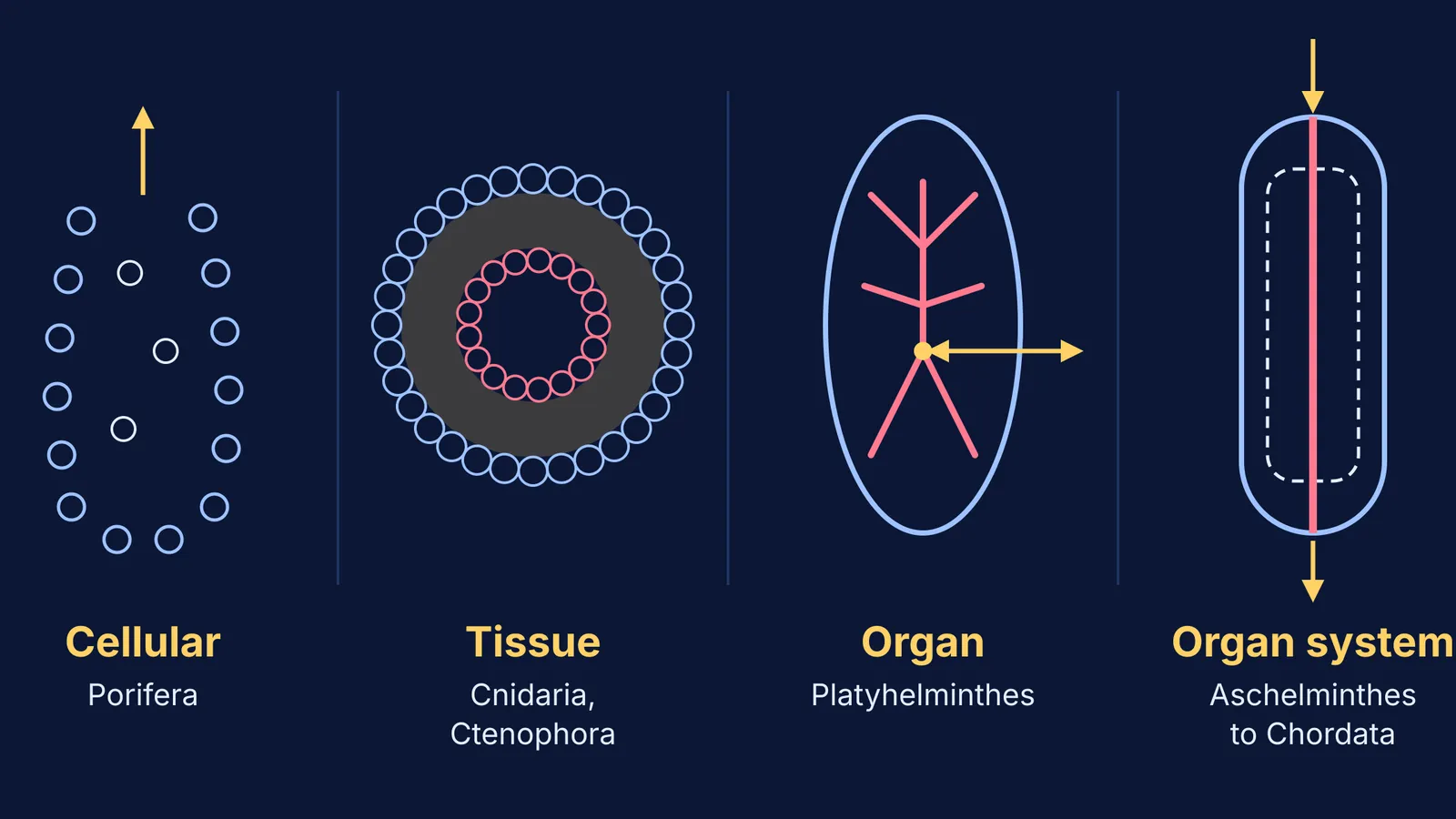
Section 4.1.1 of the NCERT Class 11 Biology chapter Animal Kingdom describes four levels, from simplest to most complex:
Cellular level: cells are arranged as loose cell aggregates, with some division of labour among them. Example: sponges.
Tissue level: cells doing the same job are arranged into tissues. Example: coelenterates (cnidarians).
Organ level: tissues are grouped into organs, each specialised for a particular function. NCERT gives Platyhelminthes (flatworms) as the example.
Organ-system level: organs work together as systems, each concerned with a specific physiological function. NCERT names annelids, arthropods, molluscs, echinoderms and chordates.
The same chapter's phylum descriptions also put Aschelminthes (roundworms) and Hemichordata at the organ-system level, and Ctenophora (comb jellies) at the tissue level.
Why are sponges at the cellular level?
A sponge is a team of cells without true tissues. NCERT describes sponges as primitive multicellular animals with cellular level of organisation, in which water enters through pores (ostia), flows into a central cavity (the spongocoel) and leaves through the osculum, with collar cells (choanocytes) lining the canals (NCERT, section 4.2.1).
The clue to remember: in sponges, digestion is intracellular. Food is digested inside cells, not in a gut that serves the whole body. Our guide to calcareous, siliceous and horny sponges sorts the sponge examples by skeleton.
Why are cnidarians at the tissue level and flatworms at the organ level?
Cnidarians such as Hydra, Adamsia and Physalia show tissue level of organisation. They are diploblastic: their cells are arranged in two embryonic layers, an outer ectoderm and an inner endoderm, with an undifferentiated layer, the mesoglea, between them (NCERT, sections 4.1.3 and 4.2.2). Their gastrovascular cavity has a single opening, and digestion is both extracellular and intracellular. NCERT keeps organ level for Platyhelminthes and the phyla above them, so cnidarians stop at tissues. If the mesoglea confuses you, read why mesoglea is not a germ layer.
Flatworms add a third germ layer, mesoderm, between the ectoderm and endoderm. NCERT calls them bilaterally symmetrical, triploblastic and acoelomate animals with organ level of organisation, and notes specialised flame cells that help in osmoregulation and excretion. NCERT also uses them as its example of an incomplete digestive system: a single opening that serves as both mouth and anus. For the germ-layer side of this story, see diploblastic vs triploblastic animals.
What is the one-line test for each level?
NCERT's Figure 4.4 separates the cellular level from the rest, then sorts the other phyla by symmetry and body cavity. Combine it with the level each phylum section states and you get a test for each level (NCERT, Figure 4.4 and section 4.2):
Cellular: mostly asymmetrical, no tissues, water flows through pores and canals. That is Porifera.
Tissue: radially symmetrical, two germ layers, no body cavity. That is Cnidaria or Ctenophora.
Organ: bilaterally symmetrical, three germ layers, but no body cavity at all. That is Platyhelminthes.
Organ system: has a body cavity of any kind, false (pseudocoelom) or true (coelom). That is Aschelminthes through Chordata.
The last test is the fastest one in an exam. If a question mentions a pseudocoelom or a coelom, the answer is organ-system level.
Can you sort these 10 animals?
Cover the answers and write C (cellular), T (tissue), O (organ) or OS (organ system) for each. Every animal is an example from the NCERT chapter.
Spongilla (freshwater sponge)
Physalia (Portuguese man-of-war)
Taenia (tapeworm)
Pleurobrachia (comb jelly)
Ascaris (roundworm)
Fasciola (liver fluke)
Pheretima (earthworm)
Asterias (starfish)
Adamsia (sea anemone)
Balanoglossus
Answers: 1 C; 2 T; 3 O; 4 T; 5 OS; 6 O; 7 OS; 8 OS; 9 T; 10 OS.
If you missed one, say the reason out loud using the test above. For example: "Ascaris has a pseudocoelom, so it is organ-system level, even though it is a worm like Taenia." The reason matters more than the letter, because assertion-reason questions test the why.
If a term in the tests is still fuzzy, such as coelom, mesoderm or mesoglea, the Fermi Concept Library has a lesson for each biology concept and shows where it sits in the map, so you can fix the gap before moving on. When you want to practise with more questions, the Fermi Problem Library has worked problems with a step-by-step solver that explains the reasoning rather than printing an answer.
Try the drill again in three days with the answers covered. If you can sort all 10 and give a reason for each, you have this part of the chapter.