On this page
If a biology question asks you to describe mammalian teeth, three words usually carry the answer: thecodont, diphyodont and heterodont. Your own mouth is the easiest example of all three. The catch is that none of the three belongs only to mammals, and not every mammal follows all three.
What do thecodont, diphyodont and heterodont mean?
Thecodont means each tooth is set in its own socket in the jawbone; a 2020 study of lizard teeth in the Journal of Anatomy defines thecodont teeth as those implanted into sockets.
Diphyodont means two successive sets of teeth in a lifetime; Animal Diversity Web gives its Greek meaning as a twofold production of teeth.
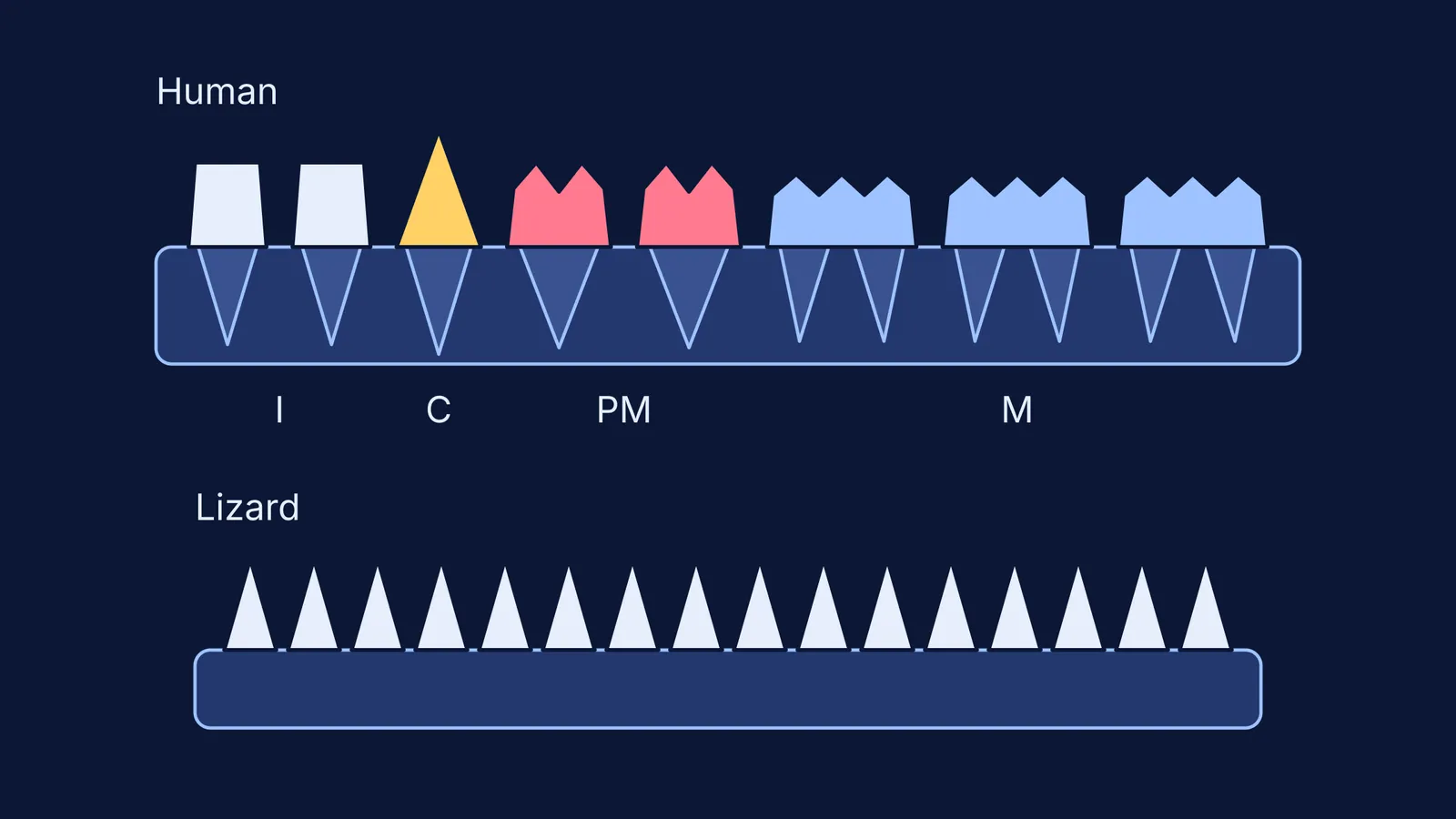
Heterodont means the teeth come in different shapes for different jobs; a 2013 PeerJ study of whale teeth describes the ancestral mammal pattern as four distinct tooth classes per jaw quadrant: incisors, canine, premolars and molars.
How do human teeth show all three?
The figures here come from the MSD Manual's page on the biology of the teeth.
Thecodont: each root sits in the jawbone, held firmly by a cushioning membrane called the periodontal ligament.
Diphyodont: children have 20 primary teeth, which start being replaced at about age 6 by 32 permanent teeth. The permanent molars come in behind the milk teeth instead of replacing any, which is why the second set has 12 more teeth. More on this in our post on why milk teeth and permanent teeth differ.
Heterodont: each quarter of an adult mouth has 2 incisors, 1 canine, 2 premolars and 3 molars. Our guide to incisors, canines, premolars and molars covers what each type does.
Which animals break the thecodont rule?
Sockets are not unique to mammals. A 2013 PNAS study of alligator teeth notes that crocodilians have typical thecodont teeth, implanted in sockets just as mammal teeth are.
Most lizards and snakes attach their teeth differently. The Journal of Anatomy study describes pleurodont teeth, attached to the inner side of the outer jaw wall, and acrodont teeth, attached to the crest of the jaw. A 2012 study of gecko teeth notes that agamid lizards and chameleons are acrodont, while other living lizards and snakes range from pleurodont to acrodont.
Which animals are not diphyodont?
More than two sets: crocodilians replace each tooth about once a year and may replace each one about 50 times, according to the PNAS alligator study. Repeated replacement like this is called polyphyodonty.
Only one set: the PeerJ whale study says a single tooth generation, called monophyodonty, characterises cetaceans, the group that includes whales and dolphins.
A conveyor belt: in elephants, cheek teeth erupt at the back of the jaw and move forward, dropping out at the front, and manatees follow a similar pattern with up to 20 teeth per quadrant, says Animal Diversity Web.
Hidden replacement: the same source notes that in seals and their relatives, and in many rodents, both sets form, but the swap happens before birth. Rodent front teeth have another twist, explained in why rat teeth never stop growing.
Are reptile teeth homodont?
Mostly, yes. The gecko study says living lizards and snakes are mostly homodont, with many small, uniform, cone-shaped teeth. Homodont is the opposite of heterodont: all teeth alike.
It is a rule of thumb, not a law. A 2021 study by Lafuma and colleagues in Nature Communications found that teeth with several cusps evolved over 20 times independently in lizards and snakes, from a single-cusped ancestor.
Some mammals go the other way. The PeerJ whale study says most toothed whales have many simple-crowned teeth that look alike along the row, and living baleen whales do not erupt any teeth at all.
A three-question check for any animal
Run these checks in order.
Are the teeth in sockets? Yes means thecodont; if not, ask whether they sit on the crest (acrodont) or the inner side (pleurodont) of the jaw.
How many sets? Two is diphyodont, one is monophyodont, many is polyphyodont.
Do the teeth differ in shape? Different types means heterodont; all alike means homodont.
Worked examples:
Human: sockets, two sets, four types. Thecodont, diphyodont, heterodont.
Crocodile: sockets, many sets. Thecodont and polyphyodont.
The gecko in the 2012 study: teeth fused to the inner jaw wall, many sets, a row of similar two-cusped teeth. Pleurodont, polyphyodont, homodont.
Dolphin: one set of similar teeth. Monophyodont and close to homodont.
If the terms keep blurring together, the Fermi Concept Library gives each biology concept its own lesson and its place in the map. And if you are not sure where to start on a chapter, Fermi's AI tutor works out what you already know and builds a plan for the session.
Try the three questions on one animal from your textbook today.