

On this page
Digestion begins long before food reaches the stomach. It starts in the mouth, where the mechanical breakdown of food takes place. An adult human typically has 32 permanent teeth (Wikipedia). Because humans are heterodonts—meaning our teeth come in different shapes—we can handle a varied, omnivorous diet that includes both tough plant matter and fibrous meats.
Unlike homodont animals, such as many reptiles whose teeth are all identical and primarily used to grab and swallow whole prey, mammals have evolved teeth that allow for thorough chewing. Each tooth in the human mouth is heavily specialised for its exact stage of the chewing process. By breaking food down into smaller pieces, our teeth vastly increase the surface area available for digestive enzymes to begin their chemical work before the food is even swallowed.
What are the types of teeth and their functions?
The 32 adult teeth (Wikipedia) are divided into four distinct classes, arranged symmetrically from the front of the mouth to the back.
Incisors: These are the eight teeth at the very front of the mouth, with four on the top jaw and four on the bottom. Incisors are primarily used for cutting (Wikipedia). They have a flat, chisel-like edge. When you bite into a firm piece of fruit, like an apple, your incisors do the heavy work of shearing off a manageable piece.
Canines: Flanking the incisors are the four canines, often referred to as eye teeth or cuspids. Canines are for tearing food (Wikipedia). Their strongly pointed, cone-like shape helps to grip and rip tougher textures. While less pronounced in humans than in purely carnivorous animals, they still play a crucial role in dealing with fibrous foods and meats.
Premolars: Also known as bicuspids, there are eight premolars positioned immediately behind the canines. They have a flatter surface with two distinct ridges (or cusps). Along with the molars, they crush the food (Wikipedia). The premolars act as transitional teeth, moving the torn food from the front of the mouth towards the back for heavy grinding.
Molars: The largest teeth in the mouth are the 12 molars. This count includes the four third molars, commonly known as wisdom teeth. Molars serve for grinding (Wikipedia). Their broad, flat surfaces with multiple cusps pulverise and turn the crushed food into a fine, smooth paste that is easy to swallow and digest.
For a fascinating look at how the shape of fossilised teeth helps us identify the diets of extinct creatures, read about Gideon Mantell and the teeth that revealed Iguanodon.
What is the human dental formula?
Biologists and dentists use a shorthand called the dental formula to quickly describe the layout and number of teeth in a mammal's mouth.
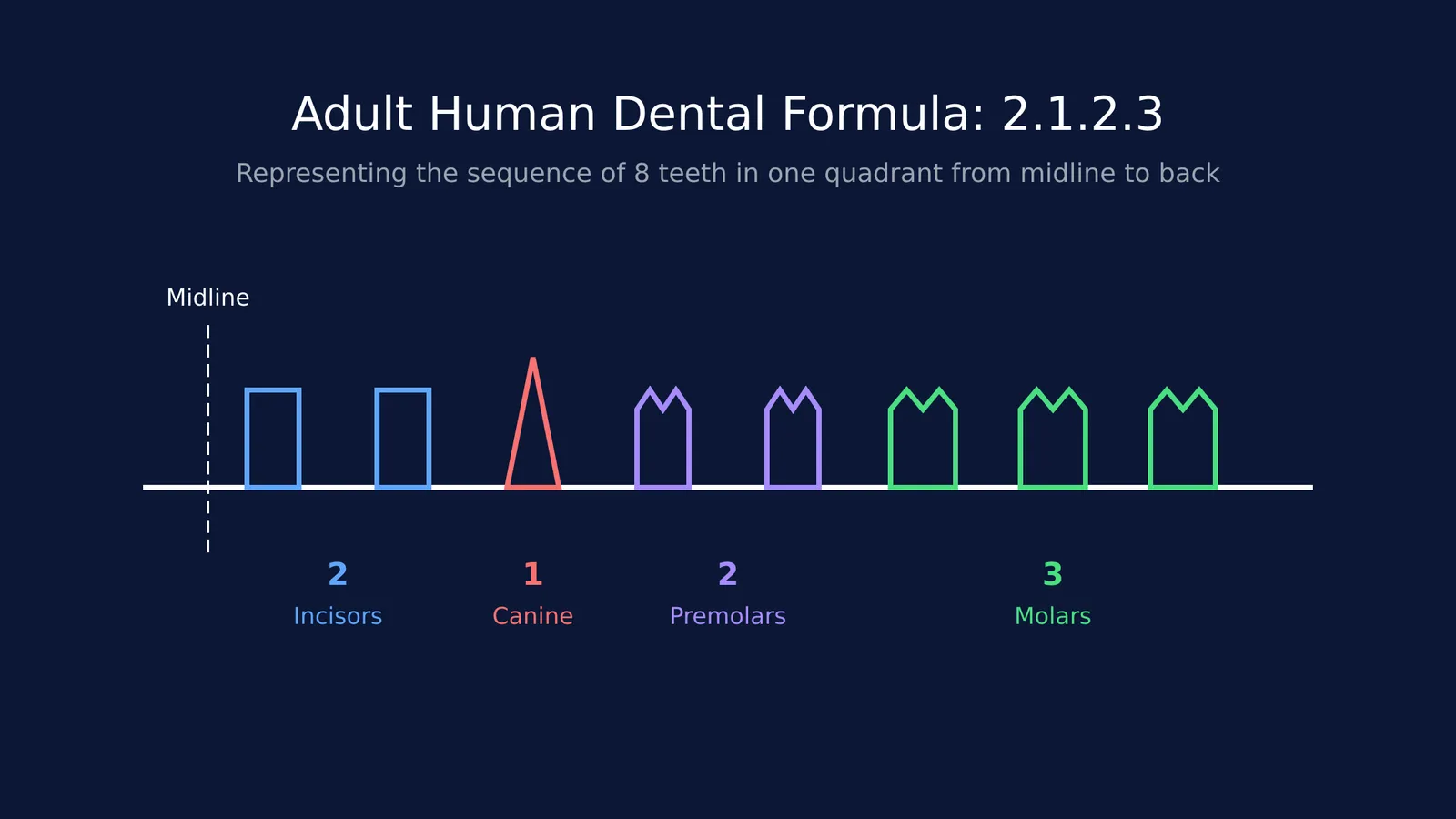
The mouth is split into four quadrants: the upper left, upper right, lower left, and lower right. The formula counts the number of each type of tooth in just one of these quadrants, proceeding from the front midline backwards. Because the human mouth is symmetrical, one quadrant tells you the entire layout.
The adult human dental formula is written as 2.1.2.3 / 2.1.2.3 (Wikipedia). This sequence represents the following teeth in each quadrant:
2 incisors
1 canine
2 premolars
3 molars
Adding these numbers together gives you 8 teeth per quadrant. If you multiply that by four, you arrive at the full adult count of 32 permanent teeth (Wikipedia).
By contrast, young children have a different set of teeth entirely, which are smaller and adapted to a growing jaw. Children have a primary (or deciduous) dental formula of 2.1.0.2. This means that a child has 20 primary teeth in total, and they lack premolars entirely (Wikipedia). As the jaw grows, these primary teeth fall out and are replaced by the permanent set, which adds the premolars and the additional molars.
How do you tackle biology diagrams in exams?
Questions about the human digestive system often ask you to label the four types of teeth, match them to their specific functions, or write down the correct adult dental formula. A solid grasp of how the physical shape of each tooth dictates its job makes these exam questions straightforward. You can see how the mechanical breakdown of food fits into the broader picture in our guide to Class 10 life processes: nutrition, respiration, transport, excretion. If you want to find out what happens after the food leaves the mouth, read the strange story of William Beaumont and watching digestion inside a living stomach.
Memorising anatomical facts can feel overwhelming if you try to learn them entirely by rote. If you struggle to turn textbook descriptions into clear mental pictures, the Fermi Concept Library holds every concept in physics, chemistry, biology, mathematics and computing, each with its own lesson and its place in the map. This helps you see how structures like the dental arch and individual teeth fit together, rather than just asking you to memorise a sequence of numbers.


