

On this page
Rats, mice and rabbits have front teeth that never stop growing, so eating has to wear them down just as fast. Here is how the tooth is built, why gnawing keeps it sharp, and a four-step way to explain any adaptation.
Why do rat and rabbit teeth keep growing?
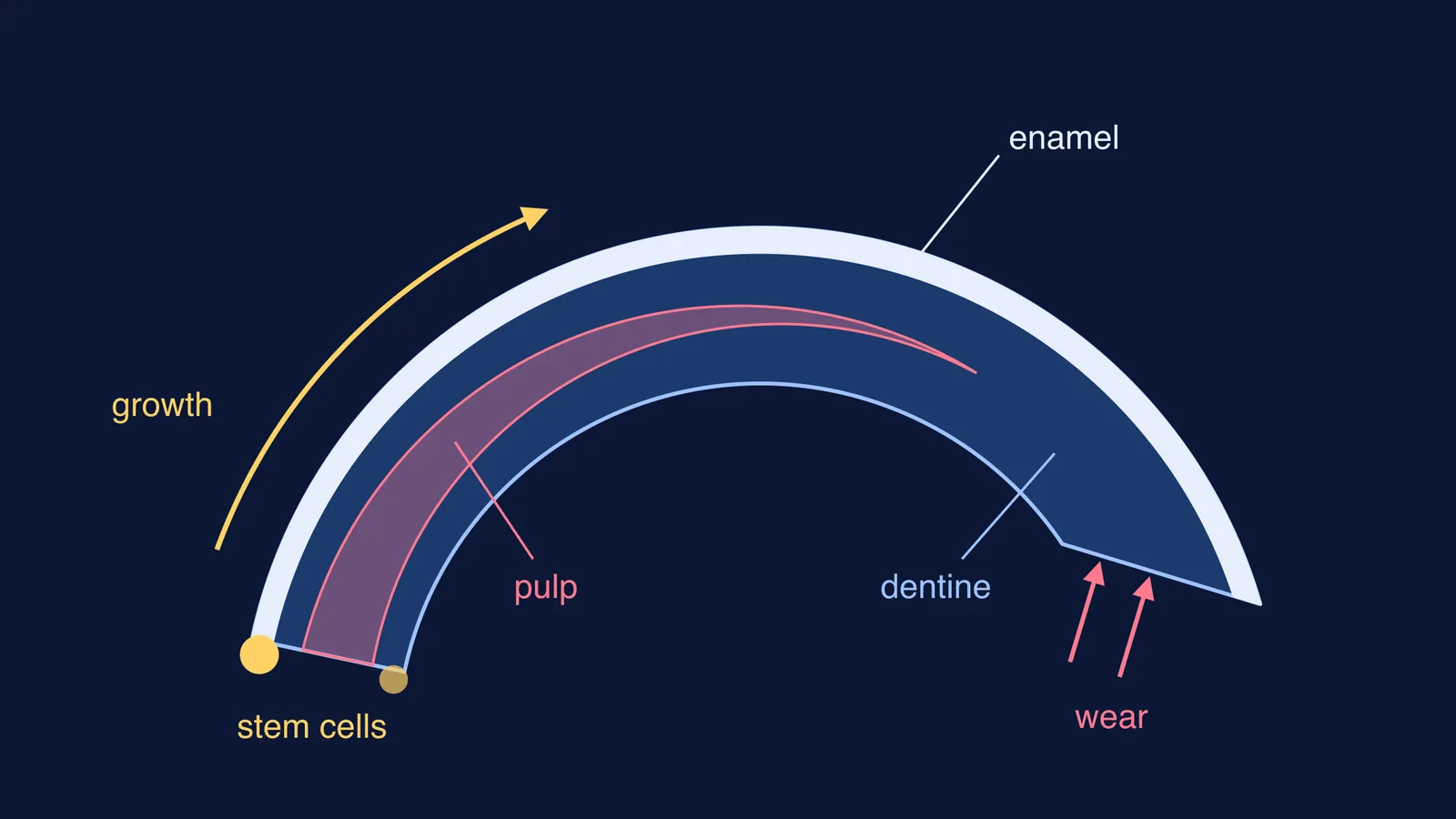
Most of your teeth stop growing once their roots form. Biologists call teeth that never stop "hypselodont", or ever-growing. A 2014 review in Frontiers in Physiology describes them as teeth that keep forming throughout life, driven by stem cells at the base of the tooth in a fold of tissue called the cervical loop (Renvoisé and Michon, 2014). The same review lists other examples: elephant tusks, walrus canines and sloth molars.
In rodents, the incisors are the teeth that keep growing. A 2010 study of mouse incisors in the journal Development states that "the continuous growth of rodent incisors throughout life results from the activity of stem cells located at their proximal end", meaning the end buried in the jaw (Parsa et al., 2010).
Rabbits go further. The Merck Veterinary Manual says all rabbit teeth keep growing throughout life, both the front incisors and the premolars and molars at the back.
How does gnawing keep a rodent's teeth sharp?
The answer is in the layers; for a refresher, see our guide to the structure of a tooth: enamel, dentine, pulp and cementum.
On a rodent incisor, enamel covers only the front (lip) side, because the enamel-making cells, called ameloblasts, form only on that surface (Parsa et al., 2010). The back is softer dentine. The paper notes that this lopsided enamel "leads to preferential abrasion on the lingual surface", the side facing the tongue.
So as the incisors grind past each other, the dentine wears faster than the enamel, leaving a sloping edge with a thin ridge of enamel at the tip: a self-sharpening chisel.
How fast do rodent and rabbit teeth grow?
A Veterinary Nursing Journal article by Brigitte Lord gives average growth and wear of 2 to 2.5 mm a week for rabbit incisors and 2.5 to 3 mm a month for the cheek teeth.
For rats, a 2003 study in Medical Science Monitor measured the lower incisors of young female laboratory rats over four weeks. Normally worn incisors erupted 0.6 mm a day, while incisors that were regularly shortened sped up to 1.0 mm a day (Law et al., 2003).
Worked example, using those figures:
Rat lower incisor: if 0.6 mm a day held for a year, 0.6 × 365 = 219 mm, about 22 cm of new tooth.
Rabbit incisor: 2 to 2.5 mm a week × 52 weeks = 104 to 130 mm, about 10 to 13 cm a year.
The visible tooth stays short, so wear must remove about the same length.
The rat study shows growth is not a fixed setting: when the teeth were kept short, eruption sped up.
If ideas like two rates balancing make more sense when you watch them change, the Fermi Simulation Lab has interactive simulations for ideas that are easier to see than to read.
What happens if the teeth don't wear down?
The balance can fail. The Merck Veterinary Manual explains that when the upper and lower teeth do not meet properly, a condition called malocclusion, they wear unevenly. Signs include very long incisors, drooling, or trouble closing the mouth, eating and drinking. It notes that plenty of hay helps wear the teeth down, and that a vet can trim the teeth under anaesthesia.
Lord's article adds that grass is highly abrasive because it contains silicates, and that dental disease is common in rabbits fed diets low in hay and grass (Lord, Veterinary Nursing Journal). If a pet's teeth look long or uneven, that is a job for a vet.
Why don't human teeth keep growing?
Humans are diphyodont: we replace our teeth only once, and our molars are never replaced (Renvoisé and Michon, 2014). The review explains that ordinary teeth stop growing once they switch from building crown to building root. With no open base adding new tooth, an adult human tooth cannot replace what wears away.
A four-step way to explain any adaptation
A strong answer connects structure to function instead of just naming the feature. Here are four steps, shown for the rodent incisor:
Structure: what is unusual? An open-based incisor with stem cells at its base and enamel only on the front.
Problem: what does it solve? Gnawing hard food wears teeth away all the time.
Mechanism: how does it work? The base keeps adding tooth, and softer dentine behind wears faster than the enamel, leaving a sharp chisel edge.
Limit: when does it fail? It depends on wear. Misaligned teeth or soft food lead to overgrowth.
Now try the same steps on how desert rats, snakes and camels survive heat and little water. If a step stalls because a term like dentine or stem cell is fuzzy, the Fermi Concept Library has a lesson for every concept in physics, chemistry, biology, mathematics and computing.


