

On this page
Your dental formula changes as you grow. The transition from a small set of primary teeth to a full set of adult teeth is a biologically elegant process of replacing temporary placeholders and making use of new jaw space. Understanding this progression is essential for students preparing for biology exams, as it brings together concepts of human anatomy, growth, and evolutionary adaptation.
Milk teeth vs permanent teeth: how many?
Children have exactly 20 milk teeth, which are officially called deciduous teeth because they eventually fall out, much like the leaves of a deciduous tree. This first set consists of eight incisors, four canines, and eight molars. These teeth begin erupting around six months of age and are usually fully present by age three. They serve a crucial role not just in chewing and speech, but in maintaining the correct spacing in the jaw for the larger adult teeth that will follow.
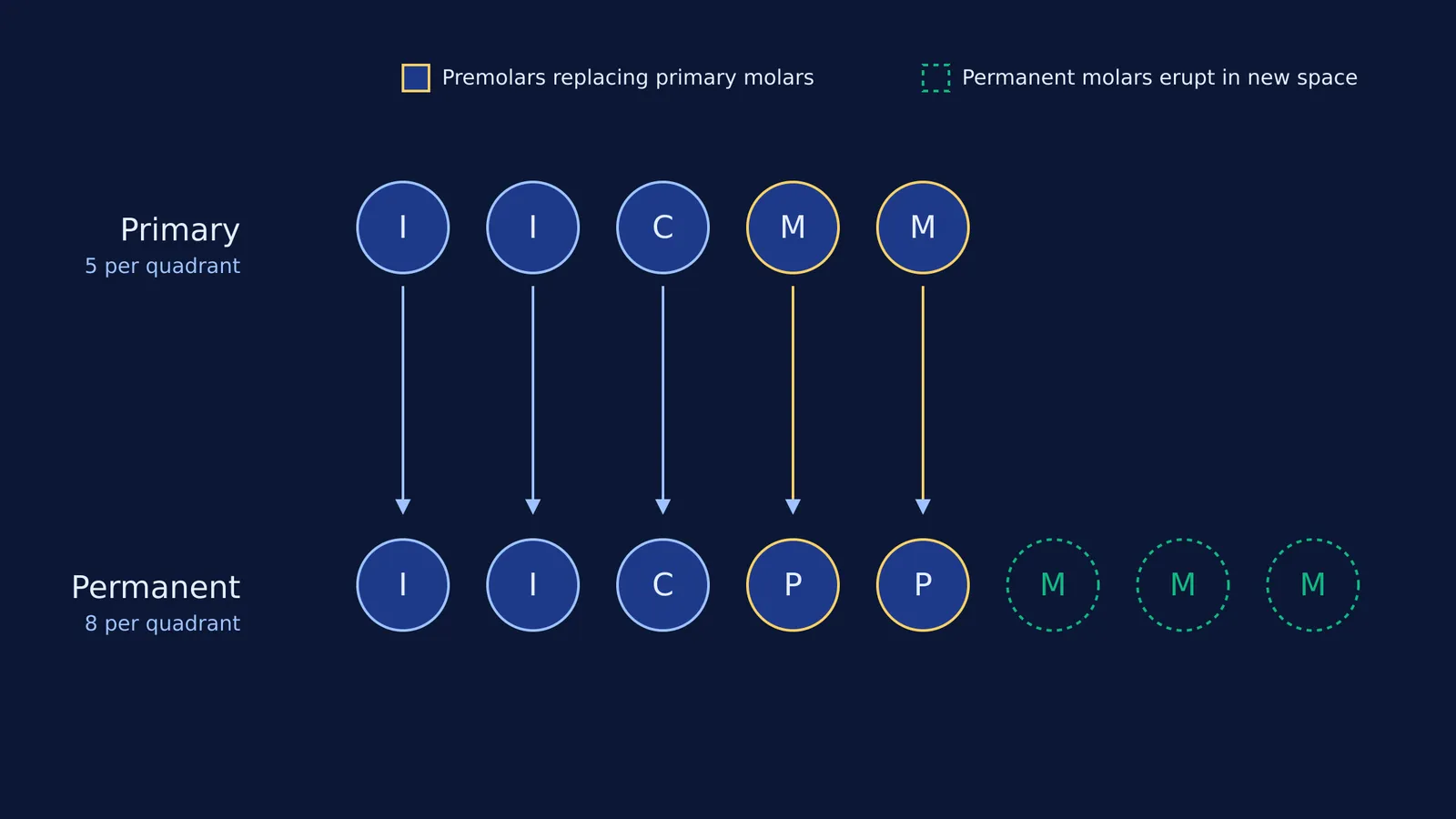
Adults, on the other hand, have 32 permanent teeth. The adult set includes the same eight incisors and four canines, but it adds eight premolars and expands the molar count to twelve (which includes the four wisdom teeth). Just as biology students must map out the 206 bones of the human skeleton, counting teeth correctly requires understanding where each one fits into the jaw's four quadrants. Each quadrant in a child has five teeth, while each quadrant in an adult holds eight.
Why are premolars missing in children?
The answer comes down to jaw size and the sequence of human development. A child's developing jaw physically lacks the space needed to accommodate 32 large adult teeth.
Because of this space constraint, children do not have premolars (which are also known as bicuspids). Instead, the spaces where the permanent premolars will eventually grow are occupied by the primary molars. When a child begins losing their primary molars around age 10 to 12, those deciduous teeth are directly replaced by the permanent premolars. The permanent molars then erupt much further back in the mouth, filling spaces that never held a baby tooth at all.
If you are reviewing human physiology for an exam and keep mixing up which teeth replace which, Fermi's AI tutor can draw the quadrant breakdown and hold a line of reasoning with you until the difference makes sense.
Where do the permanent molars come from?
Because the permanent premolars take the spots previously held by the baby molars, the permanent molars need entirely new real estate. As you grow, your jaw elongates backward, creating more room at the back of the mouth. This newly created space allows the first permanent molars to erupt at around age six, emerging right behind the last baby teeth (Wikipedia).
The second permanent molars follow around age 12, marking another major phase of jaw growth. Finally, the third molars (commonly known as wisdom teeth) typically appear between ages 17 and 21, assuming the jaw has grown enough to accommodate them. In many modern humans, the jaw does not grow large enough, leading to impacted wisdom teeth.
What is the meaning of diphyodont?
In biology, humans and most other mammals are classed as diphyodonts. A diphyodont is any animal that develops two successive sets of teeth during its lifetime: an initial deciduous set followed by a permanent adult set.
This pattern contrasts with monophyodonts, which possess only one set of teeth for their entire lives, and polyphyodonts, like sharks and elephants, whose teeth are continuously replaced as they wear down. The Concept Library maps out diphyodonty alongside every other concept in human physiology, connecting it to related terms like heterodont (having different types of teeth, such as incisors and canines) and thecodont (teeth securely embedded in deep jaw sockets), much like how it categorises the waste products of ammonotelic, ureotelic and uricotelic animals.
Developing two distinct sets of teeth is a remarkable evolutionary compromise. It provides young mammals with a set of strong, functional teeth necessary to chew solid food while their skull and jaw are still too small for adult teeth. Once the jaw has finished growing, the temporary teeth are shed in favour of a larger, more durable permanent set designed to last them through adulthood.


