On this page
If you are learning the phyla in NCERT's Class 11 Animal Kingdom chapter, you do not have to memorise eleven strange words and eleven feature lists separately. Most names are short descriptions in Latin or Greek. Translate the name and you have the first feature to write.
What do the phylum names Porifera, Annelida and Arthropoda mean?
Roots come from Wiktionary (linked on each name); features come from the NCERT Animal Kingdom chapter.
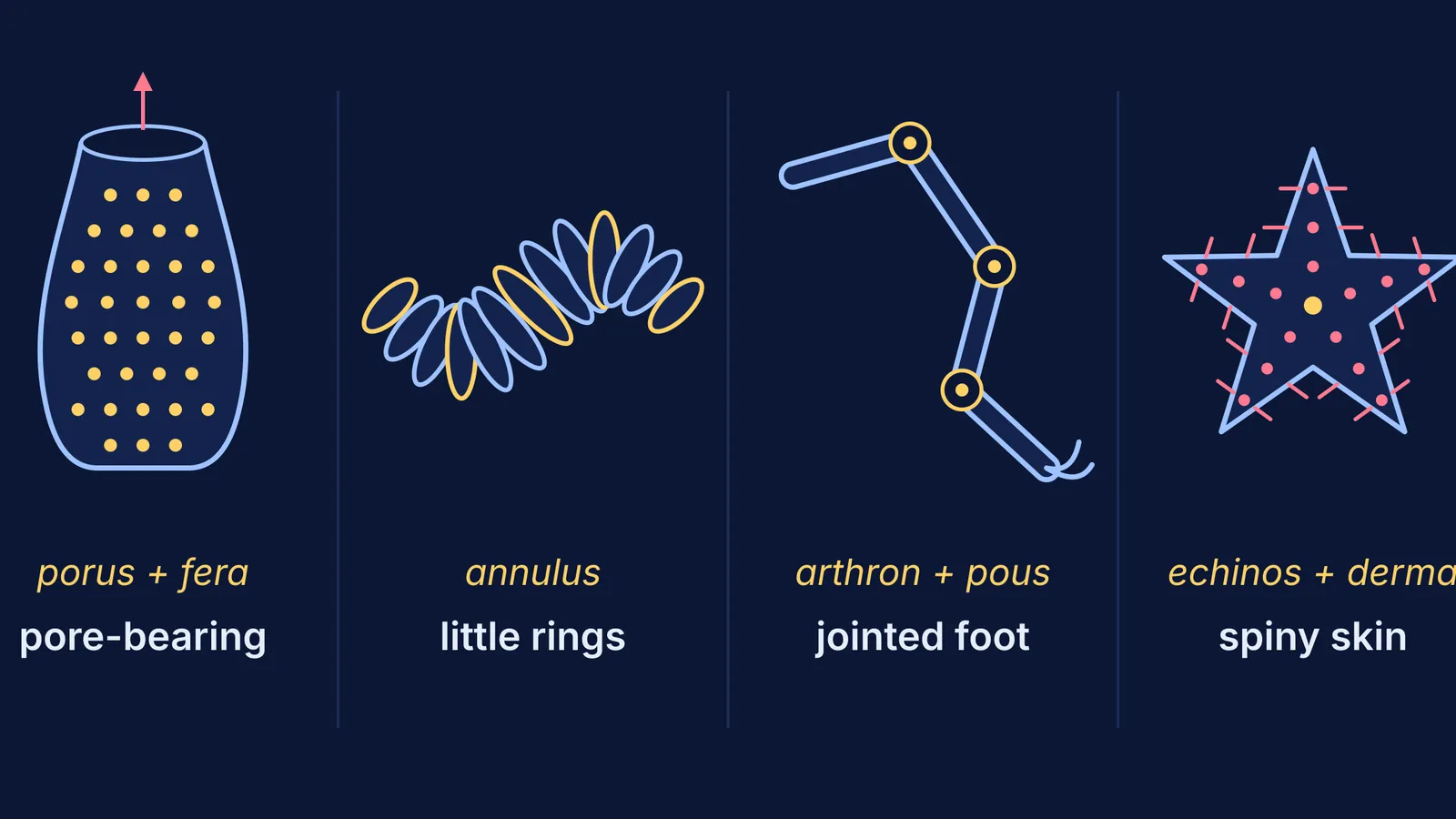
Porifera: Latin porus (pore) + -fera (bearing), so pore-bearing. Water enters a sponge through tiny pores called ostia and leaves through the osculum.
Coelenterata: Greek koilos (hollow) + enteron (gut). These animals have a central gastro-vascular cavity with a single opening.
Cnidaria: Greek knide (nettle). NCERT uses it as a second name for Coelenterata and says the name comes from cnidoblasts, the cells that hold stinging capsules.
Ctenophora: comb + bearing. The body carries eight external rows of ciliated comb plates that help in locomotion.
Platyhelminthes: Greek platys (flat) + helmins (parasitic worm). The body is dorso-ventrally flattened, hence flatworms.
Annelida: Latin annellus (little ring); NCERT gives the root as annulus. The body is marked out into segments, or metameres.
Arthropoda: Greek arthron (joint) + pous (foot). NCERT writes it as arthros-joint, poda-appendages: these animals have jointed appendages.
Mollusca: Latin molluscus (soft). The body is unsegmented, and a soft and spongy layer of skin forms the mantle.
Echinodermata: Greek echinos (hedgehog, sea urchin) + derma (skin), so spiny skin. NCERT calls them spiny bodied.
Hemichordata: hemi- (half) + Chordata. They have a stomochord, a structure similar to the notochord, in the collar region.
Chordata: Latin chorda (cord, string). The defining cord is the notochord, a rod on the dorsal side.
Arthropoda is the largest phylum of Animalia, and over two-thirds of all named species on earth are arthropods, according to the NCERT Class 11 Biology chapter. If you want the reasons behind that, read why Arthropoda is the largest animal phylum.
Which phylum names can mislead you in an MCQ?
A root gets you to the right phylum, but four names hide traps that NCERT-based questions like to use. Each point below is from the NCERT chapter unless another link is given.
Mollusca means soft, yet molluscs wear a hard shell. NCERT says the body is covered by a calcareous shell; the soft and spongy part it describes is the mantle.
Echinodermata means spiny skin, yet the skeleton is inside. Echinoderms have an endoskeleton of calcareous ossicles. The chitinous exoskeleton belongs to arthropods.
Hemichordata sounds like half a chordate, yet it is a non-chordate phylum. It was earlier a sub-phylum of Chordata and is now placed under non-chordata.
Aschelminthes does not mean roundworm. Its roots are Greek askos (hide, belly) + helmins (worm), per Wiktionary. NCERT calls them roundworms for a different reason: the body is circular in cross-section.
How do you use word roots to answer a phylum question?
Work in four steps: split the name, translate each piece, attach the NCERT feature, then check the trap list. Here is a worked example.
Question: Which animal has a body surface divided into metameres? (a) Taenia (b) Ascaris (c) Pheretima (d) Pila
Metameres are repeated segments. Which phylum name describes rings? Annelida, the little rings.
Recall NCERT's annelid examples: Nereis, Pheretima (earthworm) and Hirudinaria (blood-sucking leech).
Rule out the rest by name. Taenia, the tapeworm, looks like a chain of pieces, which makes it the tempting wrong option, but NCERT places it in Platyhelminthes, the flat worms. Ascaris is a roundworm (Aschelminthes). Pila, the apple snail, is a mollusc, the phylum named for softness.
Answer: (c) Pheretima. The roots found the right phylum and gave you a reason to reject each wrong option.
How can you remember all eleven names before an exam?
Spread this plan over short sessions on separate days.
Day 1: write the eleven names, split each into roots and write the meaning from memory. Check against the decoder and the trap list (Aschelminthes is there).
Day 2: cover the names. From the feature alone (comb plates, metameres, ostia), write the phylum and the root that gives it away.
Day 3: for each NCERT example, say the phylum and the root reason aloud, then recite the trap list without looking.
The trick works beyond phyla. Our guide to learning biology terms with 20 Greek and Latin roots covers words like coelom and diploblastic, and the Animal Kingdom Class 11 overview puts the phyla, coelom types and chordate classes on one page.
If a feature such as the coelom or the notochord still feels like a word without a picture, the Fermi Concept Library has every concept in biology, each with its own lesson and its place in the map.
Start today with four names: pore-bearing, little rings, jointed foot, spiny skin.