On this page
For most of the menstrual cycle, oestrogen keeps LH low. Then, mid-cycle, the same hormone drives LH up sharply. That flip from negative to positive feedback is why ovulation happens. Here is the chain, with the numbers from the studies that measured it.
What does negative feedback mean in the menstrual cycle?
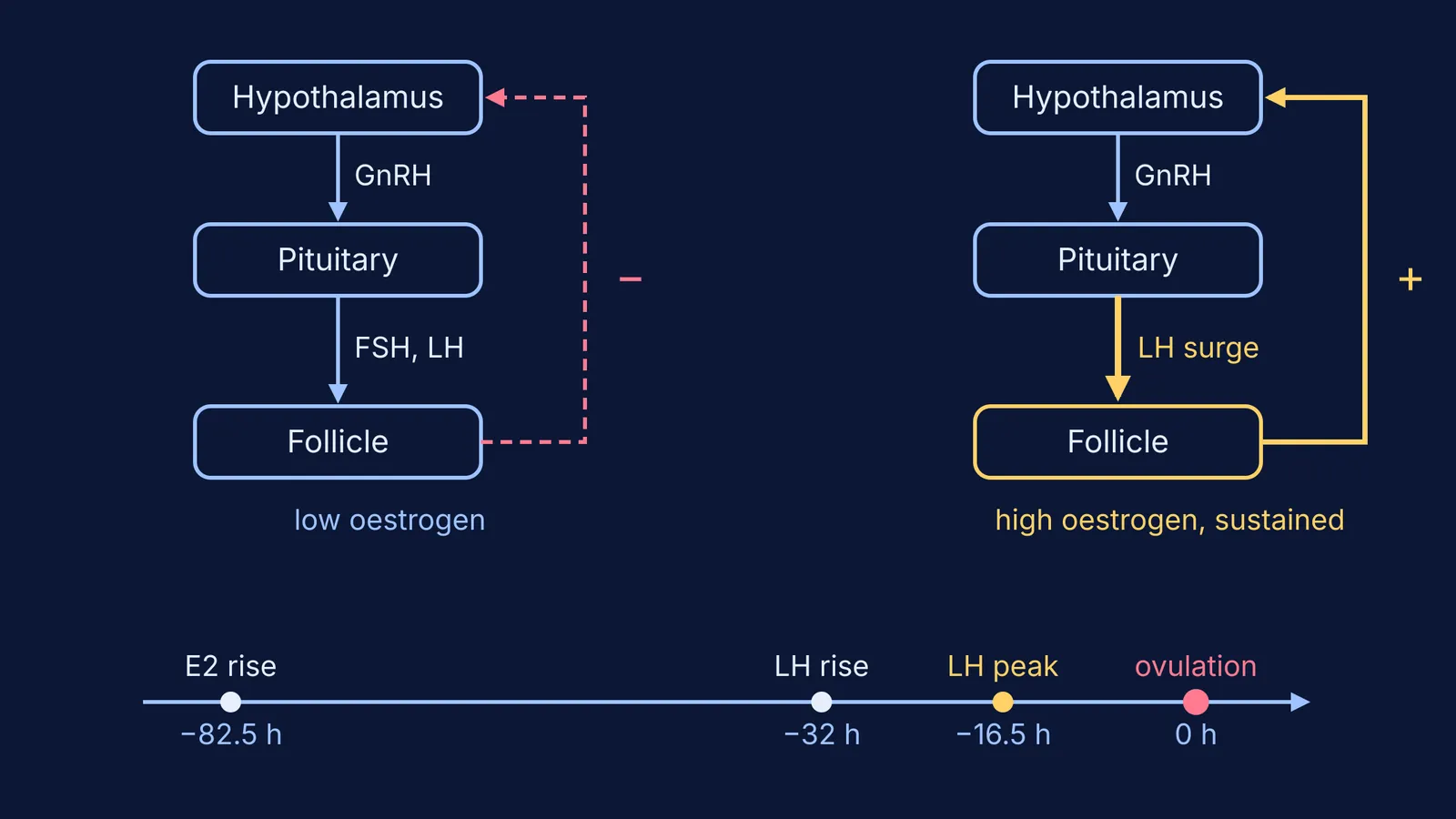
Three organs talk to each other in a loop. The hypothalamus releases GnRH, GnRH tells the anterior pituitary to release FSH and LH, and those two hormones make the follicles in the ovary grow and produce oestrogen (mainly oestradiol, written E2).
Early in the cycle, oestrogen travels back to the brain and damps GnRH and LH down. That is negative feedback: the output switches off its own input, like a thermostat. For a refresher, read our explainer on how hormonal feedback loops keep levels steady.
Why does oestrogen switch to positive feedback mid-cycle?
As one follicle pulls ahead and matures into a Graafian follicle (the stages are in our guide to primary, secondary, tertiary and Graafian follicles), it makes more and more oestradiol. In the preovulatory period, as a 2019 review in the Journal of Neuroendocrinology puts it, "the feedback action of estradiol switches from negative to positive feedback", and this switch starts a surge of GnRH and then LH. The review describes kisspeptin neurons in the hypothalamus that respond to oestradiol and stimulate GnRH neurons.
How high oestrogen gets is only half the story. In a 1975 study by Keye and Jaffe, women were given oestradiol injections from the first day of the cycle and then tested with GnRH. After 36 hours of treatment, the pituitary's gonadotropin response was not boosted. After 60 hours the LH response was modestly boosted, and from 84 hours on both LH and FSH responses were clearly larger, even though blood oestradiol stayed in a similar range (about 128 to 186 pg/mL) throughout. The authors concluded that how long the hypothalamus and pituitary are exposed to raised oestradiol, not only its level, sets how strongly the pituitary responds.
How big and how fast is the LH surge?
A 1983 study by Hoff, Quigley and Yen took blood every 2 hours for 5 days around mid-cycle in five women. The LH surge began abruptly, with LH doubling within 2 hours, at the time oestradiol reached its peak.
The surge lasted 48 hours on average: a 14-hour rise, a 14-hour plateau and a 20-hour fall. During the rise, oestradiol fell while progesterone kept climbing.
Why does the LH surge cause ovulation?
Timing first. A World Health Organization task force study90133-7) of 177 women dated ovulation by examining the ovaries surgically. The median gaps before ovulation were 82.5 hours for the rise in oestradiol, 32 hours for the rise in LH and 16.5 hours for the LH peak. The authors called a defined rise in LH the best indirect marker of impending ovulation.
Now the mechanism. A 2019 review in Endocrine Reviews by Duffy and colleagues describes what the LH surge sets off inside the follicle:
Granulosa and theca cells make steroids, prostaglandins and signalling molecules called cytokines and chemokines.
These signals activate both ovarian cells and immune cells.
Protein-cutting enzymes remodel the tissue of the follicle wall and break down the basal lamina around the granulosa cells.
The cumulus cells around the egg expand, and new blood vessels grow into the follicle wall.
The follicle ruptures and the oocyte is released.
The review compares ovulation to an inflammatory response, while noting steps such as steroid control and oocyte maturation that are specific to ovulation. The cells left behind change into the corpus luteum, which our post on corpus luteum function and progesterone picks up from here.
How do you draw the oestrogen feedback loop for an exam?
This is the diagram at the top of this page. Practise it on a blank sheet:
Draw three boxes down the page: Hypothalamus, Pituitary, Follicle.
Arrow from Hypothalamus to Pituitary, labelled GnRH; arrow from Pituitary to Follicle, labelled FSH and LH.
A return arrow from Follicle back up, labelled oestrogen.
Draw the loop twice. On the left, mark the return arrow with a minus sign: low oestrogen, early follicular phase.
On the right, mark it plus, write "high oestrogen, sustained", and draw a thick LH surge arrow.
Underneath, add the timeline: oestradiol rise, LH rise, LH peak, ovulation, with the WHO hours.
A three-line answer you can adapt: "Rising oestradiol from the Graafian follicle, once it stays high for long enough, switches from negative to positive feedback on the hypothalamus and pituitary. This triggers a surge of GnRH and LH. LH sets off enzymes and inflammation-like signals that rupture the follicle and release the secondary oocyte."
If feedback itself still feels shaky, the Fermi Concept Library gives each biology concept its own lesson and its place in the map, so you can revisit hormones before returning to the cycle.
Next step: redraw both loops from memory tonight and check them against the diagram above.