On this page
NCERT Class 12 Biology says the rupture of RBCs releases haemozoin, “which is responsible for the chill and high fever recurring every three to four days” (NCERT Class 12 Biology, Chapter 7: Human Health and Disease). Why does that fever keep time? Because the parasite runs on a clock you can draw.
Why does malaria fever come every alternate day?
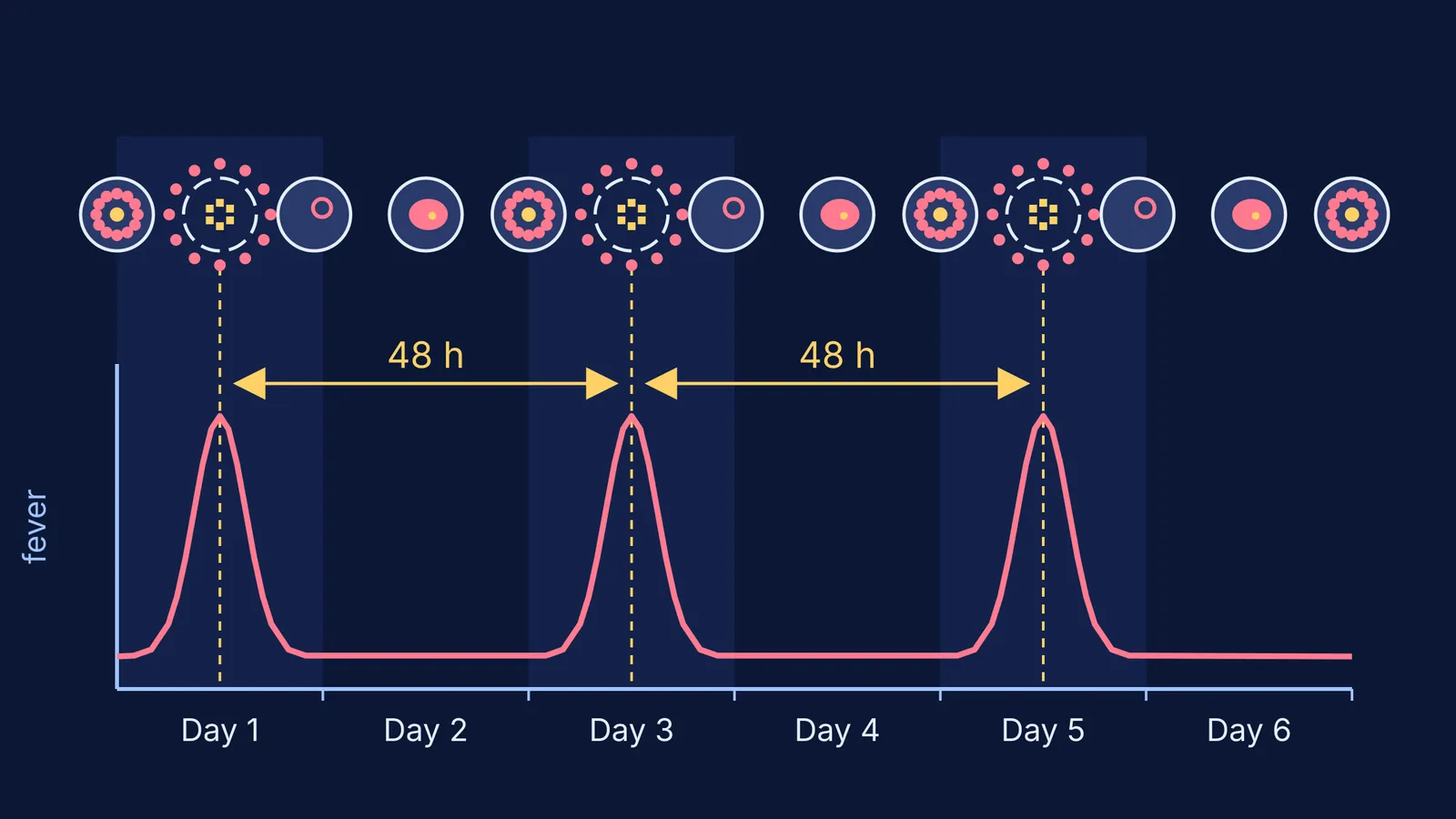
Plasmodium vivax has an intraerythrocytic life cycle lasting approximately 48 hours, according to a 2022 review in PLoS Medicine. In a synchronous infection, most infected cells finish that cycle and rupture together. The review says this bursting triggers a fever attack (a paroxysm) “every 3 days”, hence the name “tertian fever”.
A fever on Monday morning returns on Wednesday morning, then Friday: every alternate day.
What happens inside the red blood cell in those 48 hours?
NCERT Figure 7.1 draws the human half of the cycle as a loop: parasites “reproduce asexually in red blood cells, bursting the red blood cells and causing cycles of fever”, and the released parasites infect new red blood cells (NCERT Chapter 7). The CDC's parasite reference names the stages: ring-stage trophozoites mature into schizonts, which rupture and release merozoites (CDC DPDx: Malaria).
A merozoite enters a red blood cell and becomes a small ring.
The ring grows into a trophozoite.
The trophozoite divides into a schizont packed with new merozoites.
The schizont bursts the cell; the merozoites each enter a fresh cell.
The CDC page adds two details for NEET-UG: some parasites become gametocytes, the stage a mosquito picks up, and in P. vivax a dormant liver stage, the hypnozoite, can cause relapses weeks or even years later. The full two-host cycle is in our Plasmodium life cycle for NEET biology.
Is haemozoin really the toxin that causes the fever?
For exams, write NCERT's line. Haemozoin is an insoluble crystal formed in the parasite's food vacuole. Peggy Parroche and colleagues found that natural haemozoin from P. falciparum cultures strongly activated an immune sensor called TLR9, while a purified synthetic version of the same crystal had no inflammatory activity (Parroche et al., PNAS 2007). The difference was malarial DNA coating the natural crystal, which the authors called highly inflammatory, “with the potential to induce cytokinemia and fever”, but only when haemozoin carries it into immune cells.
Either way, whatever sets off the fever is released at rupture, so the fever follows the rupture clock. What the body does next is covered in why your body gets a fever during an infection.
Why do the parasites burst at the same time?
Smith and colleagues showed that four strains of P. falciparum have their own circadian and cell-cycle oscillators (Smith et al., Science 2020). Rijo-Ferreira and colleagues found that gene expression in the mouse parasite P. chabaudi stayed rhythmic in constant darkness and in mice with no working body clock, and fell into step with the host's rhythm (Rijo-Ferreira et al., Science 2020). Neither studied P. vivax, but both point to a timer inside the parasite.
Cycle lengths differ by species: a 2024 review gives about 48 hours for P. falciparum, about 72 hours for P. malariae and 24 hours for P. knowlesi (Gozalo et al., Comparative Medicine 2024). The neat pattern belongs to synchronous infections, so a fever without a rhythm does not rule malaria out.
The WHO malaria fact sheet lists fever, headache and chills as the most common early symptoms, usually starting within 10 to 15 days of the infected bite, and says early testing matters because they are not specific.
How do you sketch the 48-hour timeline from the NCERT diagram?
Using the 48-hour P. vivax cycle, draw a horizontal line marked every 24 hours from 0 to 144, and label the gaps Day 1 to Day 6.
Hour 12 (Day 1): schizonts burst. Draw merozoites and haemozoin spilling out, and a fever spike.
Day 2: a ring in a fresh red blood cell, then a larger trophozoite. No spike: the quiet day.
Late Day 2 into Day 3: a schizont full of merozoites.
Hour 60 (Day 3): 12 + 48. Burst, haemozoin, second spike.
Hour 108 (Day 5): 60 + 48. Third spike.
The rule: spike time = first burst + 48n. Test yourself with a 72-hour cycle and a first fever on Day 1; you should get spikes on Days 4 and 7.
If the stages keep slipping out of order, the Fermi Concept Library gives every biology concept its own lesson and its place in the map. To practise, the Fermi Problem Library has worked problems with a step-by-step solver that explains the reasoning rather than printing an answer.