

On this page
If you are revising Class 11 Animal Kingdom, Porifera can feel like three names to learn by heart. It gets easier once you know what holds each sponge up. The NCERT Class 11 Biology chapter on Animal Kingdom says: "The body is supported by a skeleton made up of spicules or spongin fibres." It then gives three examples: Sycon (Scypha), Spongilla (fresh water sponge) and Euspongia (bath sponge). NCERT does not say which skeleton each one has. Match-the-column questions catch students in that gap.
What are spicules and spongin fibres?
Spicules are the hard mineral pieces of a sponge skeleton, and they come in different sizes and a wide variety of 3D shapes, according to a 2020 review of sponge spicules in PeerJ. The same review says three sponge groups (Demospongiae, Hexactinellida and Homoscleromorpha) build their skeletons from silica, and one group, Calcarea, builds them from magnesium-calcite, a form of calcium carbonate.
Spongin is a protein, not a mineral. A 2018 review in Marine Drugs describes spongin as the halogenated scleroprotein of keratosan demosponges, and lists "horny protein" among its older names. That old name is why sponges built from it are called horny sponges.
Why does a sponge need a skeleton at all? A 2003 review in Microscopy Research and Technique explains that silica spicules can fuse, interlock or be joined by spongin. The frameworks they build "allow sponges to grow upwards and facilitate water exchange with minimal metabolic cost". Water exchange matters because a sponge feeds by pumping water through its body. Our post on the Porifera canal system follows that water from ostia to osculum.
Which sponges are calcareous, siliceous and horny?
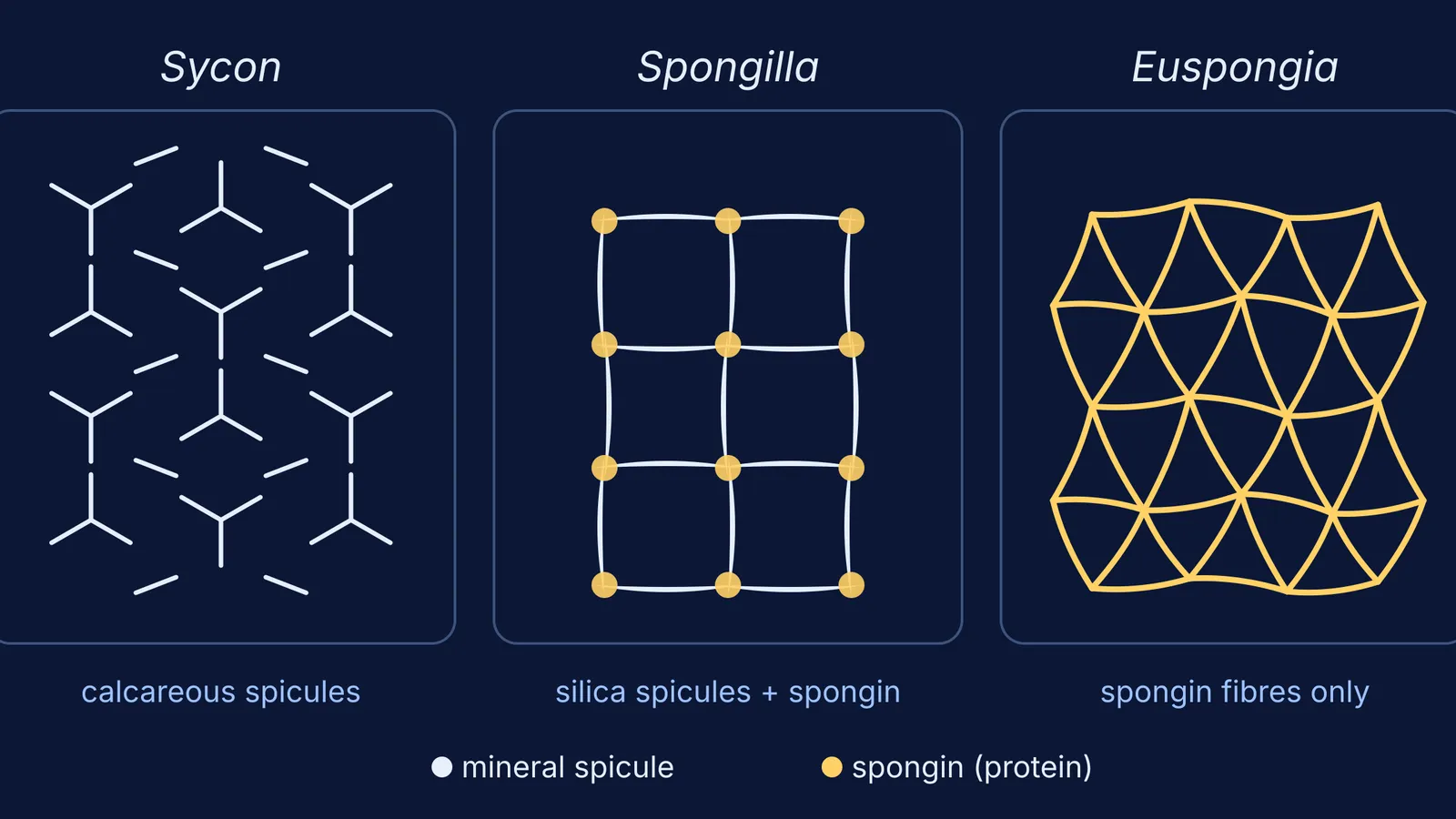
Calcareous sponges have spicules made of calcium carbonate. The World Porifera Database entry for Sycon places Sycon in class Calcarea. Calcarean spicules come in three basic forms: diactines, triactines and tetractines (PeerJ review).
Siliceous sponges have spicules made of silica. The World Porifera Database entry for Spongilla places Spongilla in class Demospongiae, order Spongillida. "The skeleton of freshwater sponges consists of only loose spicules bound together by spongin", write Pronzato and colleagues in Acta Palaeontologica Polonica (2017).
Horny sponges make no mineral spicules of their own. Their skeleton is made only of horny (spongin) fibres, with no endogenous mineral elements, according to Manconi and colleagues in ZooKeys (2013). The World Porifera Database entry for Euspongia now lists Euspongia as a synonym of Spongia, in order Dictyoceratida.
A bath sponge is that spongin network on its own. The Marine Drugs review describes the commercial sponge as the macerated and dried skeleton of a sponge with no proper spicules, with spongin fibres 5 to 100 microns across, depending on the species.
How do you remember which example goes where?
Ask three questions in this order. Examiners build statement questions on the same logic.
Does the skeleton contain mineral spicules? If not, it is a horny sponge (Euspongia).
If it does, are the spicules calcium carbonate? Then it is calcareous (Sycon).
If they are silica, it is siliceous (Spongilla), whether or not it also has spongin.
A short hook helps on exam day: chalk, glass, bath. Sycon is the chalk (calcium carbonate) sponge, Spongilla is the glass (silica) sponge from fresh water, and Euspongia is the one in a bathroom. The hook only reminds you of the answer. The three questions let you place an example you have never seen before.
For more NCERT examples drilled like this across all the phyla, try our Animal Kingdom NCERT examples question set. Our Class 11 Animal Kingdom chapter guide shows where Porifera sits among the other phyla.
Matching drill: can you pair each item with its skeleton?
Match each item to A (calcareous), B (siliceous) or C (horny). Cover the answers before you start.
Sycon
Spongilla
Euspongia
Scypha
A sponge in class Hexactinellida
The bath sponge
Spicules made of magnesium-calcite
Loose silica spicules held together by spongin
A skeleton of spongin fibres with no mineral spicules
A sponge in order Dictyoceratida
Answers: 1 A, 2 B, 3 C, 4 A (Scypha is NCERT's other name for Sycon), 5 B, 6 C, 7 A, 8 B, 9 C, 10 C.
If you got 8 wrong, read the callout above again: having spongin does not make a sponge horny. If you got 4 wrong, read the NCERT example list closely, because the brackets carry marks.
To revise the rest of the phylum, the Fermi Concept Library covers every concept in biology, each with its own lesson and its place in the map.


