

On this page
Every injection, from a vaccine to a saline drip, must be checked for a bacterial molecule your body treats as an alarm. The standard check has long used the blue blood of the horseshoe crab, an animal that, according to NOAA's Ocean Service, predates the dinosaurs by more than 200 million years. It is also not a crab.
Why is horseshoe crab blood used in medicine testing?
The target is endotoxin. Bacterial endotoxins are lipopolysaccharides (LPS) found in the outer membrane of gram-negative bacteria, as the US FDA's inspection guide on endotoxins and pyrogens defines them. Where that membrane sits: the layers of the bacterial cell envelope.
Horseshoe crab blood reacts to LPS with unusual sensitivity. In a 2007 review in the Proceedings of the Japan Academy, Sadaaki Iwanaga writes that the horseshoe crab clotting reaction is set off by pico- to nanogram amounts of endotoxin. That is why, NOAA notes, it is used to test intravenous drugs, vaccines and medical devices.
The older method injected samples into rabbits and watched for fever. The FDA guide records an endotoxin from the Legionnaires' disease bacterium that was weak in rabbits but very active in LAL, a 1,000-fold difference.
The story began with Frederik Bang's 1956 paper on a bacterial disease of Limulus, followed by his work with Jack Levin on how endotoxin clots Limulus protein (1968).
How do amoebocytes clot around endotoxin?
The cells that do the work are the amoebocytes (also called haemocytes). Iwanaga's review, based on the Japanese horseshoe crab, describes each as an oval, plate-shaped cell 15 to 20 micrometres at its longest, packed with granules that store the clotting factors. When the cells meet LPS, they stick together, release their granules and form a clot, all within about 90 seconds (Iwanaga, 2007).
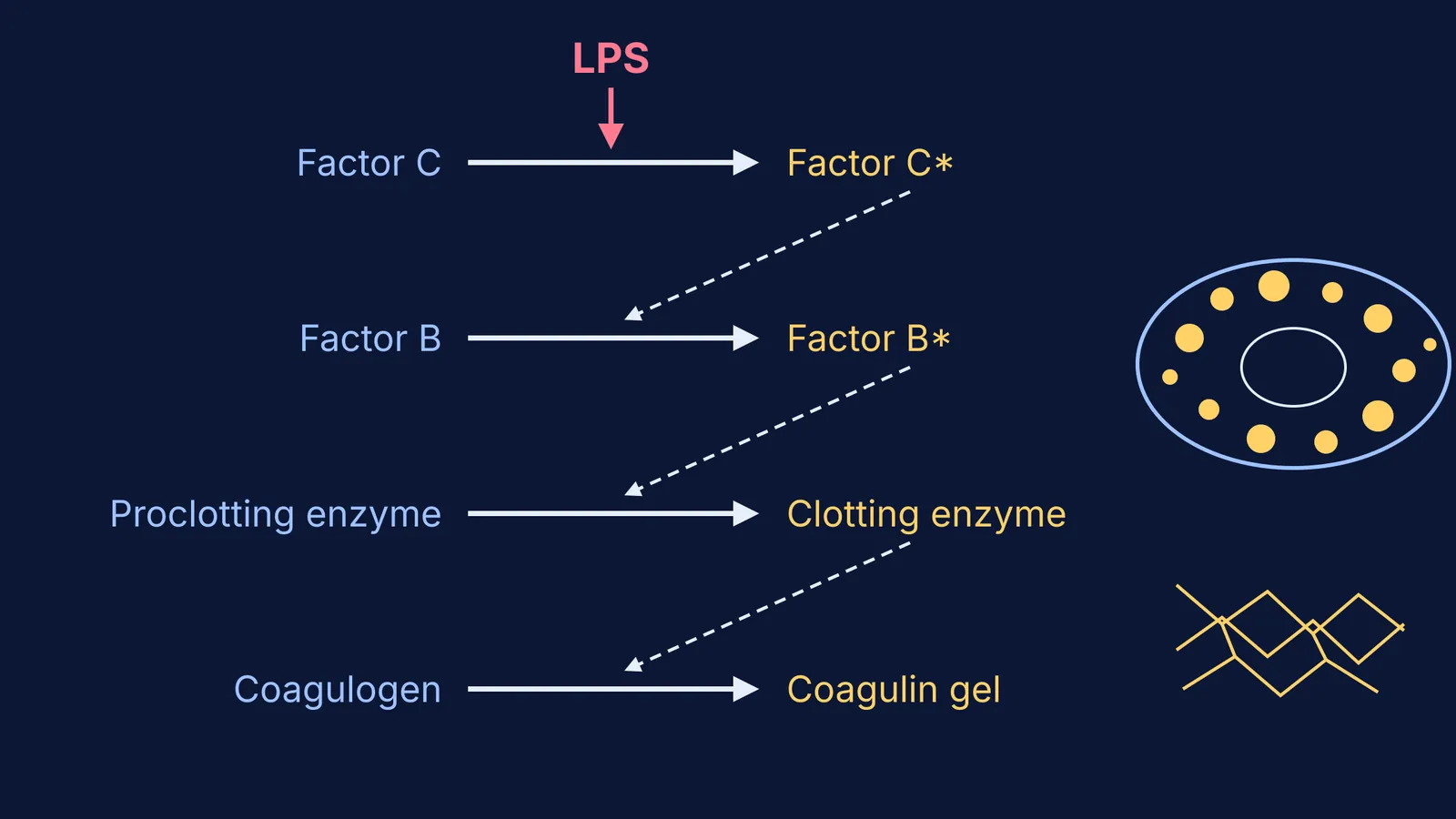
Each step below is an enzyme cutting an inactive precursor into its active form:
LPS activates factor C.
Active factor C activates factor B.
Active factor B converts proclotting enzyme into clotting enzyme.
Clotting enzyme cuts two peptide bonds in coagulogen, a soluble protein, turning it into an insoluble coagulin gel.
A second route, through factor G, is triggered by (1,3)-beta-D-glucan from fungal cell walls, so a gel alone does not prove endotoxin.
Compare it with the four barriers of innate immunity in humans.
How does a clot become a pass or a fail?
In Iwanaga's account, 50 to 150 ml of blood is drawn from each crab, the amoebocytes are spun out and broken open, and the extract (the lysate) becomes the reagent. Mix a sample with lysate: if enough endotoxin is present, the cascade runs and a gel forms.
Results are measured in Endotoxin Units (EU). The FDA guide lists a limit of 0.25 EU per ml for Water for Injection. Try the arithmetic:
A 2 ml ampoule of Water for Injection may carry at most 2 x 0.25 = 0.5 EU.
A 500 ml bag of it may carry at most 500 x 0.25 = 125 EU.
The limit is per millilitre, so a bigger volume allows more total endotoxin.
Is a horseshoe crab really a crab?
No. NOAA says horseshoe crabs are not crustaceans and are more closely related to spiders and scorpions. They belong to Chelicerata, the arthropod group whose first feeding appendages are chelicerae, which has no antennae, and whose body is split into a prosoma and an opisthosoma (Encyclopedia.com, Chelicerata).
A 2019 study in Systematic Biology by Jesús Ballesteros and Prashant Sharma placed horseshoe crabs inside the arachnids, next to hooded tick spiders, and concluded that they are aquatic arachnids.
A four-question check for any arthropod:
Does it have antennae? A horseshoe crab has none.
What is the first pair of appendages? In Limulus, chelicerae.
How many body regions? Two: prosoma and opisthosoma.
So which group? Phylum Arthropoda, subphylum Chelicerata.
For the wider picture, see why Arthropoda is the largest animal phylum. The Fermi Concept Library covers every concept in physics, chemistry, biology, mathematics and computing, each with its own lesson and its place in the map.
What is replacing horseshoe crab blood?
A 2020 review by Richard Gorman in Frontiers in Marine Science reports that more than 500,000 horseshoe crabs are captured from wild populations and bled each year. The Atlantic States Marine Fisheries Commission assumes 15% of bled crabs die, while published estimates range from 8.3% to 29.8%.
The alternative copies the cascade's first step. Recombinant factor C (rFC), made without crabs, became commercially available in 2003 and a European Pharmacopoeia compendial method effective from July 2020 (Gorman, 2020). US Pharmacopeia Chapter 86, covering recombinant reagents, was set to become official in May 2025.
India has a stake too. Mongabay India reports that two of the four living species, Tachypleus gigas and Carcinoscorpius rotundicauda, live along Odisha's Balasore and Kendrapara coasts, and that the horseshoe crab has been protected under the Wildlife (Protection) Act since 2009.
To test yourself, write the four-step cascade from LPS to coagulin gel from memory. If the order slips, Fermi's AI tutor can work out what you already know and build a plan for the session.


