On this page
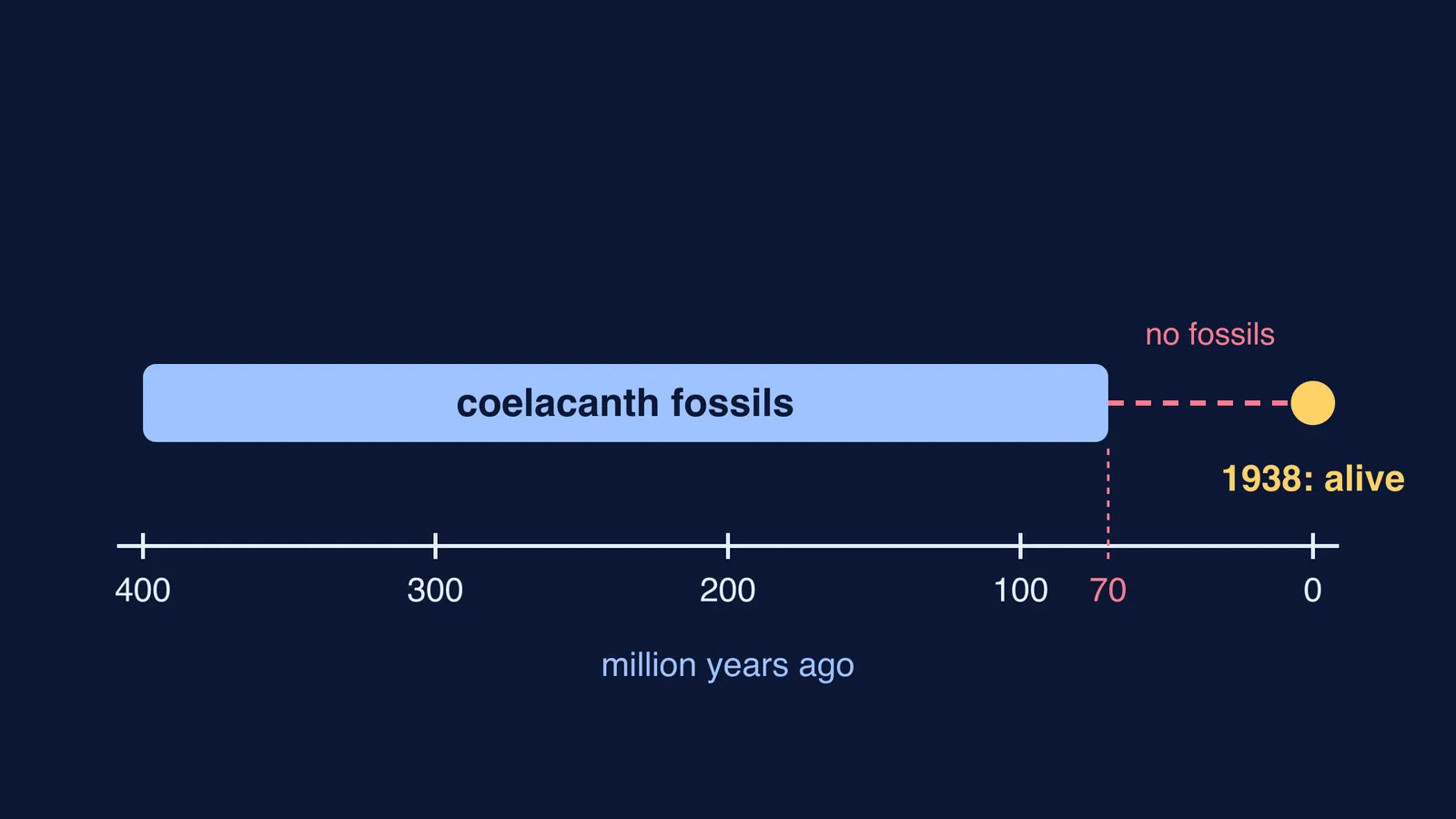
Imagine opening a fossil book, finding a fish that vanished from the rock record tens of millions of years ago, and then seeing one on a fishing boat. That is what happened in South Africa in 1938. The coelacanth is now a standard evolution example, and a common source of half-right exam answers.
What is a coelacanth, and why was 1938 such a surprise?
On 22 December 1938, Marjorie Courtenay-Latimer, curator of the East London Museum in South Africa, saw a fish from a trawler's catch unlike any she knew, as the Natural History Museum, London recounts. The ichthyologist J. L. B. Smith named it *Latimeria chalumnae*, after her and the mouth of the Chalumna River where it was caught.
Before then, coelacanths were known only from fossils. The UC Berkeley Museum of Paleontology describes them as lobe-finned fishes that appear in the fossil record almost 400 million years ago and then seemed to go extinct about 80 million years ago. The 2013 genome paper by Amemiya and colleagues in Nature gives the presumed extinction as 70 million years ago. Either way, the gap between the youngest fossil and the living fish is enormous.
A second living species turned up in Indonesia. Mark Erdmann, Roy Caldwell and M. Kasim Moosa reported it in Nature in 1998, and it was later named *Latimeria menadoensis*, according to the Natural History Museum.
What are lobe fins, and how do they link to life on land?
A lobe-finned fish (sarcopterygian) has a central stalk in each fin containing many bones and muscles, according to the UC Berkeley Museum of Paleontology. Ray-finned fish, the group most familiar fish belong to, have thin fins on bony rays instead. The page notes that these flexible fins are potentially useful for supporting the body on land, as in lungfish and tetrapods (four-limbed animals: amphibians, reptiles, birds and mammals).
The coelacanth also moves its fins in a telling way. Its diagonal pelvic and pectoral fins work in tandem, like the leg movement of a walking reptile, the Natural History Museum explains.
But the coelacanth is not our ancestor, and it is not the closest fish to us. Sequencing its genome, Amemiya and colleagues concluded that the lungfish, and not the coelacanth, is the closest living relative of tetrapods. Its genome still helped: the team tested genetic switches (enhancers) involved in the fin-to-limb transition.
Is the coelacanth really a living fossil?
Partly. Its body plan has changed slowly, and the genome paper found its protein-coding genes are evolving significantly more slowly than those of tetrapods (Amemiya et al., 2013). Yet it is a modern species, not a 70-million-year-old individual or an unchanged copy of a fossil.
One explanation is its very slow life. A 2021 study of growth marks on the scales of 27 specimens estimated a lifespan of probably around 100 years, sexual maturity at 40 to 69 years and a gestation of around five years (Mahé, Ernande and Herbin, Current Biology). Building on such figures, Cavin and Alvarez (2022) put the coelacanth's generation time at 54 years at minimum, 12.5 times longer than in ray-finned fish, and argue this helps explain its slow evolution.
How many generations does a coelacanth get in a million years?
Use the Cavin and Alvarez figures to see why slow breeding means slow change.
Coelacanth generation time: 54 years. In 1,000,000 years: 1,000,000 ÷ 54 ≈ 18,500 generations.
Average ray-finned fish generation time in the same paper: 4.4 years. In 1,000,000 years: 1,000,000 ÷ 4.4 ≈ 227,000 generations.
227,000 ÷ 18,500 ≈ 12, close to the paper's 12.5. More generations mean more rounds for mutations to be passed on and selected.
It is a simplified average, but it turns "evolves slowly" into a number.
How do you write about the coelacanth in a biology exam?
For a 3-mark "significance of the coelacanth" question, use this checklist:
Fact: a lobe-finned fish known only from fossils, caught alive off South Africa in 1938.
Feature: fleshy fins with bones and muscles inside, moved in a diagonal pattern like a walking reptile's legs.
Meaning: lobe-finned fishes are the group that gave rise to tetrapods, so the coelacanth helps us study the water-to-land transition.
Precision: say "a living relative of the ancestors of amphibians", not "the ancestor of amphibians". Lungfish are the closer living relatives.
If terms like tetrapod or homology feel loose, the Fermi Concept Library gives each biology concept its own lesson and its place in the map. For practice, the Fermi Problem Library has worked problems with a step-by-step solver that explains the reasoning rather than printing an answer.
Next, read the differences between cartilaginous and bony fish, how fins and limbs fit homologous vs analogous organs, and the features of amphibians.