

On this page
In the animal kingdom, fish are divided into two major classes based on their skeletons: Chondrichthyes (cartilaginous fish) and Osteichthyes (bony fish). If you are preparing for biology exams, understanding how these two groups evolved different solutions for swimming, breathing and protection is essential.
What are the key cartilaginous vs bony fish differences?
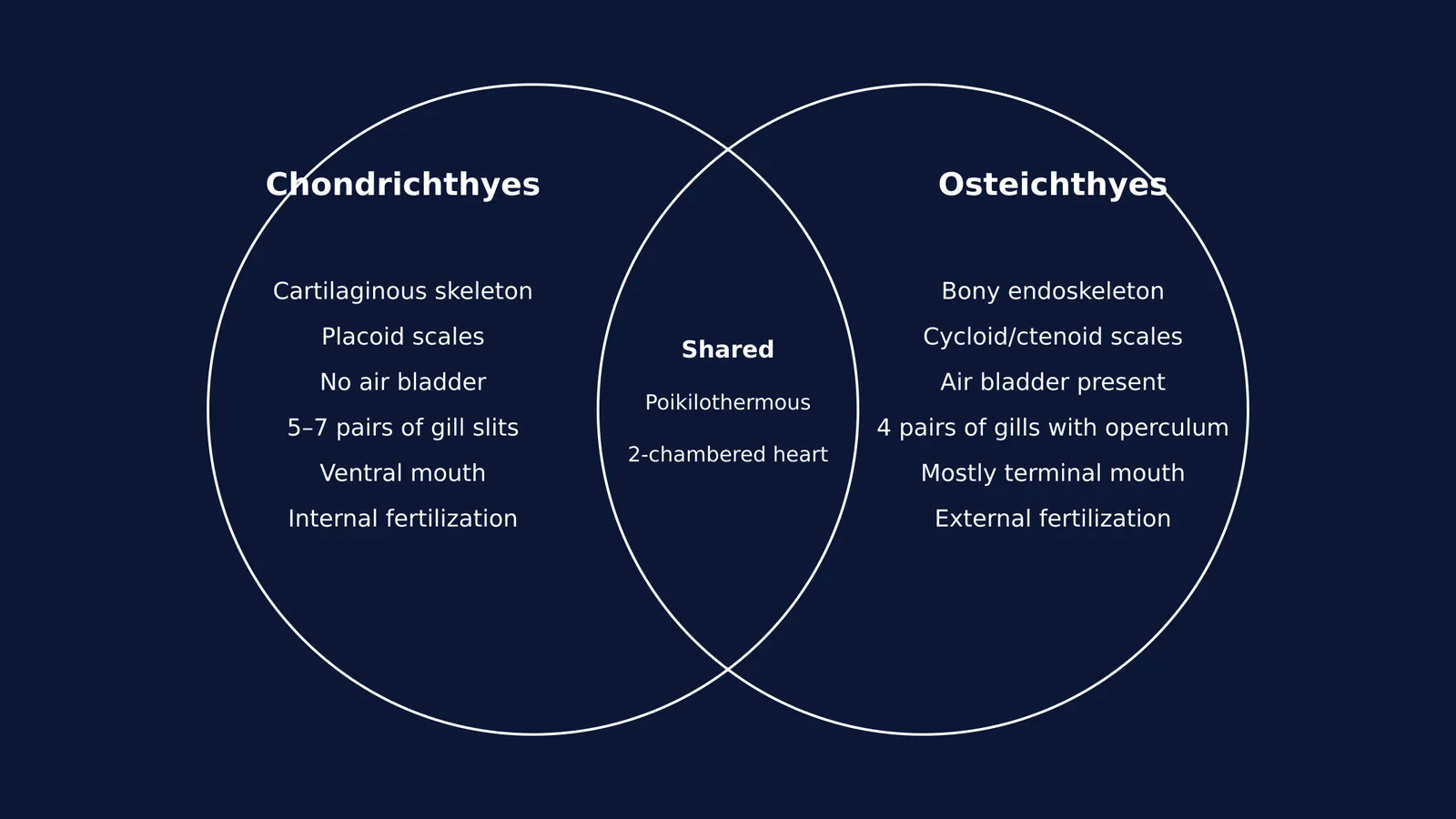
The main differences between cartilaginous and bony fish lie in their skeletons, scales, gills and buoyancy organs. According to the NCERT Class 11 Biology curriculum, Chondrichthyes have a skeleton made entirely of cartilage, whereas Osteichthyes possess a bony endoskeleton (much like the human skeleton).
Beyond the skeleton, you can tell them apart by looking at three external and internal features: the type of scales covering their skin, the presence of a gill cover (operculum) and whether they have an air bladder.
How do placoid and cycloid scales compare?
The skin of a cartilaginous fish feels like sandpaper. They are covered in minute placoid scales, which are essentially tiny, backward-pointing teeth embedded in the skin (NCERT). In fact, a cartilaginous fish's actual jaws are lined with modified placoid scales rather than standard teeth.
Bony fish take a different approach. Their skin is covered by cycloid or ctenoid scales. These are thin, flexible plates of bone that overlap like the shingles on a roof, protecting the fish while allowing it to bend smoothly through the water.
Why do cartilaginous fish lack an operculum?
When you look at a shark, you will notice 5 to 7 visible pairs of gill slits on the side of its head (Wikipedia). Cartilaginous fish have separate gill slits without an operculum (gill cover). Because their gills are exposed and they lack a pumping mechanism, many pelagic sharks must swim constantly to force oxygen-rich water over their gills.
Bony fish, however, have four pairs of gills protected by a bony flap called the operculum (NCERT). The operculum acts as a pump. By opening and closing it, bony fish can draw water in through their mouth and push it over their gills, allowing them to breathe even while resting perfectly still.
What is the function of the air bladder?
Buoyancy is another major dividing line. Bony fish possess a gas-filled sac called an air bladder (or swim bladder). By adjusting the amount of gas inside it, they can achieve neutral buoyancy and hover at any depth without expending energy (NCERT).
Cartilaginous fish lack an air bladder entirely. To keep from sinking, they rely on lift generated by their pectoral fins and a massive liver filled with low-density oil. Even with this oily liver, they must keep swimming; if a cartilaginous fish stops, it sinks.
Where do they live and how do they reproduce?
The differences extend beyond just physical anatomy and into how these fish live and reproduce. Cartilaginous fish are exclusively marine animals, perfectly adapted to the ocean environment. Bony fish are much more versatile; you will find them thriving in both marine and freshwater habitats.
Reproduction also follows two distinct paths. In cartilaginous fish, fertilization is internal. The males possess structures called claspers on their pelvic fins to transfer sperm, and many species are viviparous, meaning they give birth to live young. Bony fish, on the other hand, typically rely on external fertilization, releasing their eggs and sperm into the water. They are mostly oviparous (egg-laying) and their young undergo direct development.
Despite these many differences, both classes share a few fundamental traits: they are cold-blooded (poikilothermous) and have a simple two-chambered heart consisting of one auricle and one ventricle (NCERT).
How to remember these differences for NEET-UG?
If you have concept gaps when reviewing this topic, the Fermi Concept Library contains a lesson for every concept in biology, helping you map these anatomical features to specific examples like the dogfish (*Scoliodon*) or the flying fish (*Exocoetus*).
Use this checklist to recall the key traits of Chondrichthyes vs Osteichthyes (NCERT, Wikipedia):
Skeleton: Cartilage vs Bone.
Mouth position: Ventral (underside) in cartilaginous; mostly terminal (front) in bony.
Scales: Placoid (rough, tooth-like) vs Cycloid/Ctenoid (smooth, overlapping).
Gills: 5 to 7 exposed slits vs 4 pairs covered by an operculum.
Buoyancy: No air bladder (must swim) vs Air bladder present (can hover).


