

On this page
The cockroach in Class 11 biology is Periplaneta americana, the American cockroach, and its males and females look alike until you check one place: the tail end. The current NCERT chapter on structural organisation in animals covers only the frog (NCERT Class 11, Chapter 7), but state boards still teach the cockroach. The Tamil Nadu Class 11 Zoology textbook compares the two sexes in its Table 4.2 (Tamil Nadu SCERT, Zoology Volume I), and a practical or diagram question may ask you to sex a specimen.
How do you tell a male cockroach from a female?
There are three visible differences, in order of how far you can trust them.
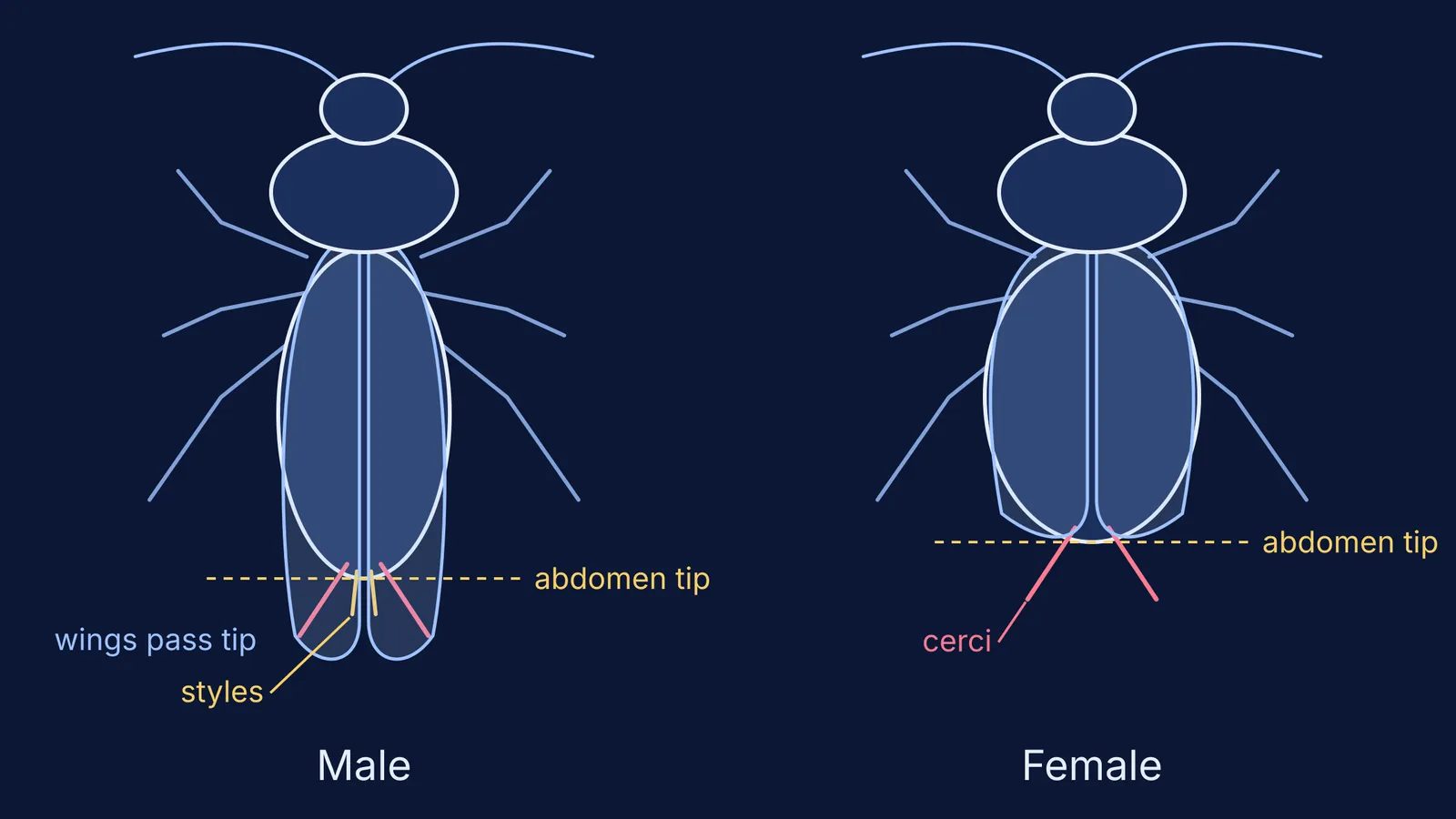
Anal styles. A male has a pair of short, slender anal styles on the 9th sternum, and the female has none (Tamil Nadu SCERT, Zoology Volume I). The University of Florida's species profile puts it plainly: males have a pair of styli between the cerci, and females do not (UF/IFAS Featured Creatures, EENY141).
Wing length. In the American cockroach, the male's wings extend 4 to 8 mm beyond the tip of the abdomen, which is why males look longer than females (UF/IFAS EENY141). In the female, the wings reach only up to the end of the abdomen (Tamil Nadu SCERT, Table 4.2).
Abdomen shape. The male abdomen is long and narrow, and the female abdomen is short and broad (Tamil Nadu SCERT, Table 4.2). The same table says nine abdominal segments are visible in a male and seven in a female. In the female, the 7th sternum is boat-shaped and, with the 8th and 9th sterna, forms a brood or genital pouch.
Both sexes carry a pair of jointed anal cerci, so cerci alone tell you nothing. Under a hand lens, male cerci have 18 to 19 segments and female cerci 13 to 14 (UF/IFAS EENY141).
What should you check on a specimen or diagram?
Work through this checklist in order, using the features listed in Tamil Nadu SCERT Table 4.2. The first clear answer usually settles it; the rest confirm it.
Find the ventral view (turn the specimen over) and locate the two cerci at the tail end. They show you are looking in the right place, not the sex.
Look between the cerci. Two short, slender threads there are anal styles: male.
Compare the wing tips with the abdomen tip. Wings clearly overshooting it point to a male; wings ending level with it point to a female.
Trace the abdomen outline. Long and narrow suggests male; short and broad suggests female.
Count the visible segments from below: nine suggests male, seven suggests female.
Look for a boat-shaped plate at the end of the abdomen. That is the female's 7th sternum forming the brood pouch, where the egg case is made; read more on the ootheca and how many eggs it holds.
Write down which points you used. "Styles present between cerci; wings extend beyond abdomen" is a stronger record than "looks male".
Worked example: how would you answer a diagram question?
Say a question shows the ventral view of two abdomen tips, A and B, and asks for the sex of each with two reasons.
Diagram A shows two long jointed filaments and, between them, two short threads. The abdomen is long and narrow. Answer: "A is male. Anal styles are present on the 9th sternum, and the abdomen is long and narrow."
Diagram B shows two jointed filaments with nothing between them and a broad, boat-shaped plate at the end. Answer: "B is female. Anal styles are absent, and the boat-shaped 7th sternum forms the brood pouch."
Notice what both answers leave out: cerci. "Cerci present" is not a reason for either sex, because both have them.
Which differences can mislead you?
Wing length works only on adults. Nymphs have no wings, and wing pads become noticeable only in the third or fourth instar (UF/IFAS EENY141), so a small wingless cockroach cannot be sexed by its wings. Wings can also be torn in a preserved specimen.
Abdomen shape and antenna length are relative. The Tamil Nadu table lists longer antennae for males (Tamil Nadu SCERT, Table 4.2), but "longer" means little without both sexes side by side. In an adult, anal styles are either there or not, which is why they should be your first check. The millimetre and segment figures above are for Periplaneta americana; other species can differ.
If a labelled diagram is where you get stuck, Fermi's AI tutor can draw the figure with you and check your understanding as it goes. The Fermi Concept Library gives each biology concept its own lesson and its place in the map.
What comes after the outside of the cockroach?
The male's internal reproductive organs have their own exam favourites, covered in mushroom gland and spermatophore in cockroach, explained. For counts such as ommatidia and Malpighian tubules, use our list of cockroach organ numbers in NCERT.
Next time you get a specimen tray, start between the cerci.


