

On this page
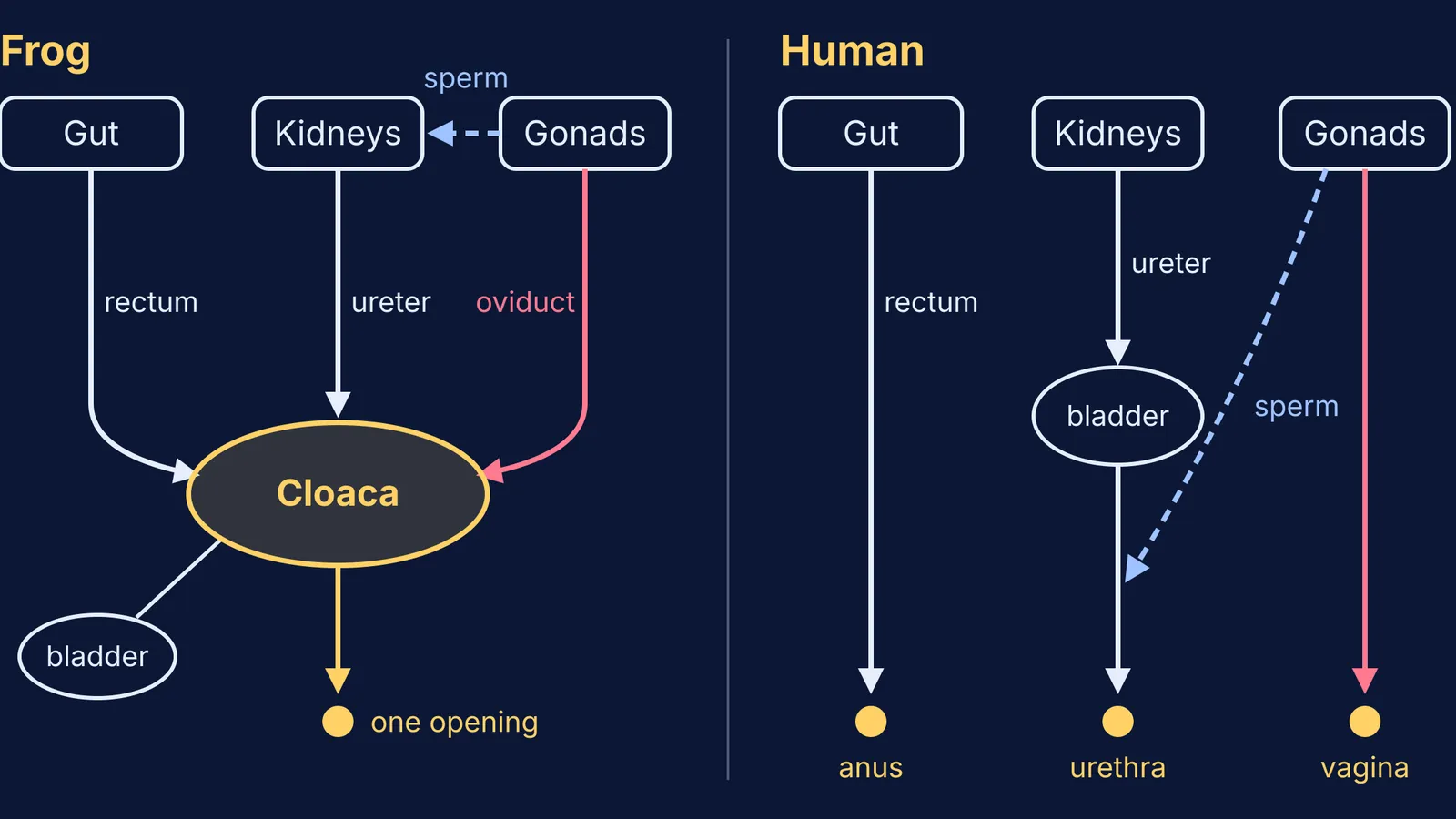
Look at the frog diagram in your Class 11 biology book and you will see the rectum, the ureters and the reproductive ducts all heading for one exit. Nothing is missing. This post traces each tube into that shared chamber, then compares it with the human body, which starts out the same way and then splits.
What is the cloaca in a frog?
The cloaca is "a small, median chamber that is used to pass faecal matter, urine and sperms to the exterior", according to the NCERT Class 11 Biology chapter on Structural Organisation in Animals. It opens to the outside through a single cloacal aperture. Think of it as a junction box: three supply lines in, one door out. Here is what feeds into it, from the same chapter:
Digestive tract. The oesophagus leads to the stomach, then the intestine, then the rectum, which finally opens outside by the cloaca. Undigested solid waste leaves this way.
Urinary tract. A pair of kidneys sends urine down two ureters into the cloaca. The thin-walled urinary bladder sits ventral to the rectum and also opens into the cloaca.
Male reproductive tract. The testes connect to the kidneys through 10 to 12 vasa efferentia, which open into Bidder's canal. That canal joins the urinogenital duct. In male frogs the ureters act as this urinogenital duct, so urine and sperm share one tube into the cloaca.
Female reproductive tract. The ovaries have no functional connection with the kidneys. A pair of oviducts opens into the cloaca separately from the ureters.
NCERT also notes that fertilisation in frogs is external and takes place in water. The female's eggs and the male's sperm simply leave the body through the cloaca.
For the outside of the animal, such as the head, trunk and the vocal sacs of males, see our frog morphology key points.
Why does a frog have a cloaca instead of separate openings?
The frog is not missing a step; humans add one. Human embryos also start with a cloaca. Between the 4th and 6th weeks, a wall of tissue called the urorectal septum divides it into a primary urogenital sinus at the front and the rectum at the back, according to the Swiss university course embryology.ch. The same septum splits the cloacal membrane into a urogenital membrane and an anal membrane. The bladder and part of the urethra develop from the urogenital sinus.
A frog never splits its cloaca, so the shared chamber stays for its whole life. Frogs are not the only animals like this. Our explainer on which animals have a cloaca covers the rest.
How is the human body different?
Adult humans have no cloaca. Compare the exits:
Digestive: the rectum ends at the anus, which is its own opening.
Urinary: the kidneys send urine through the ureters to the bladder, which empties through the urethra.
Male reproductive: "In addition to urine, the male urethra transports semen", says TeachMeAnatomy's guide to the urethra. So a man has two openings: the anus and the urethra.
Female reproductive: the same guide places the urethral orifice in front of the vaginal opening. A woman has three openings: the urethra, the vagina and the anus.
In both the male frog and the human male, urine and sperm share a tube. The difference is where it ends: in a cloaca for the frog, at its own opening for the human.
How do you trace the flow on a frog diagram?
The sketch at the top shows both animals side by side. Use five steps for any diagram question:
Start at the source organ: the gut, the kidney or the gonad.
Name every tube on the way, in order. For frog faeces: stomach, intestine, rectum, cloaca, cloacal aperture.
Ask where the last tube ends: in a shared chamber (frog) or at its own opening (human).
Check whether it is a male or a female. Male frog sperm go from the testis through the vasa efferentia, kidney, Bidder's canal and urinogenital duct. Female frog eggs go from the ovary through the oviduct.
Count the exits: one for a frog, two for a human male, three for a human female.
Now test yourself: true or false?
In female frogs, the ureters act as urinogenital ducts. False: that is true of males only.
The frog's urinary bladder opens into the cloaca. True.
The human male urethra carries both urine and semen. True.
Adult humans have a cloaca. False: only the early embryo has one.
If the male and female figures still blur together, Fermi's AI tutor can draw the figure with you and check your understanding as it goes, asking where each tube ends. For the rest of the chapter, read our Class 11 guide to structural organisation in animals, and use the Fermi Concept Library, which gives every biology concept its own lesson and shows where it sits in the map.


