

On this page
Many of the vertebrates in your NCERT Animal Kingdom chapter have a cloaca, yet the chapter's class-by-class descriptions mention it only under amphibians. Here is the full picture class by class, why humans lack one, and a quick method for odd-one-out questions.
What is a cloaca?
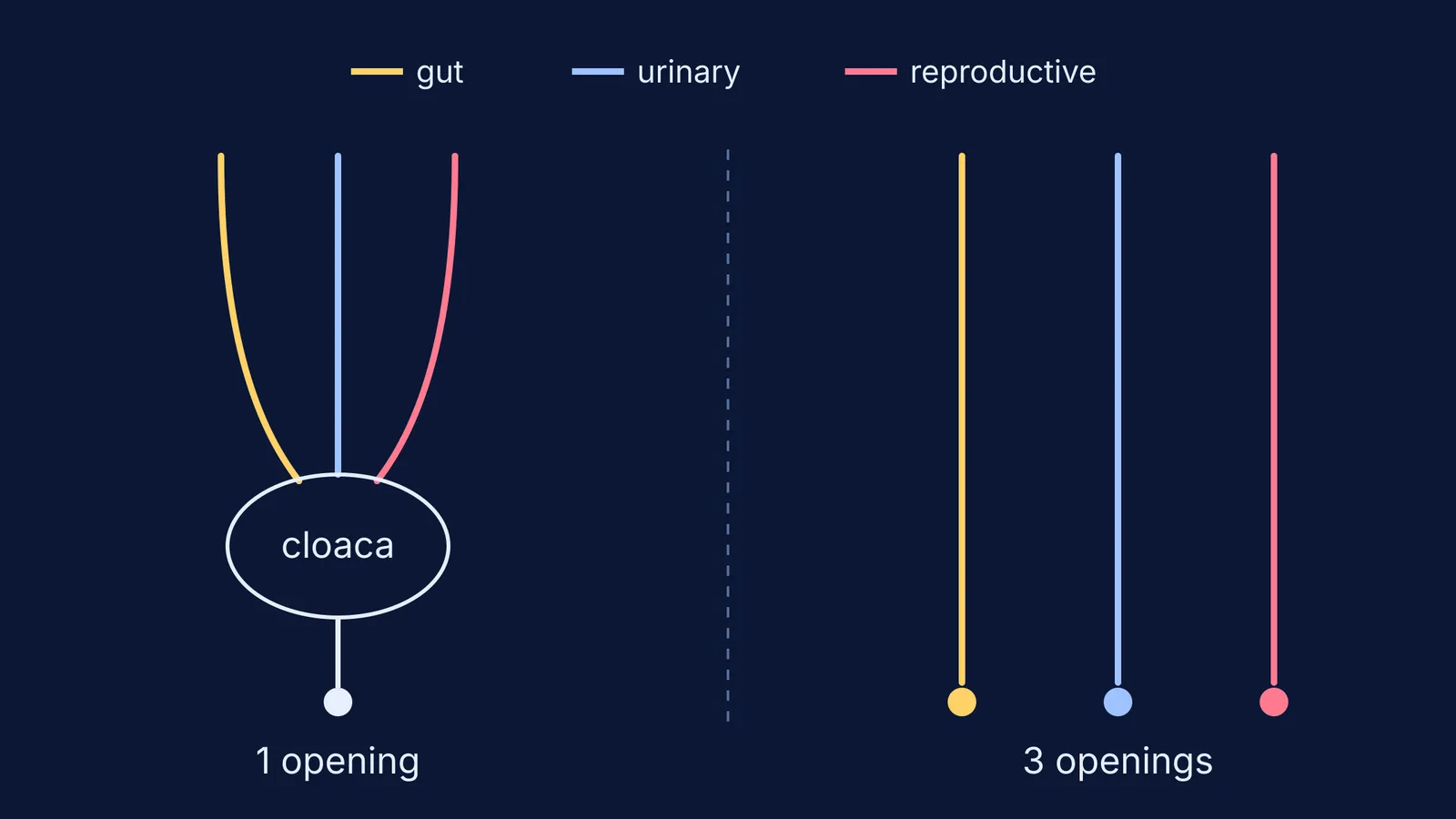
A cloaca is a single chamber where the digestive, urinary and reproductive tracts end, with one opening to the outside. The NCERT Class 11 Biology chapter puts it this way for amphibians: the alimentary canal, urinary and reproductive tracts "open into a common chamber called cloaca which opens to the exterior" (NCERT, Animal Kingdom). The Merck Veterinary Manual describes the bird version as "the saclike compartment inside the bird's body where the digestive, reproductive, and urinary tracts come together" (Merck Veterinary Manual).
Which animals have a cloaca?
Go class by class through the vertebrates you study for NEET-UG:
Cartilaginous fish (sharks and rays): yes. An FAO guide to fish digestion says a cloaca "is universal in sharks and rays" (FAO).
Bony fish: mostly no. The same FAO guide says a cloaca "never occurs in teleost fish, except the Dipnoi", the lungfishes. A 1978 paper in Nature reported that even the coelacanth, a lobe-finned fish, does not have one (Dingerkus, Mok and Lagios).
Amphibians: yes. NCERT lists the cloaca as a feature of class Amphibia, which includes the frog, toad and salamander.
Reptiles: yes. "Reptiles possess a common cloaca, which receives the lower GI, reproductive, and urinary tracts," says the Merck Veterinary Manual's reptile overview.
Birds: yes. As the Merck description above says, all three tracts meet in one chamber.
Mammals: no, except the monotremes. The platypus and the echidnas have a single opening for waste and reproduction, while other mammals have separate openings (Science News Explores).
Why do humans not have a cloaca?
Humans do have one, briefly, before birth. StatPearls, on the NIH's NCBI Bookshelf, describes the cloaca as "the shared component of the anorectal and urogenital passages at the 5th week of gestation" that "subdivides into 2 separate channels during the 6th and 7th weeks" (StatPearls, Embryology, Genitourinary). A wall of tissue called the urorectal septum splits it into the urogenital sinus at the front and the anal canal at the back.
In an adult, faeces leave through the anus and urine through the urethra; in females, the vagina is a third, separate opening.
Why is the platypus the mammal exception?
NCERT says mammals "are viviparous with few exceptions" and gives Ornithorhynchus, the platypus, as its oviparous example (NCERT, Animal Kingdom). The cloaca is the other half of that exception.
The name says it: monotreme means "single opening" in Greek, and only five species of monotreme exist today, all in Australia or New Guinea (Science News Explores).
Monotremes are still mammals. The Australian Museum notes that when platypus young hatch, the female starts secreting milk, and the young suckle from milk patches on her abdomen (Australian Museum). For why hair and milk outweigh eggs and a cloaca, read our explainer on why egg-laying mammals are still mammals.
How do you answer a cloaca question in an exam?
Odd-one-out and statement questions usually test an exception. Use this three-step check:
Name the class of each animal. Use the NCERT examples: Labeo (rohu) and Catla are bony fish; Scoliodon and Trygon are cartilaginous fish; Rana is an amphibian; Columba is a bird; Ornithorhynchus is a monotreme mammal.
Apply the rule: cartilaginous fish, amphibians, reptiles, birds and monotremes have a cloaca; bony fish (except lungfish) and other mammals do not.
Look for the trap. An egg-laying mammal, or a fish with a cloaca, is usually the point of the question.
Worked example. Which of these lacks a cloaca: Rana, Columba, Scoliodon, Labeo? Step 1 gives amphibian, bird, cartilaginous fish and bony fish. Step 2 says the first three have a cloaca. The answer is Labeo, the rohu, because bony fish have separate openings.
Now try the reverse: which of Canis, Ornithorhynchus, Rattus and Felis has a cloaca? Only Ornithorhynchus, the monotreme.
Our list of animal kingdom NCERT exceptions and odd-one-out questions collects the others in one place, and the post on features of amphibians covers the frog in detail.
If a question shows a gap, such as not knowing which class an animal belongs to, the Fermi Concept Library has a lesson for every concept in biology, each with its place in the map. For practice, the Fermi Problem Library has worked problems with a step-by-step solver that explains the reasoning rather than printing an answer.


