On this page
Mechanical Properties of Solids and of Fluids are Chapters 8 and 9 of NCERT Class 11 Physics Part II, in Unit VII of the CBSE Physics syllabus for 2026-27. Key terms follow, with SI units and "Don't confuse with" pairs, checked against the Reprint 2026-27 texts of Chapter 8 and Chapter 9. For numericals, see our Mechanical Properties of Fluids Class 11 chapter guide and the Mechanical Properties of Solids Class 11 guide.
What are stress and strain?
Source: NCERT Chapter 8.
Elasticity: a body's tendency to regain its size and shape when the deforming force is removed. Example: a spring. Don't confuse with: plasticity, staying deformed, like putty.
Stress: restoring force per unit area inside a deformed body, in N m⁻² or pascal (Pa).
Longitudinal stress: from forces at right angles to the cross-section; tensile when stretching, compressive when squeezing.
Shearing stress: from equal, opposite forces parallel to opposite faces, like pushing a book's top cover sideways.
Hydraulic stress: from a fluid pressing equally on all sides; it equals the fluid's pressure.
Strain: fractional change in length, shape or volume, so no unit: ΔL/L (longitudinal), Δx/L ≈ θ (shearing), ΔV/V (volume).
What does the stress-strain curve show?
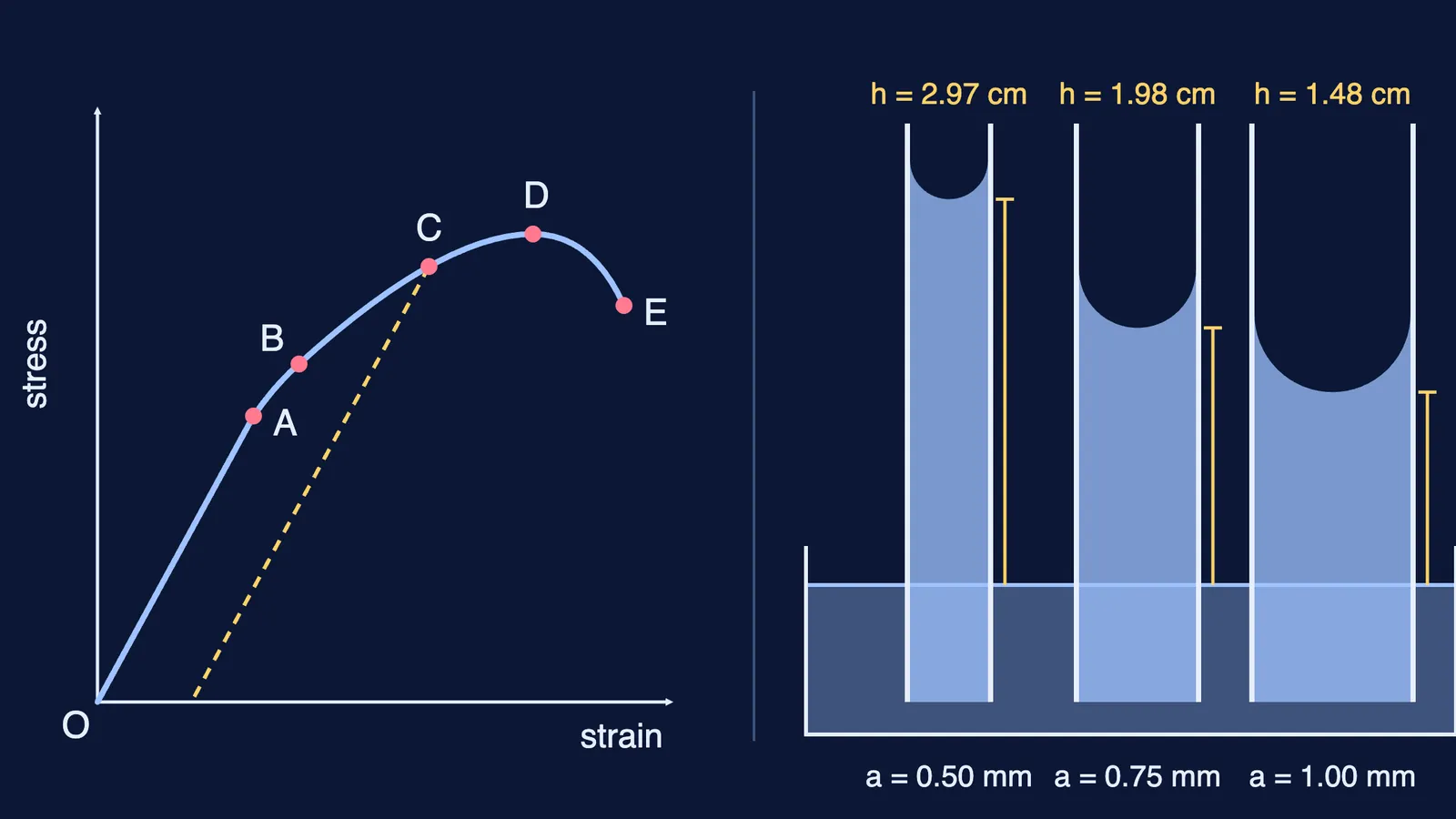
Hooke's law: for small deformations, stress is proportional to strain; the constant is the modulus of elasticity. It holds on the straight part, OA.
Yield point (elastic limit): the point B beyond which the body no longer recovers; the stress there is the yield strength.
Permanent set: strain that remains after unloading past the yield point, showing plastic deformation.
Ultimate tensile strength: the highest stress on the curve (D); fracture follows at E.
Ductile: ultimate strength and fracture points far apart. Don't confuse with: brittle, where they are close.
Elastomer: a material, such as rubber or aorta tissue, that recovers from large strains though its curve is far from straight.
What are Young's, shear and bulk modulus?
Source: NCERT Chapter 8, Example 8.1, Tables 8.3 and 8.4.
Young's modulus (Y): longitudinal stress ÷ longitudinal strain, Y = FL/(AΔL), in Pa. Structural steel: 2.0 × 10¹¹ N m⁻².
Shear modulus or modulus of rigidity (G): shearing stress ÷ shearing strain, in Pa; for most materials G ≈ Y/3.
Bulk modulus (B): hydraulic stress ÷ volume strain, B = −p/(ΔV/V), in Pa. Water: 2.2 × 10⁹ Pa; air at STP: 1.0 × 10⁵ Pa. Don't confuse with: compressibility, its reciprocal.
Poisson's ratio: lateral strain ÷ longitudinal strain, a pure number; steels 0.28 to 0.30.
Elastic potential energy: work stored in a stretched wire; per unit volume, ½ × stress × strain, in J m⁻³.
How does pressure work in a fluid at rest?
Source: NCERT Chapter 9, Section 9.2.
Pressure: normal force per unit area, a scalar, in Pa; 1 atm = 1.013 × 10⁵ Pa. Don't confuse with: stress, which in a solid can also be shear.
Density: mass per unit volume, in kg m⁻³; water at 4 °C is 1.0 × 10³ kg m⁻³. Relative density compares it with water and has no unit (aluminium: 2.7).
Pascal's law: in a fluid at rest, pressure is equal at the same height, and a change applied to an enclosed fluid reaches every part undiminished. Example: hydraulic lifts and brakes.
Gauge pressure: pressure above atmospheric pressure Pa, so P − Pa = ρgh. Don't confuse with: absolute pressure, Pa + ρgh. At 10 m under water, absolute pressure is about 2 atm.
What happens when fluids flow?
Source: NCERT Chapter 9, Sections 9.3 to 9.5.
Streamline (steady) flow: velocity at each point stays constant in time. A streamline is a curve whose tangent gives the velocity; streamlines never cross.
Turbulent flow: irregular flow above the critical speed (critical velocity in the syllabus), as in white-water rapids. Don't confuse with: laminar flow, layers sliding like pages of a book.
Equation of continuity: Av = constant for an incompressible fluid (conservation of mass), so flow speeds up in a narrow pipe.
Bernoulli's principle: along a streamline, P + ½ρv² + ρgh is constant, for steady, incompressible, non-viscous flow.
Torricelli's law: liquid leaves a hole depth h below an open surface at √(2gh), like a freely falling body.
Dynamic lift: force on a body from its motion through a fluid, as on a wing. On a spinning ball it is the Magnus effect.
Viscosity: internal friction between fluid layers; coefficient η = shearing stress ÷ strain rate, in Pa s. Water at 20 °C: 1.0 mPa s. It falls with temperature in liquids, rises in gases.
Stokes' law: viscous drag on a sphere of radius a moving at speed v, F = 6πηav.
Terminal velocity: constant speed reached when drag plus buoyancy balance weight, vt = 2a²(ρ − σ)g/(9η), with ρ the sphere's density and σ the fluid's.
What are surface tension and capillary rise?
Source: NCERT Chapter 9, Section 9.6.
Surface tension (S): surface energy per unit area of a liquid's surface, which equals force per unit length along it, in N m⁻¹. Water at 20 °C: 0.0727 N m⁻¹.
Angle of contact: where liquid meets solid, the angle through the liquid from the solid surface to the tangent of the liquid surface. Acute for water on glass; obtuse for water on a lotus leaf or for mercury.
Excess pressure: higher pressure on the concave side, 2S/r for a drop or an air bubble in liquid. Don't confuse with: a soap bubble, two surfaces, so 4S/r.
Capillary rise: h = 2S cos θ/(ρga). In a tube of radius 0.05 cm, water rises about 3 cm; mercury, with a convex meniscus, falls instead.
Reynolds number is in neither the current NCERT Chapter 9 nor the CBSE 2026-27 syllabus, so it is omitted.
How to learn these terms
Build one grid: tensile stress with Y, shear with G, hydraulic with B; mark which change shape and which volume.
Sketch the stress-strain curve from memory and name points O, A, B, C, D and E.
Write each SI unit beside its quantity: S in N m⁻¹, η in Pa s.
Look up shaky terms in the Fermi Concept Library, which has every concept in physics, chemistry, biology, mathematics and computing, each with its own lesson.