On this page
The JEE (Advanced) 2026 syllabus lists Biot–Savart's and Ampere's laws, fields of wires, coils and solenoids, forces on charges and wires, and current loops in a uniform field. All eight questions stay inside it. New to the chapter? Start with our guide on how to prepare magnetism for JEE Advanced.
How should you use this practice set?
Allow 35 minutes; cover each solution first.
Each question is labelled single-correct, one or more options correct, or numerical-value.
Judge each "one or more" option on its own; see our guide to JEE Advanced question types.
Take μ₀ = 4π × 10⁻⁷ T m A⁻¹ throughout.
Easy: which loop gives the stronger field?
Q1 (easy, single-correct). A wire of length L carrying current I is bent into a square, then into a rectangle with sides in the ratio 2 : 1. Ratio of the field at the rectangle's centre to that at the square's centre?
(A) 1 (B) 3√10/8 (C) 8/(3√10) (D) √10/4
Answer: (B). Summing four finite sides, a rectangle a × b gives 2μ₀I√(a² + b²)/(πab) at its centre. The square (side L/4) gives 8√2μ₀I/(πL); the rectangle (L/3 × L/6) gives 6√5μ₀I/(πL). Ratio 3√10/8 ≈ 1.19. Trap: (A) assumes the same wire gives the same field.
Q2 (easy, one or more options correct). A plane current loop sits in a uniform magnetic field. Then
(A) The net force on it is zero, whatever its shape. (B) The torque is greatest when the plane of the loop is perpendicular to the field. (C) For a fixed wire length, a circular turn has a larger moment than a square turn. (D) With its moment opposite to the field, it is in unstable equilibrium.
Answer: (A), (C), (D). I(∮dl) × B = 0 for any closed path. Torque mB sin θ (θ from the normal) peaks with the plane parallel to the field, so (B) fails. The circle encloses L²/4π, the square L²/16. U = −mB cos θ is a maximum at 180°: unstable. Trap: (B), reading θ from the plane.
Q3 (easy, numerical-value). A long hollow conductor (radii 1.0 cm and 3.0 cm) carries 16 A spread uniformly over its cross-section. Find the field 2.0 cm from the axis, in μT.
Answer: 60. The enclosed fraction is (r² − a²)/(b² − a²) = 3/8, or 6.0 A. B = μ₀(6.0)/(2π × 0.020) = 60 μT. Trap: using r²/b², as for a solid wire, gives 71.1.
Medium: how do crossed fields and curved wires behave?
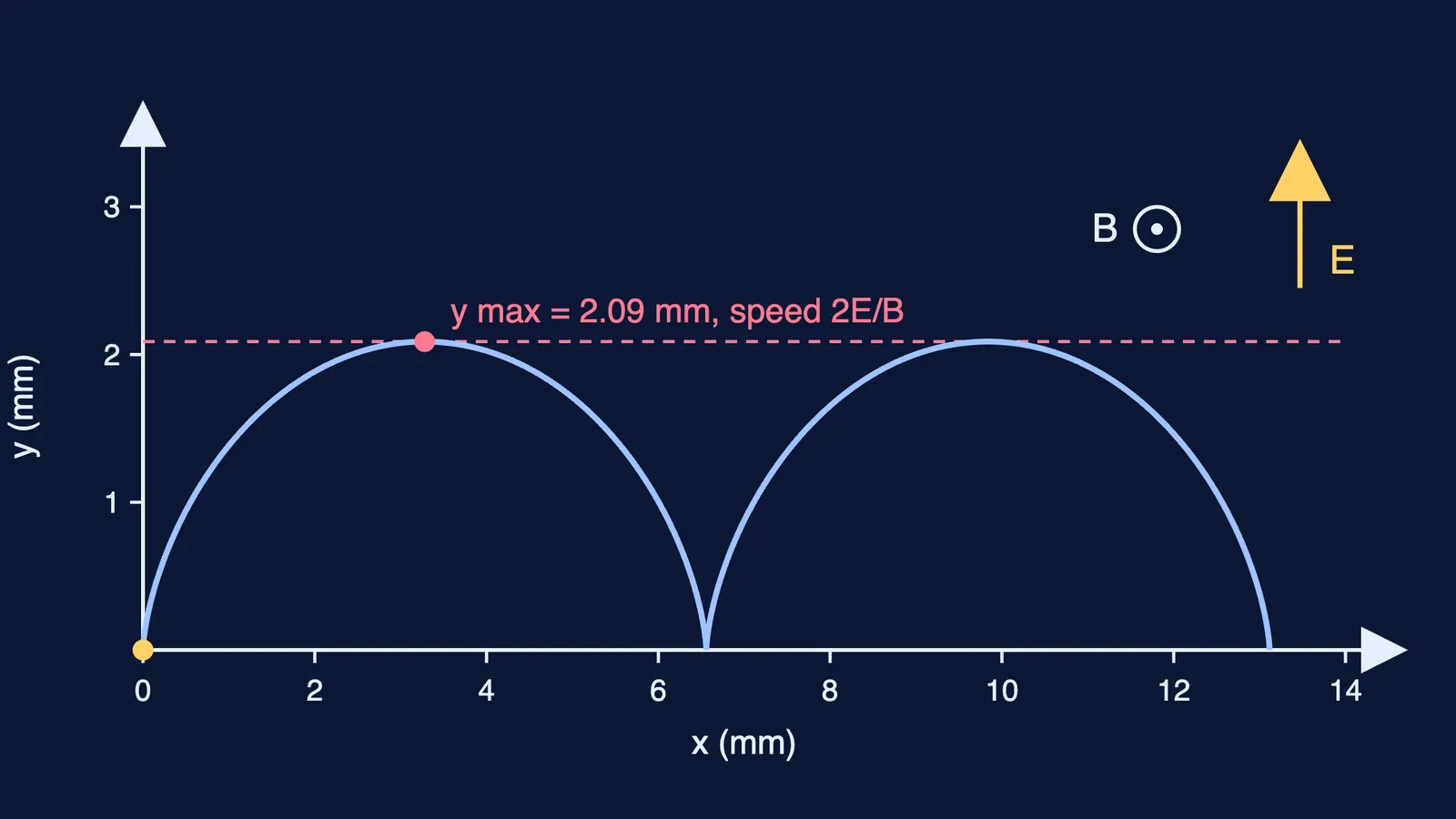
Q4 (medium, one or more options correct). A proton (m = 1.67 × 10⁻²⁷ kg, q = 1.60 × 10⁻¹⁹ C) starts from rest at the origin in uniform E = 1.0 × 10³ V/m along +y and B = 0.10 T along +z. Ignore gravity. Then
(A) its greatest speed is 1.0 × 10⁴ m/s. (B) it gets at most about 2.1 mm from the x-axis. (C) its average velocity over each full cycle is 1.0 × 10⁴ m/s along +x. (D) its kinetic energy is constant, as magnetic forces do no work.
Answer: (B), (C). The path is a cycloid, x = A(ωt − sin ωt), y = A(1 − cos ωt), with A = mE/(qB²) = 1.04 mm. So y reaches 2.09 mm, the top speed is 2E/B = 2.0 × 10⁴ m/s, and the drift is E/B along E × B (+x). (D) fails: the electric field does work. Trap: (A) mistakes the drift speed for the top speed. Our cycloid in crossed fields explainer derives it.
Q5 (medium, single-correct). A wire carrying 3.0 A runs along a quarter circle of radius 10 cm centred at the origin, from (10 cm, 0) to (0, 10 cm). A uniform 0.50 T field points along +z. The force on it is
(A) 0.21 N along y = x, away from the origin (B) 0.21 N along y = x, towards the origin (C) 0.24 N along y = x, away from the origin (D) zero, the two halves cancelling
Answer: (A). In a uniform field only the chord matters: L = (−0.10, 0.10, 0) m, so F = I L × B = (0.15, 0.15, 0) N = 0.21 N, away from the centre. Trap: (C) multiplies by the arc length, π/2 × 0.10 m.
Q6 (medium, numerical-value). A circular coil of radius 5.0 cm carries current I. A second coil with the same current has, at its centre, the same field as the first coil has on its axis 5.0 cm from its centre. Find the second coil's radius, in cm.
Answer: 14.14. On the axis, B = μ₀IR²/[2(R² + x²)^(3/2)]; at x = R this is μ₀I/(2 × 2√2R). A centre field μ₀I/(2R′) matches it when R′ = 2√2R = 14.14 cm. Trap: the far-field 1/x³ law gives 5.0, but x = R is not far.
Hard: what does a spinning or swinging charge do?
Q7 (hard, one or more options correct). A thin non-conducting annular disc (mass M, inner radius R/2, outer radius R, charge Q spread uniformly over it) spins at ω about its axis. Then
(A) the field at its centre is μ₀Qω/(3πR). (B) its magnetic moment is 5QωR²/16. (C) the ratio of its magnetic moment to its angular momentum is Q/(2M), as for a full disc. (D) moving all the charge to the outer rim would increase the field at the centre.
Answer: (A), (B), (C). A ring of radius r, width dr carries dI = σωr dr, σ = 4Q/(3πR²). Integrating μ₀dI/(2r) from R/2 to R gives μ₀Qω/(3πR); integrating πr²dI gives 5QωR²/16. With L = (5MR²/8)ω, m/L = Q/(2M). A charged rim gives μ₀Qω/(4πR), three-quarters of (A), so (D) fails. Trap: (D); the moment grows, but distant charge adds less centre field.
Q8 (hard, numerical-value). A ring of mass 20 g and radius 5.0 cm carries 2.0 A and can turn about a diameter in a uniform 0.10 T field, its moment along the field. Find the period of small oscillations, in seconds.
Answer: 0.79. Restoring torque mBθ, m = IπR²; moment of inertia about a diameter MR²/2. T = 2π√(M/(2πIB)) = 0.79 s; the radius cancels. Trap: MR² (the axial value) gives 1.12.
What should you do after this set?
Sort misses by type. Geometry (Q1, Q5, Q6): sketch each segment. Ampere's law (Q3): write the enclosed fraction first. Motion (Q4, Q8): ask which force does work and about which axis you turn. Redo misses in three days with new numbers.
For more practice, the Fermi Problem Library has worked problems with a step-by-step solver that explains the reasoning rather than printing an answer.