On this page
Macromolecules: Structure & Function is Chapter 2 of Unit II, Molecules of Life, in CBSE Class 11 Biotechnology (045) for 2026-27. Here is the syllabus, the five topics, worked numbers and practice questions.
What does the 2026-27 Biotechnology syllabus list for this chapter?
The CBSE Biotechnology curriculum for 2026-27 gives Unit II 20 marks of the 70-mark theory paper. Those 20 marks are shared with Chapter 1, Biomolecules: Building Blocks; CBSE prints no per-chapter figure.
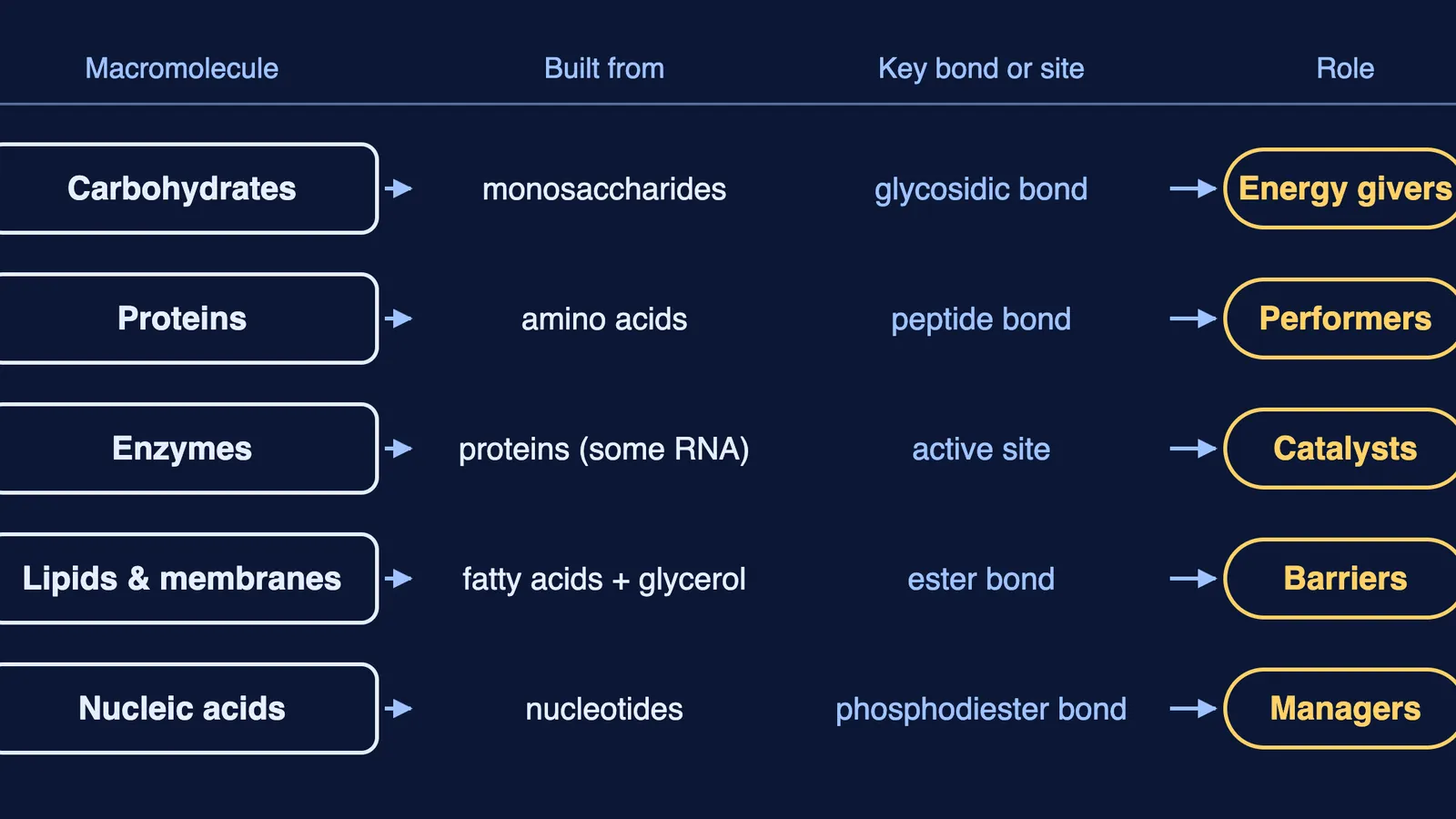
It names five topics with nicknames: carbohydrates (energy givers), proteins (performers), enzymes (catalysts), lipids and biomembranes (barriers) and nucleic acids (managers).
The prescribed book is CBSE's A Text Book of Biotechnology, Class XI. We found no official PDF of it on cbseacademic, so this guide follows the curriculum's topic list and uses the reference book it names, NCERT Biotechnology Class XI (Reprint 2026-27): Chapter 3, Chapter 4 and the membrane section of Chapter 2. The topic list does not mention bioenergetics, so we leave it out.
The core Class 11 Biology guide to Biomolecules covers the same families more lightly. This elective goes further into enzyme kinetics and units, DNA forms and RNA types.
How are carbohydrates and proteins built?
In NCERT Chapter 3, carbohydrates come as monosaccharides, oligosaccharides (two to ten units) and polysaccharides (more than ten), joined by glycosidic bonds. Starch stores energy in plants, glycogen in animals. Cellulose and chitin are structural, built on β(1→4) links; humans lack cellulase, so cellulose passes undigested.
Proteins are chains of 20 standard amino acids. Each peptide bond releases water, so each unit is called a residue, averaging about 110 Da. Four levels:
Primary: the residue order.
Secondary: the α helix (each CO bonds the NH four residues along) and the β sheet, parallel or antiparallel; Pauling and Corey proposed both in 1951.
Tertiary: the full fold, held by disulfide, hydrogen, ionic and hydrophobic contacts.
Quaternary: how separate subunits fit together.
How do enzymes work, and what changes their speed?
Per NCERT Chapter 4, nearly all enzymes are proteins; catalytic RNAs called ribozymes are the exception. Many need a cofactor (a coenzyme or a metal ion); enzyme plus cofactor is the holoenzyme, the protein alone the apoenzyme. The IUB scheme now has seven classes, translocases being the newest.
Models: Fischer's lock and key (1894) against Koshland's induced fit (1958).
Energy: enzymes lower activation energy but leave ΔG and equilibrium unchanged.
Kinetics: Michaelis and Menten (1913) give v₀ = Vmax[S] / (Km + [S]); Km is the [S] giving half of Vmax.
Inhibitors: competitive raises Km, Vmax unchanged; non-competitive lowers Vmax, Km unchanged; uncompetitive changes both.
Units: 1 U converts 1 µmol of substrate per minute; 1 kat = 6 × 10⁷ U. Specific activity is units per mg of protein.
What should you know about lipids, membranes and nucleic acids?
Per NCERT Chapter 3, simple lipids are triacylglycerols and waxes; phospholipids and steroids count as compound lipids. Phospholipids are amphipathic: a water-loving head, two water-fearing tails. Linoleic acid, 18:2 (Δ9,12), has 18 carbons and two double bonds. In Singer and Nicolson's fluid mosaic model (1972), proteins sit in a lipid bilayer; cholesterol adds rigidity.
A nucleotide is a base, a pentose and a phosphate; without the phosphate it is a nucleoside. Phosphodiester links give each strand a 5' and a 3' end. In Watson and Crick's 1953 B-DNA, A pairs with T through two hydrogen bonds and G with C through three. A-DNA is right-handed with 11 base pairs per turn; Z-DNA is left-handed with 12. mRNA carries the message, rRNA builds ribosomes, tRNA brings amino acids.
Practice questions (marks are our suggestion)
The mark labels are our suggestion, not CBSE's.
(1 mark) Which enzyme would humans need to digest cellulose?
(1 mark) Which inhibitor type leaves Km unchanged?
(2 marks) Estimate the mass of a 300-residue protein chain.
(2 marks) A sample converts 3 µmol of substrate per minute and holds 0.5 mg protein. Give its activity and specific activity.
(3 marks) A 10 bp DNA stretch has 4 G–C and 6 A–T pairs. Count its hydrogen bonds and say which pairs resist melting more.
(5 marks) Compare lock and key with induced fit, then explain why extra substrate overcomes a competitive inhibitor.
Answers: 1. Cellulase. 2. Non-competitive. 3. 300 × 110 = 33,000 Da. 4. 3 U; 6 U/mg. 5. 4 × 3 + 6 × 2 = 24; G–C. 6. Rigid versus flexible active site; at high [S] the substrate wins the shared site, so Vmax returns.
How should you revise this chapter?
Make one card per family: building block, link and nickname. Redo the worked example with fresh numbers. For an exam-focused companion, see how to prepare Biomolecules for NEET.
Short on time this week? Fermi's AI tutor works out what you already know and builds a plan for the session.