On this page
These terms come from Chapter 12, Linear Programming, of the NCERT Class 12 Mathematics Part II textbook (Reprint 2026-27), and match Unit V of the CBSE 2026-27 Class XII Mathematics syllabus, which limits problems to "up to three non-trivial constraints". The current chapter has no section on types of LPP (manufacturing, diet or transportation problems); diet and transportation problems and the simplex method appear only in its Historical Note, so this glossary leaves them out.
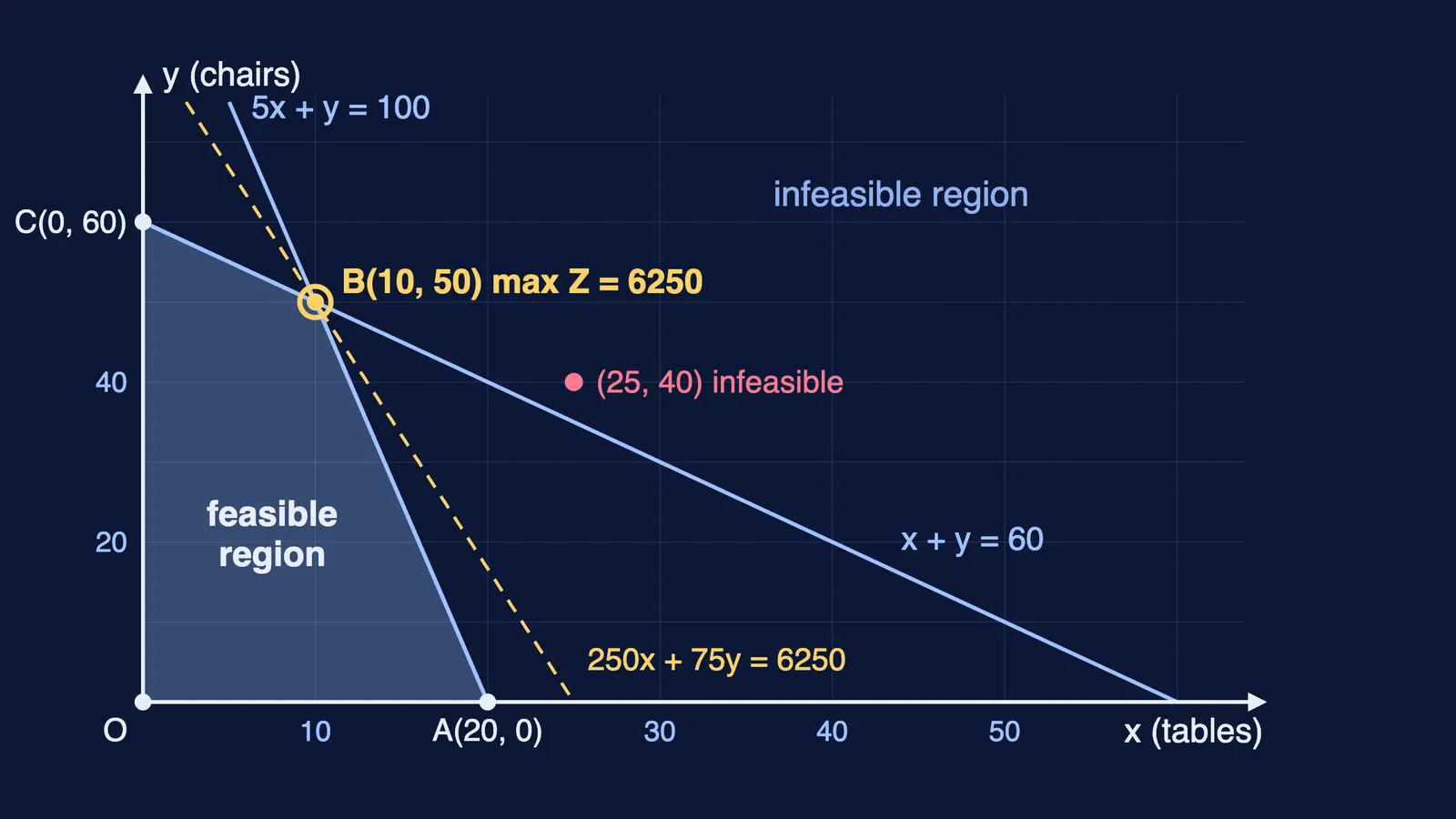
Most examples use NCERT's furniture dealer: x tables at Rs 2500 each, y chairs at Rs 500, Rs 50,000 to spend, room for 60 pieces, profit Rs 250 per table and Rs 75 per chair.
What is a linear programming problem?
Source: NCERT sections 12.1 and 12.2.
Optimisation problem: a problem that asks for the largest or smallest value of a function under given conditions.
Linear programming problem (LPP): an optimisation problem where you maximise or minimise a linear function of several variables, the variables are non-negative, and they must satisfy a set of linear inequalities. Example: maximise Z = 250x + 75y subject to 5x + y ≤ 100, x + y ≤ 60, x ≥ 0, y ≥ 0.
Linear and programming: "linear" means every relation in the problem is linear; "programming" means working out a plan of action. Don't confuse with: computer programming.
Decision variables: the non-negative quantities you choose, here x and y.
Objective function: the quantity you want as large or as small as possible, written as a linear expression Z = ax + by (a and b constants). Example: profit Z = 250x + 75y. Counter-example: Z = x² + y is not linear, so it cannot be the objective of an LPP.
Optimal value: the maximum or minimum value Z reaches. Example: Rs 6250 for the dealer.
Which conditions limit the choices?
Source: NCERT sections 12.2.1 and 12.2.2.
Constraints: the conditions, written as linear inequalities or equations, that limit which values x and y may take. Example: 2500x + 500y ≤ 50000, which simplifies to 5x + y ≤ 100 (money), and x + y ≤ 60 (storage).
Non-negative restrictions (also called non-negative constraints): x ≥ 0 and y ≥ 0. Example: the dealer cannot buy −3 tables.
Half plane: the graph of one linear inequality, all points on one side of its boundary line. Example: (0, 0) satisfies 5x + y ≤ 100, so shade the side containing the origin.
Open half plane: a half plane without its boundary line, such as ax + by > M.
What is a feasible region?
Source: NCERT section 12.2.2.
Feasible region (solution region): the set of points that satisfy every constraint at once, the non-negative restrictions included. Example: OABC with O(0, 0), A(20, 0), B(10, 50), C(0, 60), shaded in the diagram above.
Infeasible region: everything outside the feasible region.
Feasible solution: any point inside or on the boundary of the feasible region. Example: (10, 50), (0, 60) and (20, 0).
Infeasible solution: any point outside it. Example: (25, 40), since 5(25) + 40 = 165 > 100.
Optimal (feasible) solution: a point of the feasible region where Z takes its optimal value. Example: B(10, 50). Don't confuse with: optimal value, which is the number Z = 6250, not the point.
Corner point (vertex): a point of the region where two boundary lines meet. Example: B, found by solving 5x + y = 100 and x + y = 60 together.
Bounded region: a feasible region that can be enclosed in a circle. Example: OABC. Don't confuse with: unbounded region, which extends indefinitely in some direction, such as x + y ≥ 2, x ≥ 0, y ≥ 0.
Convex region: one where the segment joining any two of its points stays inside it. NCERT notes that the feasible region is always convex. Counter-example: an L-shaped region.
How does the corner point method find the answer?
Source: NCERT section 12.2.2, Examples 1 to 5. NCERT gives no proofs.
Graphical method: solving a two-variable LPP by drawing its feasible region; the only method in this chapter.
Theorem 1: if Z has an optimal value on the feasible region R (a convex polygon), that value occurs at a corner point of R.
Theorem 2: if R is bounded, Z has both a maximum and a minimum on R, each at a corner point.
Corner point method: find the region and its corners, work out Z at each corner, and call the largest value M and the smallest m. If the region is bounded, M is the maximum and m the minimum. Example: Z = 0, 5000, 6250, 4500 at O, A, B, C, so the maximum is 6250 at B.
Unbounded check: M is the maximum only if the open half plane ax + by > M shares no point with the region; otherwise Z has no maximum. For m, check ax + by < m. Example: NCERT's Example 4 gets −300 as the smallest corner value of Z = −50x + 20y, but −50x + 20y < −300 overlaps the region, so Z has no minimum.
Multiple optimal solutions: when two corners give the same best value, every point on the segment joining them does too. Example: Z = 3x + 9y in NCERT's Example 3 reaches 180 at both (15, 15) and (0, 20).
No feasible region: the constraints share no point, so there is no feasible solution. Example: x + y ≥ 8 and 3x + 5y ≤ 15 with x, y ≥ 0 (NCERT's Example 5).
How to learn these terms
Learn the pairs together: feasible and infeasible solution, optimal value and optimal solution, bounded and unbounded region.
Redraw the dealer's region and label its corners, both lines and (25, 40).
Make a card for the three special cases (tied corners, unbounded with no optimum, no feasible region), each with its NCERT example.
For a refresher on linear inequalities and graphs from Class XI, the Fermi Concept Library has a lesson for each concept in mathematics, with its place in the map.
Then practise with the linear programming Class 12 board exam guide and the linear programming assertion-reason questions.