On this page
This sheet covers every formula in Chapter 12, Limits and Derivatives, of the rationalised NCERT Class 11 Mathematics textbook (Reprint 2026-27), checked against the CBSE Class XI Mathematics syllabus for 2026-27. Throughout, a is a real number and x → a means x gets close to a without equalling it. If you want the concepts explained before the formulas, start with our Limits and Derivatives Class 11 guide.
What is a limit, and when does it exist?
Left hand limit lim(x → a⁻) f(x): the value f(x) approaches from x < a. Right hand limit lim(x → a⁺) f(x): from x > a.
lim(x → a) f(x) = l exists only when both one-sided limits exist and equal the same number l.
Algebra of limits (when lim f(x) and lim g(x) both exist as x → a): lim [f(x) ± g(x)] = lim f(x) ± lim g(x); lim [f(x)·g(x)] = lim f(x) · lim g(x); lim [λ·f(x)] = λ·lim f(x) for any real constant λ.
Quotient: lim [f(x)/g(x)] = lim f(x) / lim g(x), only if lim g(x) ≠ 0.
Worked example: f(x) = 3x − 1 for x < 2 and x² + 1 for x ≥ 2. Left limit at 2 = 5, right limit = 2² + 1 = 5, so lim(x → 2) f(x) = 5.
Watch for: using the quotient rule for limits when the bottom limit is 0. That gives no answer; simplify first.
Limits of polynomials and rational functions
Polynomial f(x) = a₀ + a₁x + … + aₙxⁿ: lim(x → a) f(x) = f(a).
Rational function p(x)/q(x): lim(x → a) = p(a)/q(a), provided q(a) ≠ 0.
If p(a) = q(a) = 0 (the 0/0 form), factor out (x − a), cancel it (allowed because x ≠ a), then substitute.
Standard limit: lim(x → a) (xⁿ − aⁿ)/(x − a) = n·aⁿ⁻¹ for any positive integer n. NCERT notes it also holds when n is any rational number and a > 0.
Worked example: lim(x → 2) (x⁵ − 32)/(x² − 4). Divide top and bottom by (x − 2) and use the standard limit on each part: (x⁵ − 2⁵)/(x − 2) → 5·2⁴ = 80 and (x² − 2²)/(x − 2) → 2·2 = 4, so the limit is 80/4 = 20.
Watch for: writing 0/0 = 0 or 1. The form 0/0 means simplify.
Which trigonometric limits do you need to know?
lim(x → 0) (sin x)/x = 1, with x in radians.
lim(x → 0) (1 − cos x)/x = 0.
lim(x → 0) (tan x)/x = 1.
Sandwich theorem: if f(x) ≤ g(x) ≤ h(x) near a and lim f(x) = lim h(x) = l as x → a, then lim g(x) = l.
The inequality behind the sin x/x limit: cos x < (sin x)/x < 1 for 0 < x < π/2.
Worked example: lim(x → 0) (sin 5x)/(tan 3x). Rewrite it as [(sin 5x)/(5x)] · [(3x)/(tan 3x)] · (5/3). The first two factors tend to 1, so the limit is 5/3.
Watch for: these results need radians and the same angle on top and bottom. (sin 5x)/x tends to 5, not 1.
How is the derivative defined?
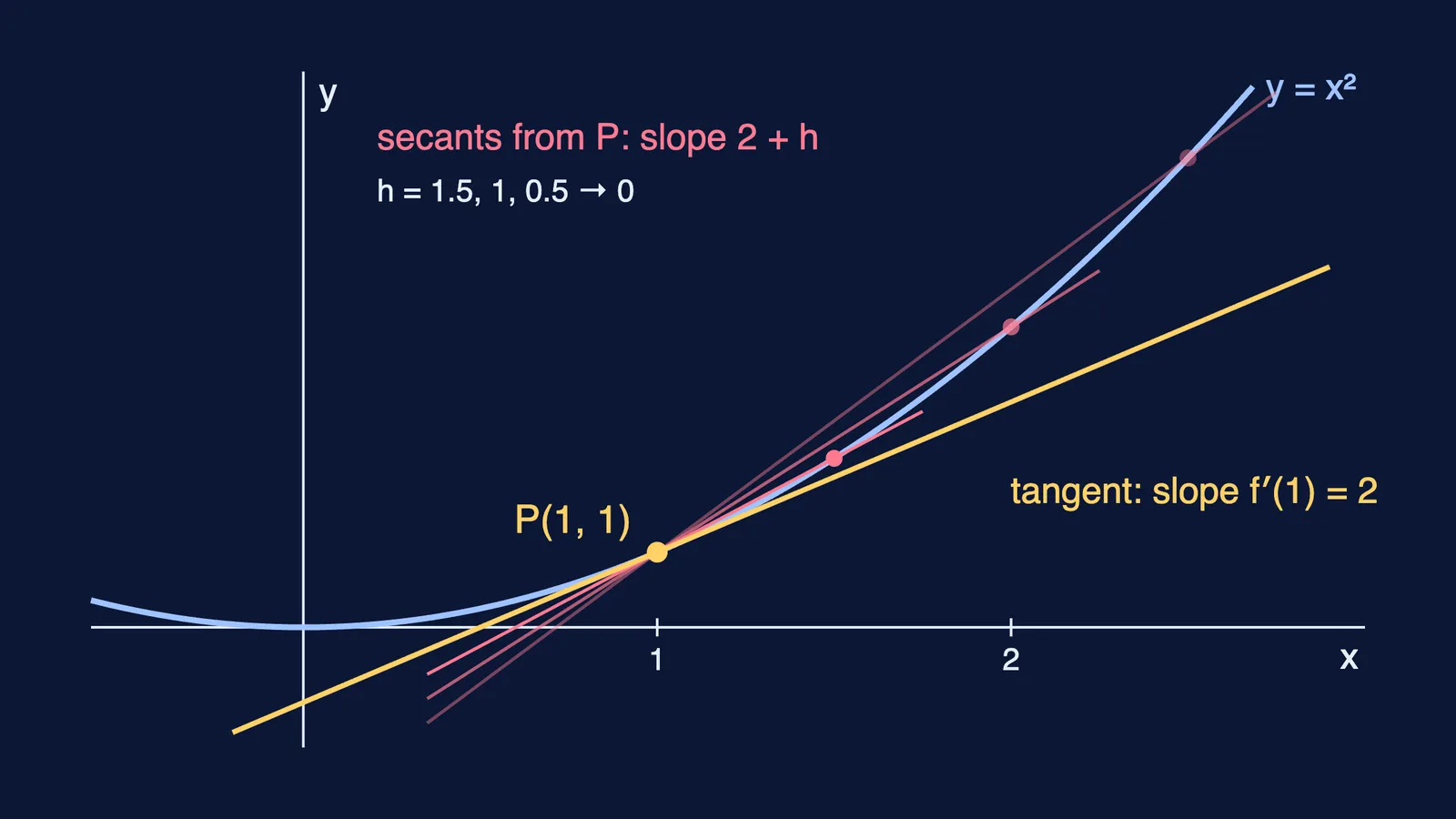
Derivative at a point: f′(a) = lim(h → 0) [f(a + h) − f(a)]/h, when this limit exists.
Derivative function: f′(x) = d/dx f(x) = lim(h → 0) [f(x + h) − f(x)]/h.
Meaning: f′(a) is the slope of the tangent to y = f(x) at (a, f(a)), and the instantaneous rate of change of f at a.
Worked example: f(x) = x² + 3x at a = 2. Then f(2 + h) − f(2) = (4 + 4h + h² + 6 + 3h) − 10 = 7h + h². Divide by h to get 7 + h, which tends to 7 as h → 0. So f′(2) = 7. More practice: derivatives from first principles in Class 11.
Watch for: subtracting only part of f(a). Put f(a + h) and f(a) in full brackets before you expand.
What are the derivative rules and standard derivatives?
Rules, with u = f(x) and v = g(x) differentiable on a common domain:
Sum and difference: (u ± v)′ = u′ ± v′.
Constant multiple: (λu)′ = λu′; the derivative of a constant is 0.
Product (Leibnitz) rule: (uv)′ = u′v + uv′.
Quotient rule: (u/v)′ = (u′v − uv′)/v², wherever v ≠ 0.
Standard derivatives:
d/dx (xⁿ) = n·xⁿ⁻¹ (NCERT proves it for positive integers n and states it holds for any real n).
Polynomial: d/dx (aₙxⁿ + … + a₁x + a₀) = n·aₙxⁿ⁻¹ + … + 2a₂x + a₁.
d/dx (sin x) = cos x.
d/dx (cos x) = −sin x.
d/dx (tan x) = sec² x, where cos x ≠ 0.
Worked example: f(x) = (2x + 3)/(x² + 1). With u = 2x + 3, v = x² + 1, u′ = 2, v′ = 2x, f′(x) = [2(x² + 1) − (2x + 3)(2x)]/(x² + 1)². At x = 1: [2(2) − 5(2)]/2² = −6/4 = −3/2.
Watch for: writing uv′ − u′v in the quotient rule, which flips the sign, and dropping the minus in d/dx (cos x).
Not in this sheet: the chain rule, which this NCERT chapter does not cover.
How to revise this formula sheet
Rewrite each standard limit with its condition beside it: radians for the trigonometric limits, positive integer n (or rational n with a > 0) for (xⁿ − aⁿ)/(x − a).
Derive d/dx (sin x) = cos x from first principles once; it reuses the sin x/x limit.
In every limit, substitute x = a first; only 0/0 sends you to factoring or a standard limit.
Check quotient rule answers by redoing them as u·v⁻¹ with the product rule.
Test yourself with these limits and derivatives assertion-reason questions.
If a step keeps going wrong, the Fermi Problem Library has worked problems with a step-by-step solver that explains the reasoning rather than printing an answer.