On this page
What do these questions cover?
Treat this set as practice. Every item stays inside Unit IV of the CBSE 2026-27 Class XI Mathematics syllabus and the rationalised NCERT Chapter 12, Limits and Derivatives (Reprint 2026-27). For the full chapter, start with our Limits and Derivatives Class 11 guide.
How do you answer assertion-reason questions?
Judge each statement alone first. If both are true, read them as "A, because R" and ask whether R is the actual reason. See our assertion-reason strategy guide.
Keys for Q1 to Q6:
(A) Both A and R are true and R is the correct explanation of A.
(B) Both A and R are true but R is NOT the correct explanation of A.
(C) A is true but R is false.
(D) A is false but R is true.
Keys for Q7 to Q10:
(A) Both statements are correct.
(B) Both statements are incorrect.
(C) Statement I is correct, Statement II is incorrect.
(D) Statement I is incorrect, Statement II is correct.
Assertion-reason questions with answers
Q1 (easy). Assertion (A): The limit of (x² − 9)/(x − 3) as x → 3 is 6. Reason (R): For every x ≠ 3, (x² − 9)/(x − 3) = x + 3.
Answer: (A). Near 3 (but not at 3) the expression equals x + 3, and x + 3 → 6. The limit uses only x ≠ 3, so R explains A.
Trap: writing 0/0 as the answer instead of simplifying first.
Q2 (easy). Assertion (A): The derivative of x² sin x is 2x sin x + x² cos x. Reason (R): The derivative of a product of two functions is the product of their derivatives.
Answer: (C). A follows from the product rule (uv)′ = u′v + uv′. R is false: the product of the derivatives would give 2x cos x.
Trap: writing (uv)′ = u′v′.
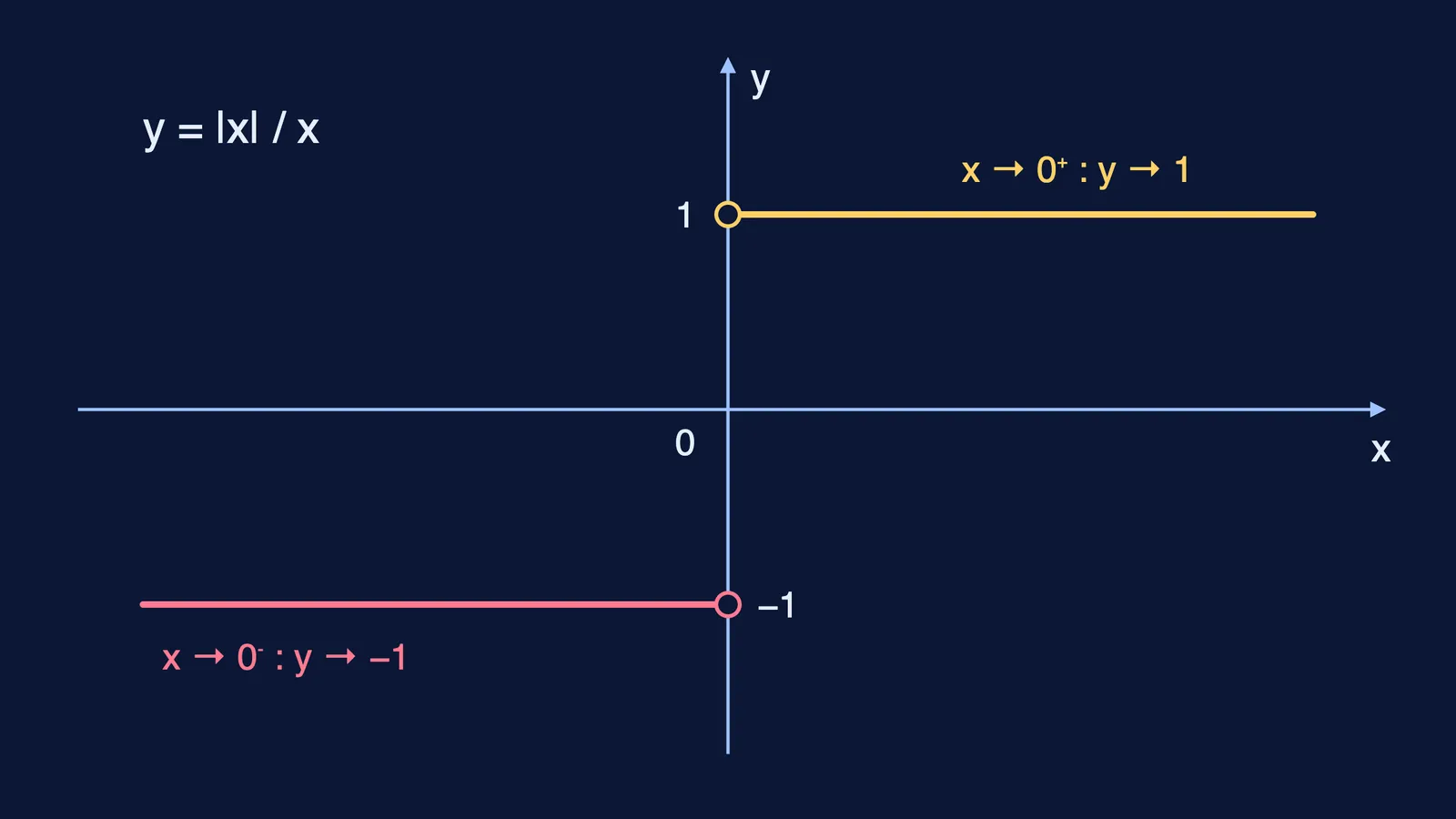
Q3 (medium). Assertion (A): The limit of |x|/x as x → 0 does not exist. Reason (R): |x|/x is not defined at x = 0.
Answer: (B). Both are true. The limit fails because the left hand limit is −1 and the right hand limit is 1. Being undefined is not the reason: NCERT's g(x) = |x|, x ≠ 0, is also undefined at 0, yet its limit there is 0.
Trap: thinking "undefined at a" means "no limit at a".
Q4 (medium). Assertion (A): The limit of (x² − 25)/(x − 5) as x → 5 does not exist. Reason (R): The limit of a function as x → a depends only on its values near a, not on its value at a.
Answer: (D). R is true and shows why A is false: for x ≠ 5 the expression is x + 5, so the limit is 10.
Trap: treating a missing value as a missing limit.
Q5 (medium). Assertion (A): The limit of (1 − cos x)/x as x → 0 is 0. Reason (R): 1 − cos x ≥ 0 for every real x.
Answer: (B). Both are true, but R only gives the sign of the numerator. The 0 comes from 1 − cos x = 2 sin²(x/2), which gives (sin(x/2)/(x/2)) × sin(x/2) → 1 × 0.
Trap: picking (A) because R is about the same expression.
Q6 (hard). Assertion (A): The limit of (x¹⁰ − 1)/(x⁴ − 1) as x → 1 is 5/2. Reason (R): For a positive integer n, the limit of (xⁿ − aⁿ)/(x − a) as x → a is naⁿ⁻¹.
Answer: (A). Divide top and bottom by x − 1. By R they tend to 10 and 4, giving 10/4 = 5/2.
Trap: cancelling to x⁶ and answering 1.
Statement I and II questions with answers
Q7 (easy). Statement I: The derivative of cos x is −sin x. Statement II: The derivative of tan x is sec x tan x.
Answer: (C). I is correct. II is incorrect: the quotient rule on sin x/cos x gives sec² x; sec x tan x is the derivative of sec x.
Trap: swapping the derivatives of tan x and sec x.
Q8 (medium). Statement I: If x is measured in degrees, the limit of (sin x)/x as x → 0 is 1. Statement II: The limit of (tan x)/x as x → 0, with x in radians, is 1.
Answer: (D). NCERT proves sin x/x → 1 in radians. In degrees, sin x° = sin(πx/180), so the limit is π/180: I is incorrect. II is correct: tan x/x = (sin x/x) × (1/cos x) → 1 × 1.
Trap: using a radian-only result with degrees.
Q9 (hard). Statement I: For f(x) = x|x|, the derivative at x = 0 exists and equals 0. Statement II: For g(x) = |x|, the derivative at x = 0 does not exist.
Answer: (A). For f, [f(h) − f(0)]/h = h|h|/h = |h|, which tends to 0 from both sides. For g, the quotient is |h|/h, with one-sided limits −1 and 1, so g′(0) does not exist.
Trap: assuming anything with |x| has no derivative at 0.
Q10 (hard). Statement I: If the limit of f(x) + g(x) as x → a exists, then the limits of f(x) and g(x) as x → a both exist. Statement II: The limit of (sin x)/(x − π) as x → π is 1.
Answer: (B). I reverses NCERT's sum rule, which assumes both limits exist. Take f(x) = |x|/x and g(x) = −|x|/x: f + g = 0 for x ≠ 0, yet neither limit exists at 0. For II, put x = π + t: sin(π + t) = −sin t, so the quotient is −sin t/t → −1, not 1.
Trap: reversing a theorem, and losing the sign of sin(π + t).
How should you use this set?
Attempt all ten in 15 minutes.
Label each miss: wrong fact (you misjudged a statement) or wrong link ("because").
Redo the misses two days later, saying the reason aloud first.
If your misses are wrong facts, the gap is a concept. The Fermi Concept Library covers every concept in mathematics, each with its own lesson. For the long-hand method behind Q9, see our derivatives from first principles with worked examples.