On this page
In a limits and continuity multiple-correct question, the trap is usually a corner, a jump or an oscillation that a quick look gets wrong. Here are eight original questions in that format.
How does partial marking work in JEE Advanced multiple-correct questions?
In the official JEE Advanced 2025 Paper 1 mathematics answer key, Section 2 has three questions where one or more of four options is correct, marked like this:
+4 for all the correct options and nothing else.
+3 if all four are correct and you choose exactly three.
+2 if three or more are correct and you choose two, both correct.
+1 if two or more are correct and you choose one correct option.
0 if blank; −2 in all other cases.
The scheme can change, so read it again on exam day.
Eight limits and continuity questions, option by option
[x] is the greatest integer less than or equal to x.
Q1. f(x) = x|x|. Which are true?
(A) f is continuous at 0. True.
(B) f is differentiable at 0. True: f(h)/h = |h| → 0.
(C) f′ is differentiable at 0. False: f′(x) = 2|x| has a corner at 0.
(D) f is increasing on ℝ. True: f′(x) = 2|x| ≥ 0, zero only at 0.
Answer: A, B, D. Students miss B, assuming |x| always means a corner.
Q2. Which limits as x → 0 are correct?
(A) (1 − cos x)/x² → 1/2. True.
(B) (eˣ − 1 − x)/x² → 1. False: it is 1/2.
(C) (tan x − sin x)/x³ → 1/6. False: tan x − sin x = x³/2 + …, so it is 1/2.
(D) (x − sin x)/x³ → 1/6. True.
Answer: A, D. C is the wrong tick: the 1/6 belongs to D.
Q3. f(x) = [x] + [−x]. Which are true?
(A) f(x) = −1 for every non-integer x. True.
(B) The limit of f as x → 2 exists. True: it is −1 from both sides.
(C) f is discontinuous at x = 2. True: f(2) = 0.
(D) Every integer is a removable discontinuity. True.
Answer: A, B, C, D. Dropping B, as if [x] never has a limit at an integer, earns +3, not +4.
Q4. f(x) = x² for x ≤ 1 and ax + b for x > 1, differentiable at 1. Which are true?
(A) a = 2. True: the slopes match.
(B) b = 1. False: continuity needs a + b = 1, so b = −1.
(C) f is twice differentiable at 1. False: f″ is 2 on the left, 0 on the right.
(D) f(2) = 4. False: f(2) = 2a + b = 3.
Answer: A only. One correct option is allowed; D tempts anyone who uses x² on the wrong piece.
Q5. f(x) = x² sin(1/x) for x ≠ 0, f(0) = 0. Which are true?
(A) f is continuous at 0. True: |f(x)| ≤ x².
(B) f′(0) = 0. True: f(h)/h = h sin(1/h) → 0.
(C) f′ is continuous at 0. False: f′(x) = 2x sin(1/x) − cos(1/x) has no limit at 0.
(D) f′ is bounded near 0. True: |f′(x)| ≤ 2|x| + 1.
Answer: A, B, D. C is the costly tick: f′ can exist at 0 without being continuous there.
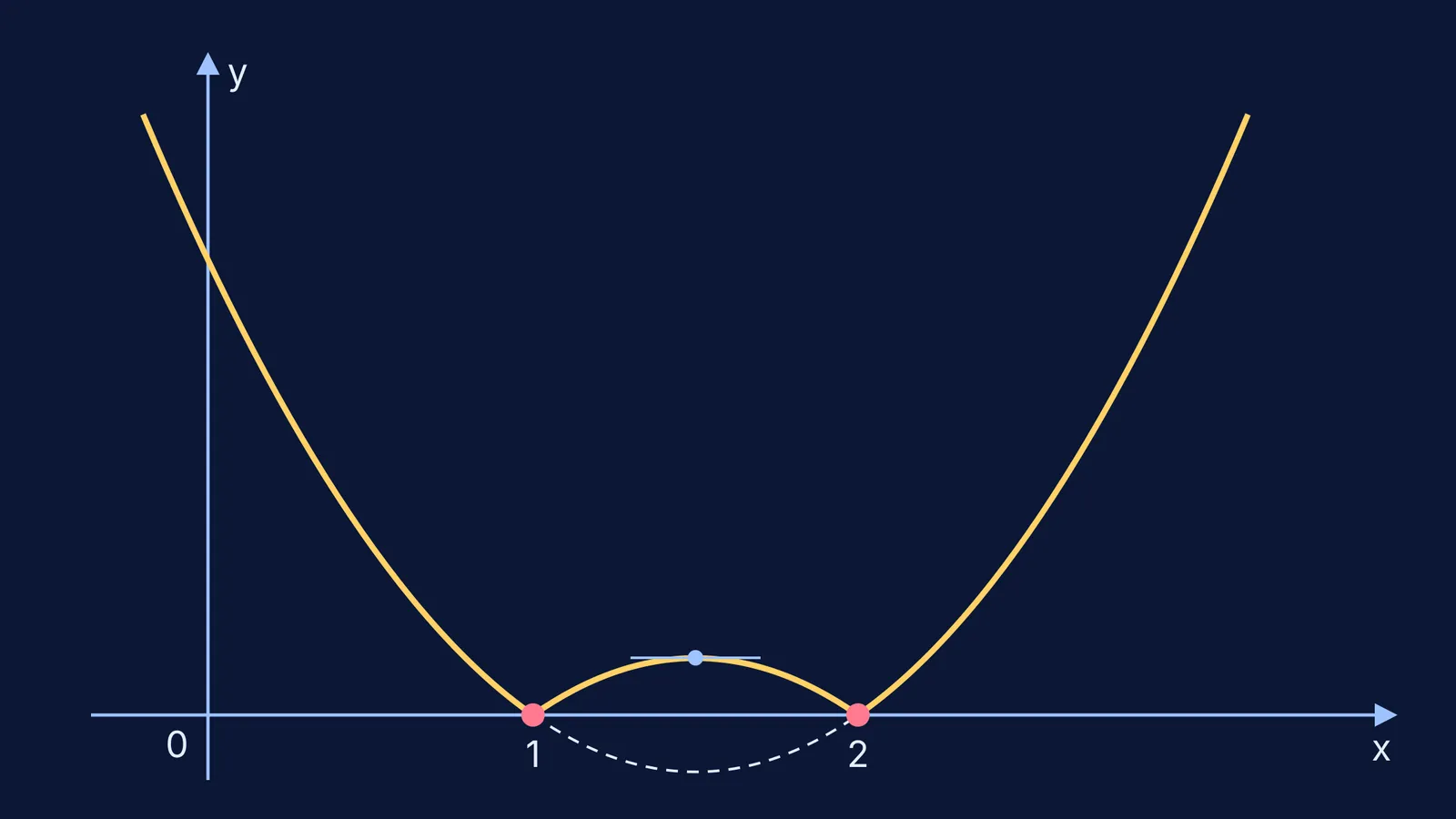
Q6. f(x) = |x² − 3x + 2|. Which are true?
(A) f is continuous on ℝ. True.
(B) f is not differentiable at exactly two points. True: x = 1 and x = 2.
(C) f′(1.5) = 0. True: on (1, 2), f′ = 3 − 2x.
(D) (x − 1)f(x) is not differentiable at 1. False: the factor (x − 1) flattens the corner, giving derivative 0.
Answer: A, B, C. D is the wrong tick.
Q7. (sin 2x + a sin x)/x³ has a finite limit L as x → 0. Which are true?
(A) a = −2. True: the x-term (2 + a)x must vanish.
(B) L = 1. False: the x³ terms give −4/3 + 1/3, so L = −1.
(C) L = −4/3. False: this drops the cubic term of a sin x.
(D) No other a gives a finite limit. True.
Answer: A, D.
Q8. f(x) = [x] sin(πx). Which are true?
(A) f is continuous at every integer. True: sin(πx) = 0 there, so both sides tend to f(n) = 0.
(B) f is differentiable at 0. False: the left derivative is −π, the right is 0.
(C) f is differentiable at x = 1/2. True.
(D) f is differentiable at no integer. True: the one-sided slopes at n, (n − 1)π(−1)ⁿ and nπ(−1)ⁿ, never match.
Answer: A, C, D. Students miss A, seeing [x] and assuming a jump.
What should you tick when you are unsure?
Mark each option T, F or ? before ticking anything.
Settle corners and jumps with one-sided limits or derivatives, not a sketch.
Tick every T. Never tick a ?.
With no sure T, leave the question blank.
For worked solutions, see the limits and continuity JEE Advanced practice questions, the JEE Advanced numerical answer questions on limits and our guide on how to prepare limits and differentiability for JEE Advanced. If one kind of option keeps fooling you, the Fermi Problem Library has a step-by-step solver that explains the reasoning. For the rest of your JEE Main and Advanced preparation, start at Fermi Test Prep.