

On this page
No options means a half-finished limit scores nothing.
How do numerical-answer questions work in JEE Advanced?
In the mathematics part of JEE (Advanced) 2026 Paper 1, Section 3 had four numerical-value questions. A correct value earned +4 and anything else 0, with no negative marking. Longer decimals are truncated or rounded to two places. One of the four added the points where a function is not continuous to those where it is not differentiable.
The JEE (Advanced) 2026 syllabus lists limits, continuity, L'Hospital's rule, continuity of composite functions, the intermediate value property and the derivative of a function.
Allow 35 minutes; commit to a number before reading each solution.
Our decimal answers are chosen so that truncating and rounding agree.
For option-based questions, use our JEE Advanced practice set on limits and continuity.
Easy for Advanced: can you finish a limit without options?
Q1. Find the limit as x → 0 of (e^(3x) − 1 − 3x)/x².
e^(3x) = 1 + 3x + 9x²/2 + …, so the numerator is about 9x²/2. Exact 9/2; enter 4.50. Check: L'Hospital's rule twice gives 9e⁰/2. Lost mark: replacing e^(3x) − 1 by 3x and entering 0.
Q2. Find the limit as x → 0 of (sec x)^(3/x²).
For this 1^∞ form, the logarithm is (3/x²) ln sec x, and ln sec x ≈ x²/2, so the logarithm tends to 3/2. Exact e^(3/2) ≈ 4.4817; enter 4.48. Check: at x = 0.1 the expression is about 4.483. Lost mark: treating 1^∞ as 1.
Medium: is the function continuous and differentiable?
Q3. f(x) = (1 − cos 4x)/x² for x < 0, f(0) = a, and f(x) = √x/(√(16 + √x) − 4) for x > 0. If f is continuous at 0, find a.
On the left, 1 − cos 4x = 2 sin²2x, so the limit is 2 × 4 = 8. On the right, put t = √x and rationalise: t(√(16 + t) + 4)/t → 8. Exact 8; enter 8. Check: both one-sided limits agree. Lost mark: writing 1 − cos 4x ≈ 16x² without the half, and entering 16.
Q4. f(x) = ax² + b for x ≤ 1 and f(x) = 1/|x| for x > 1. If f is differentiable at x = 1, find b.
The right-hand derivative of 1/x at 1 is −1, so 2a = −1 and a = −1/2. Continuity gives a + b = 1, so b = 3/2. Exact 1.5; enter 1.50. Check: both pieces give value 1 and slope −1 at x = 1. Lost mark: using only continuity, which leaves b undetermined.
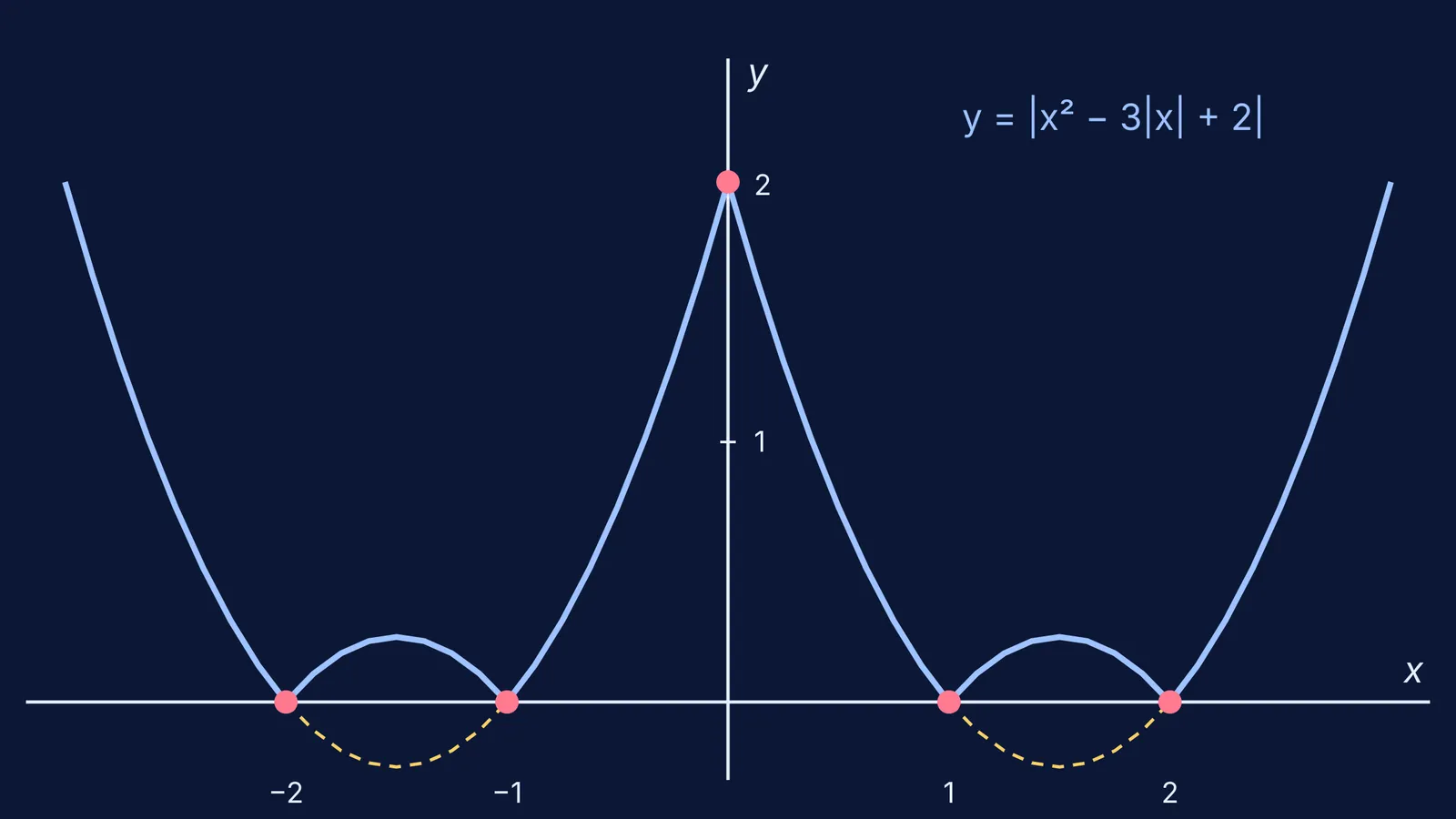
Q5. At how many real points is f(x) = |x² − 3|x| + 2| not differentiable?
g(x) = x² − 3|x| + 2 has simple zeros at ±1 and ±2, each a corner of f. At x = 0, g has slope +3 on the left and −3 on the right, and g(0) = 2, so f keeps that corner too. Exact 5; enter 5. Check: the graph at the top shows all five corners. Lost mark: forgetting x = 0 and entering 4.
Hard: what happens when two ideas meet?
Q6. On (0, 2), at how many points is g(x) = [x²] sin(πx) discontinuous, where [ ] is the greatest integer function?
[x²] jumps at x = 1, √2 and √3. At x = 1, sin(πx) = 0, so both sides tend to 0 = g(1). At √2 and √3 the sine is not zero, so the jump survives. Exact 2; enter 2. Check: sin(π√2) ≈ −0.96. Lost mark: counting every jump of [x²] and entering 3.
Q7. If the limit as x → 0 of (x(1 + a cos x) − b sin x)/x³ equals 1, find ab.
Expanding, the numerator is (1 + a − b)x + (b/6 − a/2)x³ + …. So b = 1 + a, and b/6 − a/2 = 1 gives a = −5/2, b = −3/2. Exact 15/4; enter 3.75. Check: −a/2 + b/6 = 1.25 − 0.25 = 1. Lost mark: matching only the x³ term.
Q8. f(x + y) = f(x) + f(y) + 2xy for all real x, y, and f′(0) = 3. Find f(2).
Putting x = y = 0 gives f(0) = 0. From first principles, f′(x) = lim [f(h) + 2xh]/h = f′(0) + 2x = 3 + 2x, so f(x) = x² + 3x. Exact 10; enter 10. Check: (x + y)² + 3(x + y) satisfies the equation. Lost mark: assuming f is linear and entering 6.
What should you do after this set?
Sort your misses: expansion slips (Q1, Q2, Q7) need the series written to one more term; one-sided slips (Q3, Q4, Q6) need both sides checked; counting slips (Q5) need a sketch. Warm up with our JEE Main numerical questions on limits, continuity and differentiability; for a revision order, see how to prepare limits and differentiability for JEE Advanced.
For method slips, the Fermi Problem Library has worked problems with a step-by-step solver that explains the reasoning rather than printing an answer. For JEE Main and Advanced preparation, see Fermi Test Prep.


