On this page
These are the key terms of Chapter 5, Life Processes, in the current NCERT Class 10 Science textbook (Reprint 2026-27), defined in our own words in chapter order. For notes, diagrams and practice questions, use our Life Processes Class 10 chapter guide.
The chapter is part of the CBSE 2026-27 Class X Science syllabus, which covers the basic ideas of nutrition, respiration, transport and excretion in plants and animals.
What are life processes?
Life processes: the maintenance jobs a body keeps doing, even during sleep, to stop its organised structure breaking down: nutrition, respiration, transport and excretion.
Nutrition: bringing a source of energy and building material (food) from outside into the body.
Respiration: breaking down food inside cells to release energy, usually with the help of oxygen. Don't confuse with: breathing, which only moves air in and out.
Excretion: removing harmful waste made by the body's own chemical reactions. Example: urea removed by the kidneys.
How do plants and animals get their food?
Autotroph: an organism that makes its own food from simple inorganic substances, carbon dioxide and water. Example: green plants, some bacteria.
Heterotroph: an organism that depends on complex food made by other organisms. Example: animals, fungi. Don't confuse with: autotroph.
Photosynthesis: using sunlight trapped by chlorophyll to turn carbon dioxide and water into carbohydrates, releasing oxygen.
Chlorophyll and chloroplast: chlorophyll is the green pigment that absorbs light; chloroplasts are the cell organelles that hold it.
Stomata: tiny pores on leaves through which gases are exchanged.
Guard cells: the pair of cells around each stoma. They open the pore when they swell with water and close it when they shrink.
Parasitic nutrition: feeding on a living plant or animal without killing it. Example: cuscuta (amar-bel), lice, tapeworms.
What happens to food in the human body?
Enzymes: biological catalysts that break complex food into small molecules the body can absorb. Example: salivary amylase turns starch into simple sugar.
Peristalsis: rhythmic contraction of the gut's muscular lining that pushes food along.
Pepsin and hydrochloric acid: gastric glands release both; the acid lets pepsin digest proteins, and mucus shields the lining.
Bile: a juice from the liver that makes the acidic food alkaline and breaks fat into small droplets. Don't confuse with: lipase, the pancreatic enzyme that actually digests the fat.
Trypsin: a pancreatic enzyme that digests proteins.
Villi: tiny finger-like projections on the small intestine's inner lining that increase the area for absorbing digested food.
Which enzyme works where: see our guide to digestive enzymes for Class 10.
What happens during respiration?
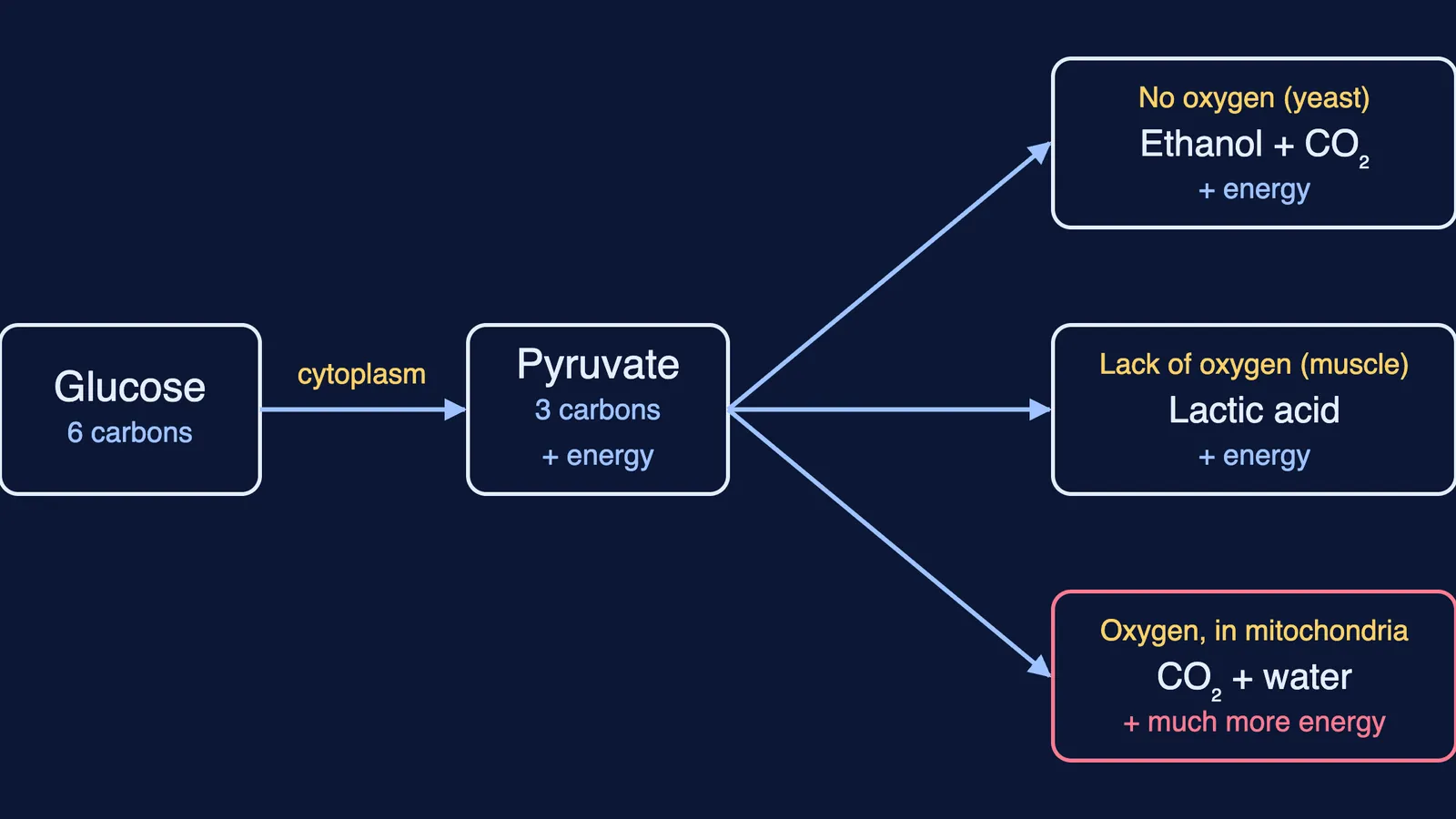
Pyruvate: the three-carbon molecule made when glucose (six carbons) is first broken down in the cytoplasm.
Aerobic respiration: breakdown of pyruvate using oxygen, in the mitochondria, into carbon dioxide and water. It releases far more energy than the anaerobic route.
Anaerobic respiration: breakdown without oxygen. Example: yeast makes ethanol and carbon dioxide during fermentation.
Lactic acid: a three-carbon product made in muscle cells short of oxygen; its build-up during sudden hard exercise causes cramps.
ATP: the cell's energy currency, made using the energy released in respiration and spent to drive other reactions.
Alveoli: tiny air sacs in the lungs, wrapped in blood vessels, where gases are exchanged.
Haemoglobin: the respiratory pigment in red blood corpuscles that picks up oxygen in the lungs and releases it in tissues short of oxygen.
How are materials transported in humans and plants?
Plasma: the liquid part of blood. Food, carbon dioxide and nitrogen wastes travel dissolved in it.
Atria and ventricles: the heart's upper receiving chambers and lower pumping chambers. Ventricles have thicker muscle walls because they push blood out to organs.
Double circulation: blood passes through the heart twice in each trip round the body. Example: birds and mammals. Don't confuse with: fishes, whose two-chambered heart sends blood through it once per trip.
Arteries, veins and capillaries: arteries carry blood away from the heart under high pressure, veins bring it back and have valves, and one-cell-thick capillaries let materials pass to and from cells.
Platelets: blood cells that help clot blood at a wound.
Lymph: a colourless fluid that leaks out of capillaries into tissue spaces; it carries absorbed fat and returns extra fluid to the blood.
Xylem: plant tissue that moves water and minerals up from the roots.
Phloem: plant tissue that moves food from leaves to other parts, up and down. Don't confuse with: xylem.
Transpiration: loss of water vapour from the aerial parts of a plant; it creates the pull that draws water up the xylem by day.
Translocation: moving food made in the leaves (and other substances) through the phloem to other parts of the plant. It happens in sieve tubes, helped by companion cells, and uses energy from ATP.
Compare them side by side in xylem and phloem in Class 10.
How do humans and plants remove waste?
Nephron: the tiny filtering unit of the kidney; each kidney has many.
Glomerulus and Bowman's capsule: the glomerulus is a nephron's cluster of thin-walled capillaries; Bowman's capsule is the cup that collects the filtrate.
Selective reabsorption: taking back useful substances (glucose, amino acids, salts and most of the water) from the filtrate as it flows along the tubule.
Ureter, urinary bladder and urethra: each ureter takes urine to the bladder, which stores it until it leaves by the urethra.
Haemodialysis: cleaning blood with an artificial kidney; wastes pass into a dialysing fluid. Don't confuse with: a real nephron, because dialysis involves no reabsorption.
Excretion in plants: waste stored in vacuoles, in falling leaves or as gums and resins in old xylem, or released into the soil.
How to learn these terms
Redraw the glucose pathway above from memory, with where each step happens.
Learn the chapter's pairs together: autotroph and heterotroph, bile and lipase, xylem and phloem, aerobic and anaerobic, nephron and dialysis.
Trace one meal from mouth to villi, naming each enzyme.
Compare alveoli and nephrons: both have thin walls and lie close to tiny blood vessels (capillaries).
If a term like ATP or transpiration still feels fuzzy, the Fermi Concept Library gives every biology concept its own lesson and its place in the map.