

On this page
Plants do not have a heart to pump fluids, yet a tall tree can move water hundreds of feet into the air. In Class 10 Science, understanding how plants manage this incredible feat comes down to two specialised tissues: the xylem and the phloem.
Together, these vascular tissues form the plant's internal transport system. They ensure that every cell receives the hydration and energy it needs to survive, but they operate using entirely different biological and physical principles.
How does water move up through the xylem?
The xylem handles the heavy lifting of hydration. The xylem is a network of hollow, tube-like structures that transports water and dissolved minerals from the soil to the rest of the plant (Wikipedia).
Because the main conducting cells in the xylem are dead at maturity, the tissue cannot actively pump water. Instead, it relies on a passive physical process called transpiration pull. During the day, water evaporates from the microscopic pores (stomata) on the surface of the leaves. This constant evaporation creates a negative pressure, or suction, which pulls the column of water up from the roots, much like drinking through a straw.
The volume of water moved this way is staggering. Between 97% and 99.5% of the water taken up by plant roots is lost through transpiration and guttation, leaving only a tiny fraction for actual growth and metabolism (Wikipedia). At night, when the stomata are closed and transpiration stops, a much weaker force called root pressure helps push water a short distance up the stem.
If you are struggling to picture how negative pressure lifts heavy columns of water against gravity, the Fermi Concept Library places transpiration pull on a map of all biology concepts, letting you trace exactly how it connects to osmosis, cohesion, and water potential.
What cells make up these vascular tissues?
To understand how these tissues function so differently, you have to look at their anatomy.
The xylem consists primarily of vessels and tracheids. As they mature, these cells die and lose their internal contents, leaving behind empty tubes. Their cell walls become thickened with a tough substance called lignin. This lignification is crucial because it gives the tubes the mechanical strength they need to withstand the intense negative pressure of transpiration pull without collapsing inward. Over time, this thick, lignified xylem tissue becomes what we recognise as wood.
The phloem is built very differently. It is made of living cells, primarily sieve-tube elements and companion cells. Sieve tubes are stacked end-to-end with porous connections called sieve plates, allowing sap to flow through. Because sieve tubes lose most of their organelles to clear a path for the sap, they rely entirely on the adjacent companion cells to manage their metabolic functions and provide energy.
How is food transported in plants?
While the leaves manufacture food through photosynthesis, the roots, flowers, and developing fruits need that food but cannot make it themselves. This is where the phloem steps in. The phloem transports soluble organic compounds, primarily sucrose, from the leaves to all other parts of the plant in a process called translocation (Wikipedia).
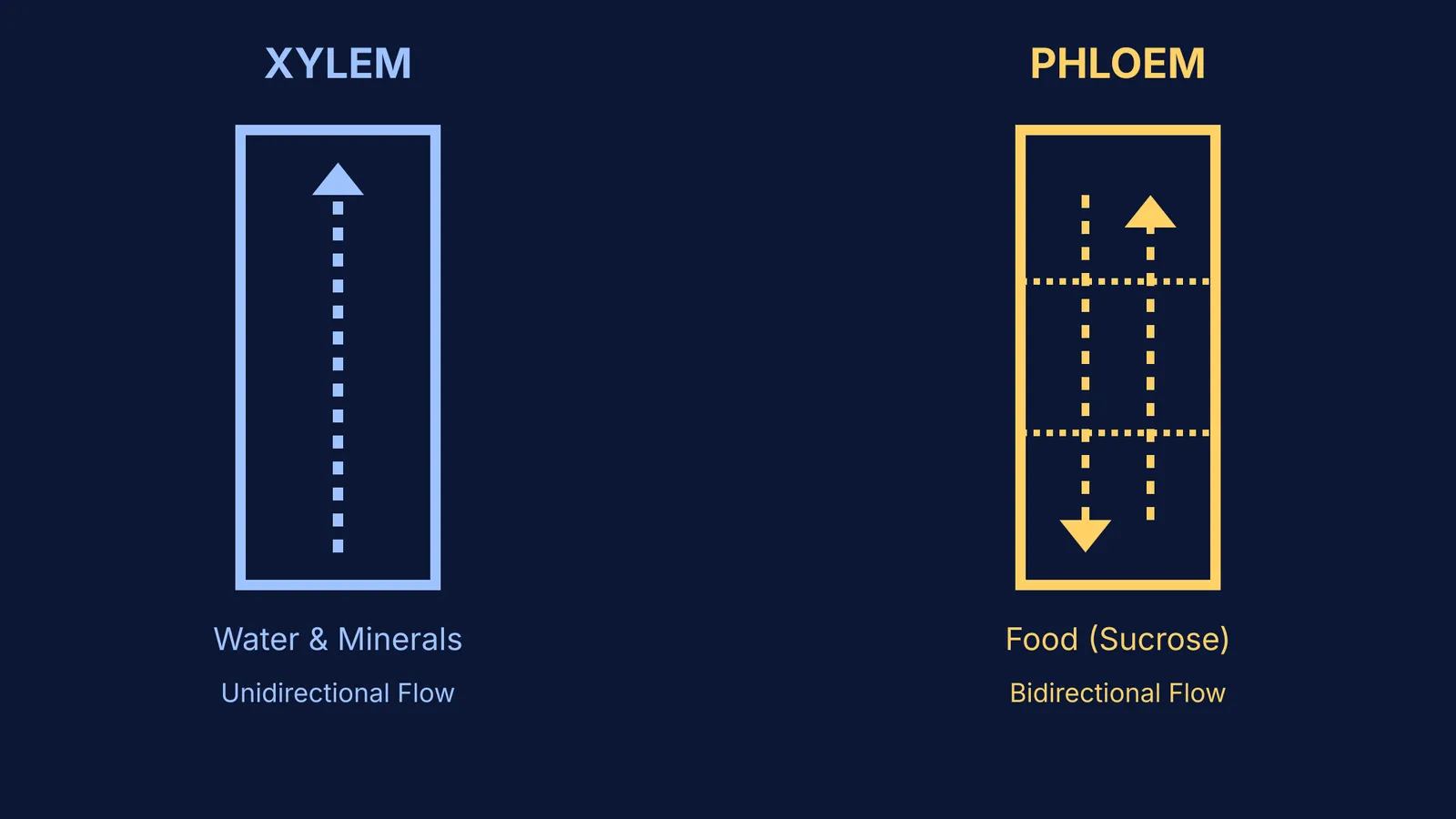
Unlike the one-way flow of water in the xylem, phloem transport is bidirectional. Food can travel downwards to feed growing roots or be stored as starch, and it can also travel upwards to supply developing buds or flowers.
Because sap must often move against concentration gradients, translocation is an active process. The plant spends its own energy, in the form of ATP, to actively pump sucrose into the phloem tissue at the "source" (usually the leaves). This high concentration of sugar draws water in from the neighbouring xylem via osmosis, creating a high positive hydrostatic pressure. This physical pressure then forces the sugary sap away from the leaves and towards the "sinks" (areas of lower pressure) where the food is needed.
Xylem vs phloem transport class 10 checklist
When facing a board exam question asking you to compare these two systems, use this framework to ensure you hit all the necessary marks:
Materials: Xylem transports water and minerals; phloem transports food (sucrose) and amino acids.
Direction: Xylem flow is strictly unidirectional (upwards from roots to leaves); phloem flow is bidirectional (both upwards and downwards depending on need).
Energy requirement: Xylem uses a passive mechanism (transpiration pull) without spending ATP; phloem uses an active mechanism, spending ATP to load sugars and create pressure.
Cell state: Xylem's main conducting cells are dead; phloem's conducting cells are living.
Understanding these transport systems builds a solid foundation for other core botany topics. Once you know how hormones travel alongside sugars in the phloem, you can better understand phototropism and geotropism in Class 10, as well as how growth is directed by apical, intercalary and lateral meristems. Similarly, knowing how water flows from the soil into the xylem is vital for understanding how toxins accumulate in plant tissues, a key step in biological magnification in Class 10.


