On this page
Eight original questions, easy to hard; each solution names the trap. Take g = 10 m/s², sin 37° = 0.6, cos 37° = 0.8.
What does JEE Advanced test in laws of motion?
The official JEE (Advanced) 2026 syllabus lists Newton's laws, inertial and uniformly accelerated frames of reference, and static and dynamic friction. For the theory, read our guide to preparing laws of motion and friction for JEE Advanced.
How should you attempt these questions?
Hide solutions; allow 4 to 8 minutes each.
In accelerating frames, add −ma.
Find the friction needed, then compare with μN.
In multiple-correct questions, judge every option on its own.
Formats: JEE Advanced question types.
Easy: pseudo-forces, angled pushes and pulleys
Q1 (easy, single correct). A 2 kg block rests without sliding on a rough 37° incline fixed in a truck, its lower edge facing the front. The truck accelerates forward at 2 m/s². Friction on the block acts up the incline and equals
(A) 8.8 N (B) 15.2 N (C) 12 N (D) 4.4 N
Answer: (A). The 4 N backward pseudo-force has a component up the slope: f = mg sin 37° − ma cos 37° = 12 − 3.2 = 8.8 N. Trap: (B) adds it; (C) ignores the truck.
Q2 (easy, one or more options correct). You push a 5 kg crate (μs = 0.5, μk = 0.4) at 37° below the horizontal. Which are true?
(A) With a 20 N push, friction is 16 N.
(B) The least push that starts it is 50 N.
(C) At 60° below the horizontal, no push can start it.
(D) Moving under a 50 N push, it accelerates at 4 m/s².
Answer: (A), (B). 16 N is below the 31 N limit. At the limit, 0.8F = 0.5(50 + 0.6F): F = 50 N. Pushing fails only if tan θ > 2; at 60°, about 373 N works. Moving, a = (40 − 0.4 × 80)/5 = 1.6 m/s². Trap: (D) keeps N = mg.
Q3 (easy, numerical value). Block A (1 kg) lies on a table, μ = 0.5. Its string passes over a fixed edge pulley, under a movable pulley carrying block B (6 kg), and up to a hook. Released, B accelerates at ____ m/s².
Answer: 5. a_B = a_A/2; T − 5 = a_A and 60 − 2T = 3a_A give a_A = 10, a_B = 5 m/s². Trap: 6.25 gives both blocks one acceleration.
Medium: accelerated frames and wedges
Q4 (medium, single correct). A box slides down a 37° incline, μk = 0.5, with a 0.5 kg bob hanging steady from its roof. The string tension is
(A) 2√5 N (B) 4 N (C) 5 N (D) √26 N
Answer: (A). The box accelerates at g(0.6 − 0.5 × 0.8) = 2 m/s². In its frame the bob feels g − a: parts 1.6 and 8.8 m/s², size √80. T = 0.5√80 = 2√5 N. Trap: (B) is mg cos θ, right only without friction; (D) is 0.5√(g² + a²).
Q5 (medium, list match). A 2 kg block has μs = 0.8, μk = 0.5 everywhere. Match each case with its friction.
List-I: (P) level floor, 14 N horizontal push; (Q) 37° incline, 20 N push up the slope; (R) pressed on a wall by 30 N horizontally; (S) truck floor, truck accelerating at 9 m/s²
List-II: (1) 8 N, (2) 10 N, (3) 14 N, (4) 16 N, (5) 20 N
(A) P→3, Q→1, R→5, S→2
(B) P→3, Q→1, R→5, S→4
(C) P→3, Q→3, R→5, S→2
(D) P→4, Q→1, R→5, S→2
Answer: (A). P: 14 N, under the 16 N limit. Q: 8 N, under 12.8 N. R: it holds the 20 N weight (limit 24 N). S: 18 N is needed, only 16 N exists, so it slides: μk mg = 10 N. Trap: (B) skips the slip check; (D) uses the limit for P.
Q6 (medium, numerical value). A 2 kg block slides down the smooth 45° face of a free 4 kg wedge on a smooth floor. The wedge's acceleration is ____ m/s².
Answer: 2. A = mg sin θ cos θ / (M + m sin² θ) = 10/5 = 2 m/s². Trap: 2.5 treats the wedge as fixed.
Hard: where does friction give way?
Q7 (hard, one or more options correct). A horizontal force F pushes a 3 kg block on a 45° incline, μs = 0.5. Which are true?
(A) The least F that stops it sliding down is 10 N.
(B) The greatest F before it slides up is 45 N.
(C) At F = 30 N, friction is zero.
(D) If μs were 1, no horizontal push could slide it up.
Answer: (A), (C), (D). N = (mg + F)/√2; along the slope, times √2: down-limit F + 0.5(30 + F) = 30, so F = 10 N. Up-limit: F = 30 + 0.5(30 + F), so F = 90 N. At 30 N, F balances gravity along the slope. With μ = 1, friction grows as fast as drive. Trap: (B) leaves F out of N.
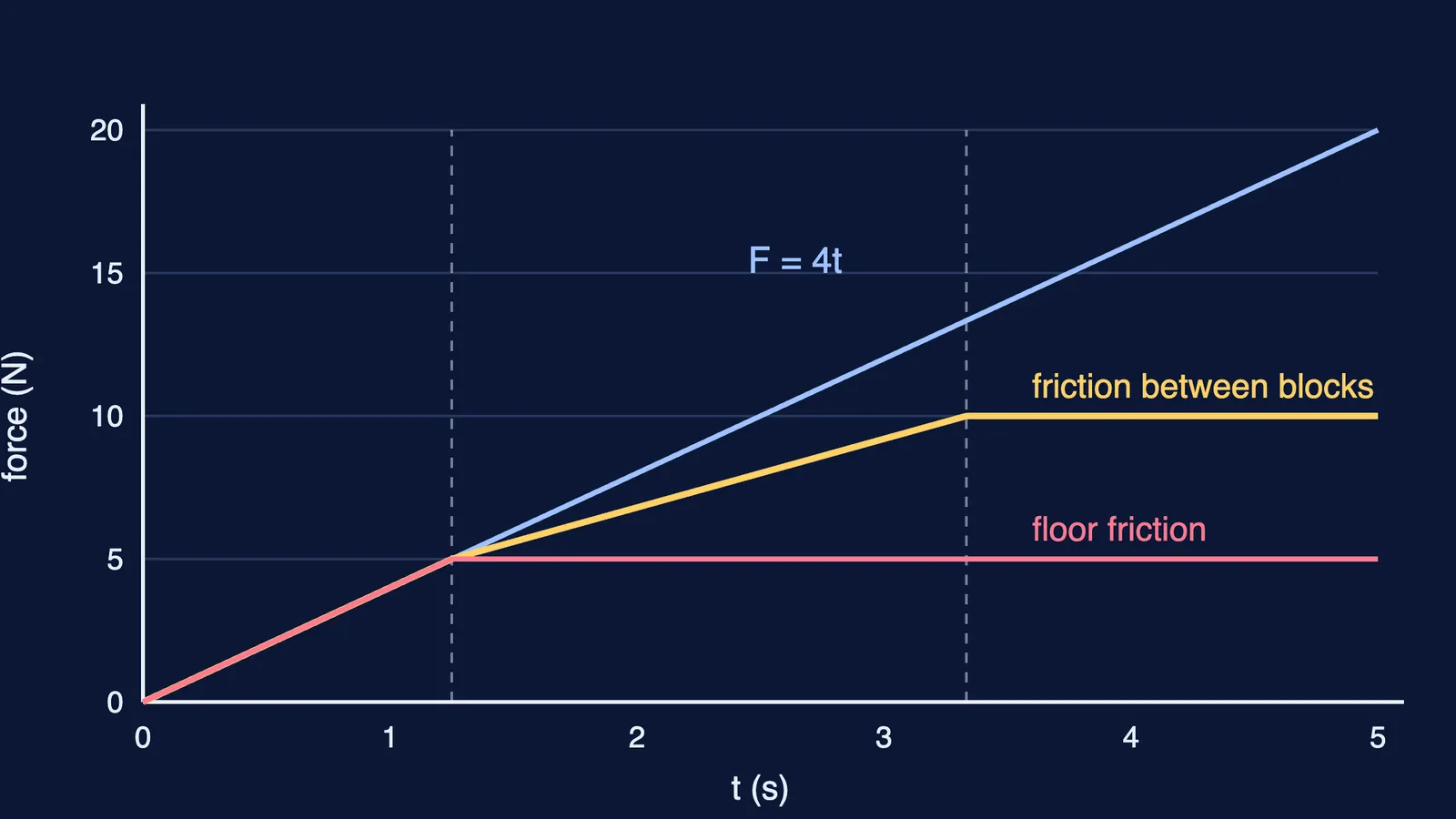
Q8 (hard, one or more options correct). A 2 kg block sits on a 3 kg plank; μ = 0.5 between them, 0.1 at the floor. F = 4t N (t in s) pulls the block. Which are true?
(A) Nothing moves until t = 1.25 s.
(B) The block slips on the plank from t = 2.5 s.
(C) After slipping starts, the plank's acceleration stays 5/3 m/s².
(D) At t = 2 s, friction between them is 8 N.
Answer: (A), (C). The floor holds at most 5 N. Then a = (4t − 5)/5, and the plank needs 5 + 3a from the block, hitting the 10 N limit at t = 10/3 s. Afterwards the plank gets 5 N net: 5/3 m/s². At t = 2 s friction is 6.8 N. Trap: (B) sets F = 10 N, forgetting the plank.
How did you score?
Score 6+? Try timed mixed mechanics. Fewer? Revise pseudo-forces and limiting friction; redo misses in three days.
If one wrong step keeps returning, the Fermi Problem Library has worked problems with a step-by-step solver that explains the reasoning rather than printing an answer. More on static and kinetic friction against applied force.