On this page
Eight new JEE Advanced-style kinematics questions, easy to hard, in four formats: single-correct, one or more options correct, numerical-value and list-match.
The official JEE (Advanced) 2026 syllabus lists kinematics in one and two dimensions (Cartesian coordinates only), projectiles, uniform circular motion and relative velocity. Every question stays inside it.
How should you use this practice set?
Allow 30 minutes and hide the solutions.
In "one or more options correct" questions, judge each option on its own. See JEE Advanced question types.
Take g = 10 m/s² and ignore air resistance.
Shaky on a topic? Read our guide on how to prepare kinematics for JEE Advanced first.
Easy: can you go beyond the constant-acceleration formulas?
Q1 (easy, single-correct). A particle starts at 16 m/s with acceleration a = −2√v (SI units) until it stops. How far does it travel?
(A) 16 m (B) 21.3 m (C) 32 m (D) 64 m
Answer: (B). With a = v dv/dx, dx = −½√v dv. Integrating from 16 to 0 gives (1/3)(16)^(3/2) = 64/3 ≈ 21.3 m. Trap: (A) treats the initial 8 m/s² as constant.
Q2 (easy, numerical-value). From one point, at one instant, ball P is thrown straight up at 20 m/s and ball Q horizontally at 15 m/s. How far apart, in metres, are they after 2 s?
Answer: 50. Gravity cancels, so the relative velocity stays √(15² + 20²) = 25 m/s. Gap = 25 × 2 = 50 m.
Q3 (easy, one or more options correct). A particle moves with x = 2t³ − 15t² + 36t (metres, seconds). Which are correct?
(A) It is momentarily at rest at t = 2 s and t = 3 s. (B) It covers 34 m from t = 0 to t = 4 s. (C) Its average velocity from t = 0 to t = 4 s is 8.5 m/s. (D) It slows down throughout 2 s < t < 3 s.
Answer: (A), (B). v = 6(t − 2)(t − 3). Positions at t = 0, 2, 3, 4 s are 0, 28, 27, 32 m: distance 34 m, displacement 32 m, so average velocity is 8 m/s (8.5 m/s is average speed). a = 12t − 30 has the same sign as v from t = 2 s to 2.5 s, so it speeds up first. Trap: (D).
Medium: can you use symmetry and the right frame?
Q4 (medium, one or more options correct). A projectile from level ground is at the same height h at t = 1 s and t = 3 s, at points 40 m apart horizontally. Which are correct?
(A) h = 15 m (B) Launch speed is 20√2 m/s. (C) Maximum height is 40 m. (D) Horizontal range is 80 m.
Answer: (A), (B), (D). The top is at t = 2 s, so u_y = 20 m/s and h = 20 − 5 = 15 m. u_x = 40/2 = 20 m/s, so speed is 20√2 m/s. Range = 2u_x u_y/g = 80 m; H = u_y²/2g = 20 m. Trap: (C) uses the full speed in u²/2g.
Q5 (medium, numerical-value). A balloon rises from rest on the ground at 2.5 m/s². At t = 4 s a packet is let go; the balloon keeps accelerating. How far apart, in metres, are they when the packet reaches its highest point?
Answer: 6.25. At release both move up at 10 m/s. In the balloon's frame the packet starts at rest with relative acceleration 12.5 m/s² downward. It peaks 1 s later, so the gap is ½ × 12.5 × 1² = 6.25 m. Trap: 5 m forgets the balloon's acceleration.
Q6 (medium, single-correct). A ball is thrown from the ground at 25 m/s, at angle θ with sin θ = 0.6, towards a smooth wall 30 m away. It rebounds elastically. Where does it land?
(A) At the thrower's feet (B) 15 m from the wall (C) At the foot of the wall (D) 60 m behind the thrower
Answer: (A). u_x = 20 m/s, so it hits the wall at 1.5 s, exactly at its peak (u_y = 15 m/s). The rebound mirrors the path back to the start. Trap: (C) assumes a ball hitting at its peak drops straight down.
Hard: can you handle list-match and colliding projectiles?
Q7 (hard, list-match). A particle moves with x = 3t and y = 4t − t² (metres, seconds). Match List-I with List-II.
List-I: (P) speed at t = 2 s, in m/s; (Q) x when y returns to zero, in m; (R) magnitude of average velocity from 0 to 2 s, in m/s; (S) first time, in s, when the velocity makes 45° with the x-axis.
List-II: (1) 0.5 (2) 3 (3) 3.6 (4) 6 (5) 12
(A) P→2, Q→5, R→3, S→1 (B) P→2, Q→4, R→3, S→1 (C) P→2, Q→5, R→2, S→1 (D) P→3, Q→4, R→2, S→1
Answer: (A). v = (3, 4 − 2t), so at t = 2 s the speed is 3 m/s. y = 0 again at t = 4 s, x = 12 m. Displacement over 2 s is (6, 4): √52/2 ≈ 3.6 m/s. 4 − 2t = 3 gives t = 0.5 s. Trap: (B) takes x at the top (6 m).
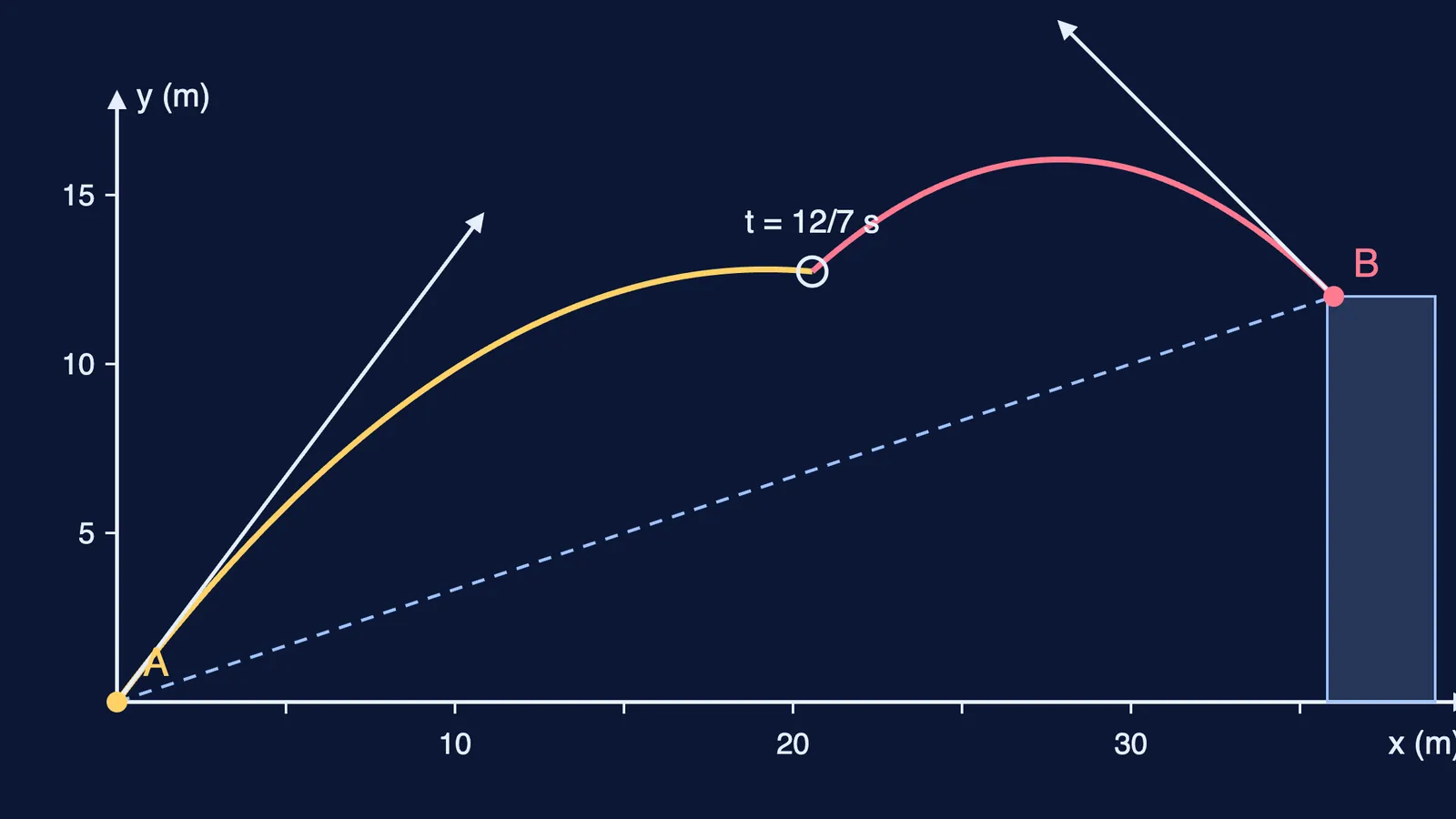
Q8 (hard, one or more options correct). Stone A is thrown from the origin at (12, 16) m/s. At the same instant stone B is thrown from a ledge at (36 m, 12 m) at (−9, 9) m/s. Which are correct?
(A) They collide at t = 12/7 s. (B) They collide about 12.7 m above the ground. (C) Seen from A, B moves along a parabola. (D) A is still rising when they collide.
Answer: (A), (B). In A's frame gravity cancels: B moves straight at (−21, −7), pointing back along (36, 12). They meet after 36/21 = 12/7 ≈ 1.71 s, when A is at 16(12/7) − 5(12/7)² ≈ 12.7 m. A peaked at 1.6 s. Trap: (D).
What should you do after checking your answers?
Sort misses into wrong frame, wrong formula or arithmetic. If projectiles caused most, our Motion in a Plane guide for Class 11 rebuilds components.
For more practice, the Fermi Problem Library has worked problems with a step-by-step solver that explains the reasoning rather than printing an answer.
Redo the set in a week, timed.