On this page
Journey Inside the Atom is Chapter 8 of Exploration, the new NCERT Class 9 Science textbook (First Edition 2026). The CBSE Class IX Science curriculum for 2026-27 covers the same ideas. Here are 30 key terms in five groups. For a study plan, read our Journey Inside the Atom Class 9 chapter guide.
Not defined here: the quantum mechanical model ("electron clouds"), which the chapter only names and leaves for higher grades.
Where did the idea of the atom come from?
From section 8.1 of the NCERT chapter.
Parmanu: Acharya Kanada's name for the smallest bit of matter you reach by dividing it again and again, too small to sense.
Atomos: Greek for "indivisible", used by Leucippus and Democritus.
Dalton's atomic theory: John Dalton's 1808 proposal, based on experiments, that all matter is made of atoms that cannot be broken down.
Radioactivity: some elements giving out invisible energy and particles by themselves, the first sign that atoms have parts.
How did atomic models change from Thomson to Bohr?
From section 8.2 of the NCERT chapter.
Cathode rays: streams of particles moving from the cathode (negative electrode) to the anode (positive electrode) through gas at very low pressure under high voltage. J. J. Thomson studied them in 1897.
Electron: the negative particle in cathode rays, far lighter than an atom and found in every element; its charge is written as −1.
Thomson's model (plum pudding model): positive charge spread evenly through a ball, with electrons dotted inside. Example: seeds in a watermelon's red pulp.
Alpha (α) particle: a small positive particle given out by some radioactive elements; a helium nucleus with 2 protons and 2 neutrons.
Gold foil (α-ray scattering) experiment: Geiger and Marsden's 1911 test, under Rutherford, firing alpha particles at very thin gold foil. Most passed straight through, some were sharply deflected (scattered), a few bounced back.
Nucleus: the tiny, dense centre holding all of an atom's positive charge and most of its mass: about 10⁻¹⁵ m across, against 10⁻¹⁰ m for the atom.
Rutherford's model (planetary model): electrons revolving around a central nucleus like planets around the Sun, with mostly empty space.
Stability problem: Rutherford's flaw: a circling electron should lose energy and spiral into the nucleus, yet atoms do not collapse.
Bohr's model: Niels Bohr's 1913 fix: electrons move only in fixed circular paths, where they lose no energy.
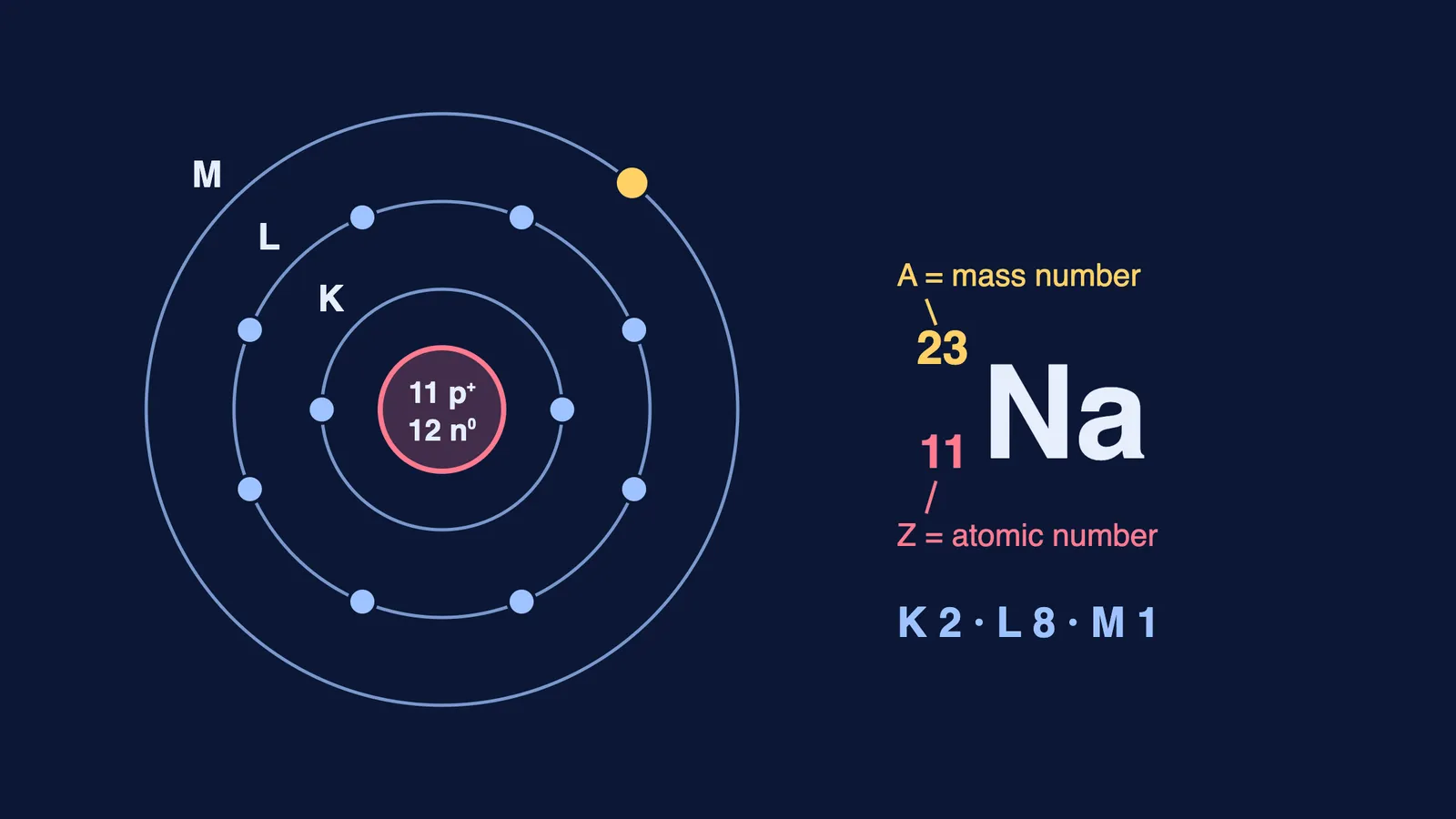
Shells (orbits, stationary states, energy levels): Bohr's allowed paths, named K, L, M, N or n = 1, 2, 3, 4. K is nearest the nucleus and lowest in energy. Changing shell takes in or gives out exactly the energy difference. Electrons are never between shells.
What is inside the nucleus?
From sections 8.3 to 8.6 of the NCERT chapter.
Proton (p⁺): a positive particle in the nucleus, much heavier than an electron, with charge +1. A neutral atom has as many protons as electrons.
Neutron (n⁰): an uncharged particle with nearly a proton's mass, found by James Chadwick in 1932. It explains why helium (2 protons) weighs about four times as much as hydrogen.
Nucleons: protons and neutrons together. Don't confuse with: nucleus, the place that holds them.
Atomic number (Z): the number of protons in the nucleus; it decides the element.
Mass number (A): protons plus neutrons. Example: chlorine with 17 protons and 20 neutrons has A = 37. Don't confuse with: atomic number, which counts protons only.
Atomic notation: the symbol with A at top left and Z at bottom left, as in ²³₁₁Na. Neutrons = A − Z, so 12 here.
Chemical symbol: an IUPAC-approved one- or two-letter name; capital first letter, small second letter, so Co is cobalt. Some come from Latin, such as Na (natrium) for sodium.
How are electrons arranged in shells?
For the first 18 elements, from sections 8.7 and 8.8 of the NCERT chapter.
Bohr-Bury rules: shell n holds at most 2n² electrons (K 2, L 8, M 18), the outermost shell at most 8, and shells fill in order K, L, M.
Electronic configuration: how an atom's electrons are shared among its shells. Example: aluminium (Z = 13) is 2, 8, 3.
Valence electrons: electrons in the outermost occupied (valence) shell. Example: sulfur (2, 8, 6) has 6.
Octet: 8 electrons in the outermost shell (2 for helium). Atoms with a full outer shell, such as neon (2, 8), are largely unreactive.
Valency (combining capacity): the number of electrons an atom loses, gains or shares to complete its octet. Example: magnesium (2, 8, 2) loses 2, valency 2; chlorine (2, 8, 7) gains 1, valency 1; carbon (2, 4) shares 4. Don't confuse with: valence electrons; chlorine has 7.
What are isotopes and isobars?
From section 8.9 of the NCERT chapter.
Isotopes: atoms of one element that share an atomic number but differ in mass number, because their neutron counts differ. Example: protium, deuterium and tritium, hydrogen with 0, 1 and 2 neutrons. Chemical properties are similar; melting points differ.
Unified atomic mass unit (u): the unit for atomic masses, since grams and kilograms are far too large; earlier written amu.
Average atomic mass: the average mass of an element's atoms, weighted by how common each isotope is in nature. Example: chlorine is about 75% chlorine-35 and 25% chlorine-37, so 35 × 0.75 + 37 × 0.25 = 35.5 u. Don't confuse with: the simple average, (35 + 37) ÷ 2 = 36 u.
Isobars: atoms of different elements that share a mass number while their atomic numbers differ. Example: argon (Z = 18), potassium (19) and calcium (20) each have atoms with A = 40. Don't confuse with: isotopes, where Z stays and A changes.
How to learn these terms
Learn the models as a timeline, Dalton to Bohr, naming the result that forced each change.
Learn the pairs together: atomic and mass number, isotopes and isobars, valence electrons and valency.
Draw shells for the first 18 elements from memory; check against Table 8.4.
Later, our Class 11 Chemistry guide to Structure of Atom builds on these terms.
If energy levels still feel abstract, the Fermi Concept Library gives every chemistry and physics concept its own lesson and its place in the map.