On this page
The 2026-27 session brings a new NCERT science book for Class 9, *Exploration* (first edition, April 2026). Its Chapter 8, Journey Inside the Atom, covers much of what the old book's Structure of the Atom chapter did, with more history and new in-text questions.
What does Journey Inside the Atom cover?
The chapter runs from page 140 to page 161 of NCERT Exploration, Chapter 8, just before Chapter 9, Atomic Foundations of Matter (contents page). It opens with Acharya Kanada's parmanus and the Greek atomos, walks through four atomic models, then covers the neutron, symbols, atomic and mass number, shells for the first 18 elements, valency, isotopes and isobars.
In the CBSE 2026-27 Class IX science curriculum, Chapters 5, 8 and 9 together make up Unit II, Matter: Its Nature and Behaviour, worth 25 of the 80 theory marks.
How did atomic models change from Dalton to Bohr?
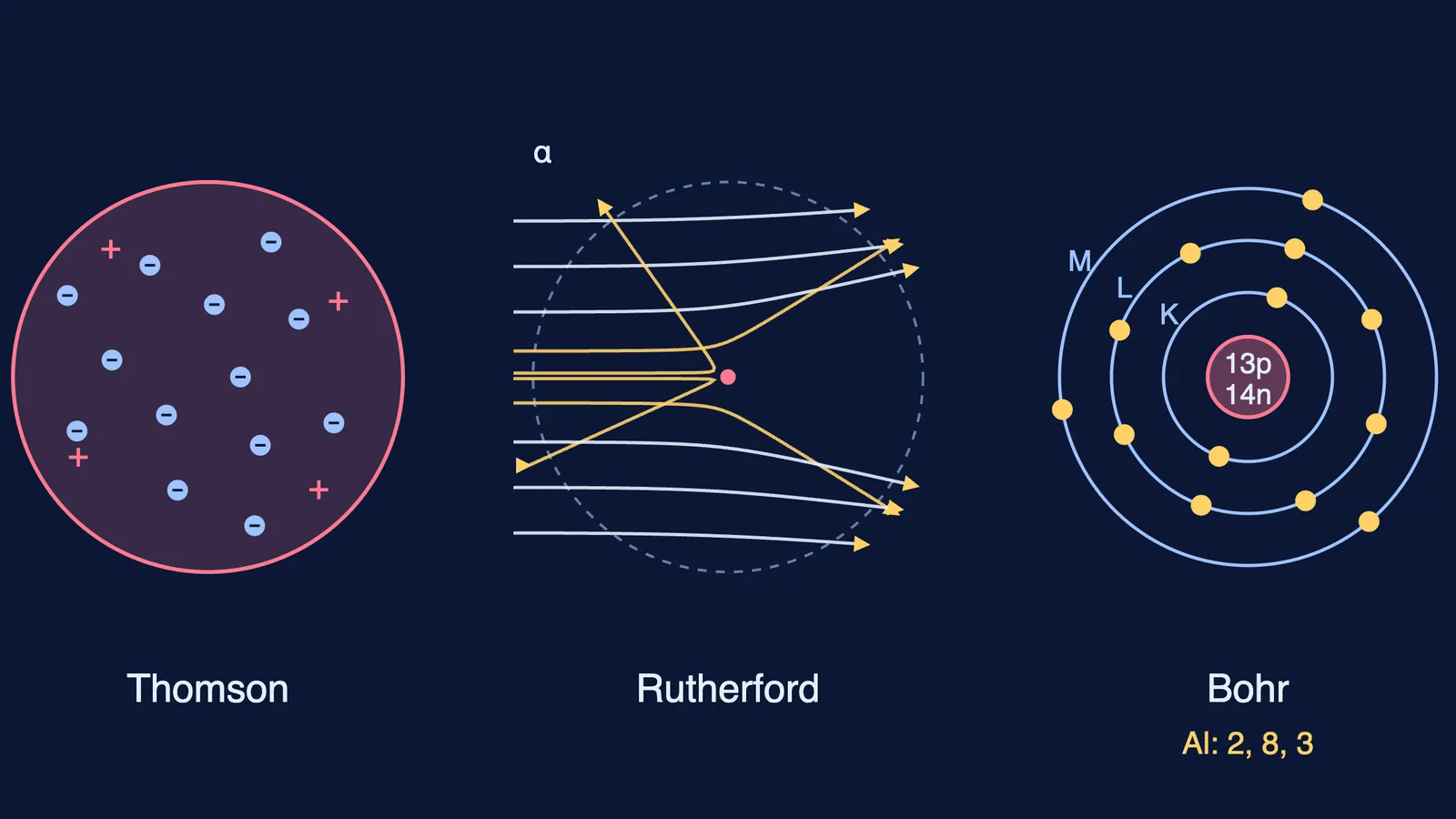
Learn the models as a chain, each fixing a problem in the last (section 8.2 of the chapter; dates checked against the original papers).
Dalton (1808): matter is made of indivisible atoms.
Thomson: his 1897 paper on cathode rays showed the rays are negatively charged particles, far lighter than atoms, later named electrons. His plum pudding model: electrons spread through a sphere of positive charge.
Rutherford (1911): Hans Geiger and Ernest Marsden (Rutherford's team) fired alpha particles at thin metal foils, gold among them, and in 1909 they reported some bouncing back by more than 90°. Rutherford's 1911 paper explained this with a tiny, dense central charge, the nucleus, surrounded by mostly empty space.
Bohr (1913): in his 1913 paper, Bohr allowed electrons only in fixed orbits, or stationary states, where they do not lose energy. The chapter names these shells K, L, M, N.
Chadwick (1932): his report of the neutron supplied the neutral particle explaining why helium has about four times the mass of hydrogen with only twice the protons.
What your textbook says: the chapter dates the gold foil experiment to 1911. Geiger and Marsden first published the bounce-back result in 1909; 1911 is when Rutherford explained it. In a CBSE answer, follow the textbook's 1911.
Expect a question on why Rutherford's model fails: an electron moving in a circle is accelerating, so it should lose energy and spiral into the nucleus. Bohr's stationary states answer that, which the chapter calls a postulate.
That scale is also why you cannot see an atom, even with a light microscope.
If the models are hard to picture, the Fermi Simulation Lab has interactive simulations for the ideas that are easier to see than to read.
How do you find protons, neutrons and electrons from Z and A?
Sections 8.5 to 8.9 of the chapter boil down to three facts:
Atomic number Z = number of protons = number of electrons in a neutral atom.
Mass number A = protons + neutrons (the nucleons).
Shells fill in the order K, L, M; a shell holds at most 2n² electrons (2, 8, 18), and the outermost shell holds at most 8: the Bohr-Bury rules for filling shells.
Worked example 1: aluminium-27 (Z = 13). Protons 13, electrons 13, neutrons 27 − 13 = 14. Configuration: 2, 8, 3. Aluminium loses its 3 valence electrons, so its valency is 3.
Worked example 2: carbon-13 (Z = 6). Protons 6, electrons 6, neutrons 13 − 6 = 7. Configuration 2, 4, as in carbon-12, so valency is still 4. Carbon-12 and carbon-13 are isotopes: same Z, different A, similar chemical properties (why isotopes behave alike).
Isobars are the reverse: argon, potassium and calcium all have mass number 40, but their atomic numbers are 18, 19 and 20.
Which mistakes cost marks in this chapter?
Putting 18 electrons in an outermost M shell. 2n² sets the shell's limit, but the outermost shell stops at 8, which is why potassium (Z = 19) is 2, 8, 8, 1.
Confusing mass number (a whole-number count of nucleons) with average atomic mass, such as 35.5 u for chlorine.
Swapping isotopes (same element, same Z) and isobars (same A, different elements).
Wrong credits: Thomson found the electron, Rutherford proposed the nucleus and named the proton, Chadwick found the neutron, and Geiger and Marsden ran the gold foil experiment.
How should you prepare for CBSE 2026-27 questions?
The CBSE 2026-27 question paper design gives 50% of theory marks to knowledge and understanding, 30% to application and 20% to formulating, analysing, evaluating and creating, with assertion-reason and case-based questions among the question types. A five-day plan:
Day 1: draw the three models from memory, noting what each fixed.
Day 2: write configurations for all 18 elements, check them against Table 8.4, then add each valency yourself.
Day 3: swap Z-and-A puzzles with a friend.
Day 4: write assertion-reason pairs on the models and judge each.
Day 5: isotopes, isobars and average atomic mass, then a timed set.
If a calculation keeps going wrong, the Fermi Problem Library has worked problems with a step-by-step solver that explains the reasoning rather than printing an answer.