

On this page
The problem is not your eyes. It is light itself, which is why no ordinary light microscope, however expensive, will show you a single atom.
Why can't we see an atom with naked eyes?
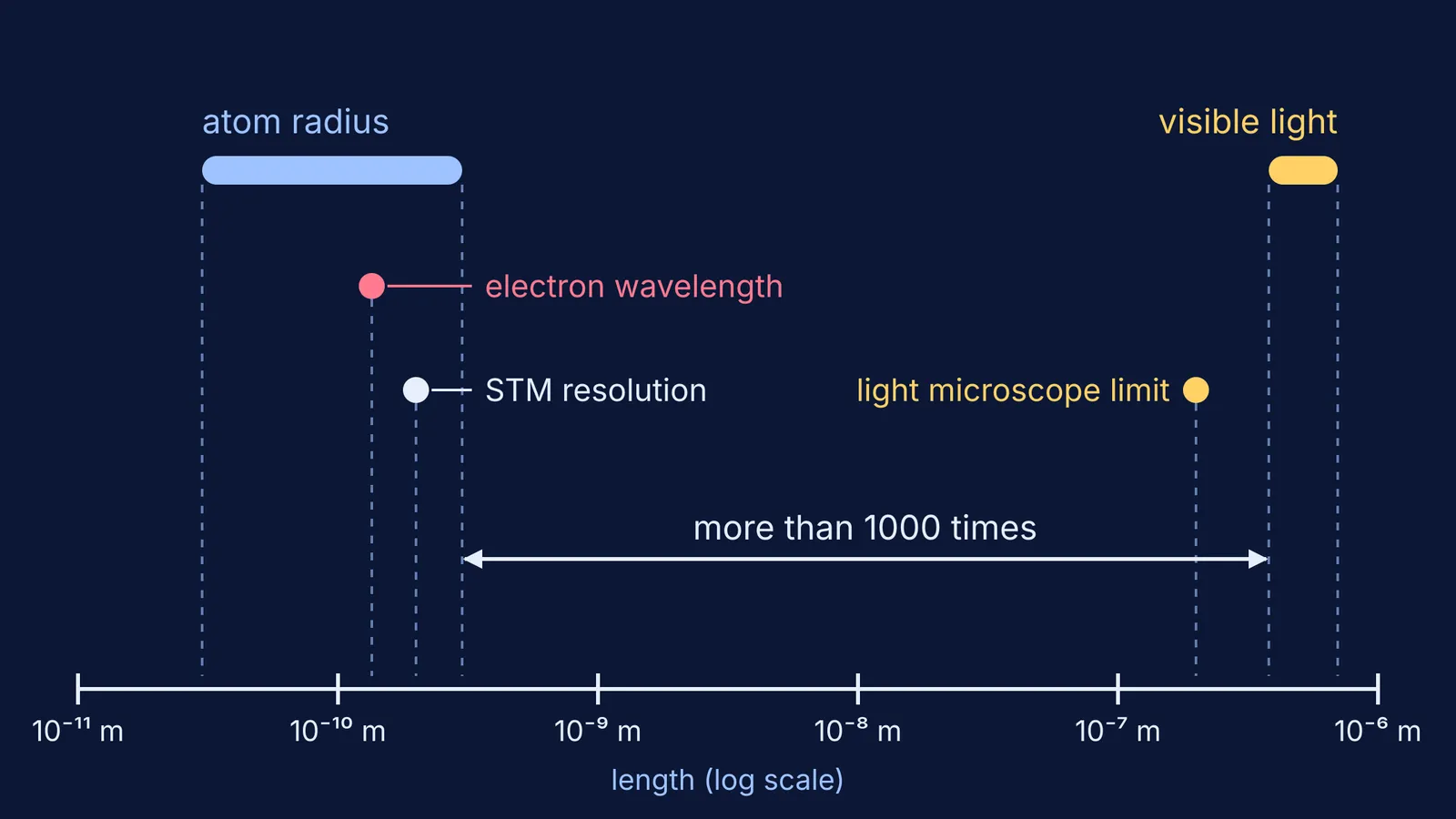
Start with size. Under most definitions, the radii of isolated neutral atoms range between 30 and 300 picometres, or 0.3 to 3 ångströms (Wikipedia, Atomic radius). One picometre is 10^-12 m, so a typical atomic radius is around 10^-10 m.
Now light. The human eye typically detects wavelengths from 380 to 700 nanometres (NASA, Visible Light). The same Wikipedia article puts an atom's radius at less than a thousandth of the wavelength of visible light.
That mismatch defeats an ordinary light microscope. At the end of the 19th century Ernst Abbe set the resolution limit of an optical microscope at roughly half the wavelength of light, about 0.2 micrometres (Nobel Prize in Chemistry 2014, popular information). Resolution is the smallest distance at which two details still look like two, not one blur. The 2014 laureates bypassed this limit using fluorescent molecules, not a better lens.
How much smaller is an atom than a light wave?
A worked example, with numbers from Wikipedia, NASA and the Nobel Prize summary:
Pick an atom with radius 100 pm = 1 × 10^-10 m. Its diameter is 0.2 nm.
Pick green light at 550 nm, inside the visible range.
Compare: 550 nm ÷ 0.1 nm = 5,500. The wavelength is about 5,500 times the atom's radius.
Compare with the microscope limit: 200 nm ÷ 0.2 nm = 1,000. The smallest detail a light microscope can separate is about a thousand such atoms laid side by side.
For the formula behind the limit, see the resolving power of a microscope and telescope.
How does an electron microscope see atoms?
Swap light for electrons. In 1924 Louis de Broglie proposed that a moving particle has a wavelength λ = h/p, where p is its momentum (NCERT Class 12 Physics, Chapter 11). NCERT's Example 11.3 works it out for an electron moving at 5.4 × 10^6 m/s: λ = 0.135 nm, comparable to X-ray wavelengths. That is roughly 4,000 times shorter than 550 nm green light (NASA), and close to the size of an atom.
Ernst Ruska built the first electron microscope with performance clearly superior to the light microscope in 1933, and received half of the 1986 Nobel Prize in Physics (Nobel Prize press release, 1986). The same release puts a conventional light microscope's resolution at some 4,000 Å and says electron microscopes have reached resolutions down to about 1 Å in practice. More on this in why an electron microscope has better resolution.
How does a scanning tunnelling microscope see atoms?
The other half of the 1986 prize went jointly to Gerd Binnig and Heinrich Rohrer, of the IBM Research Laboratories in Zürich, for the scanning tunnelling microscope (STM). The Royal Swedish Academy of Sciences noted that it is not a true microscope, because it does not form a direct image; it senses a surface the way fingers read braille (1986 press release).
As the press release describes it:
A sharp stylus, its tip formed of one single atom, is held about 10^-7 cm from the surface, roughly two atom diameters.
A voltage between tip and surface makes a current flow even though they do not touch. This is quantum tunnelling.
The current depends strongly on distance, so the tip is moved up and down to keep the gap constant as it scans.
Recording that vertical motion maps the surface atom by atom, with horizontal resolution of about 2 Å and vertical resolution of about 0.1 Å.
In April 1990, D. M. Eigler and E. K. Schweizer of IBM reported in Nature that they had used an STM at 4 K to position individual xenon atoms on a nickel surface (IBM Research).
How do you write this as an exam answer?
Give a number, a reason and a fix, with figures from Wikipedia, NASA, the Nobel Prize summary, NCERT and the 1986 press release:
Size: an atomic radius is about 10^-10 m (0.1 nm).
Probe: visible light has wavelengths of 380 to 700 nm, thousands of times larger.
Limit: a conventional light microscope cannot resolve details smaller than about half the wavelength, roughly 0.2 µm, so a single atom never appears.
Fix: electrons have far shorter de Broglie wavelengths (0.135 nm even at 5.4 × 10^6 m/s), so electron microscopes reach about 1 Å, and STMs scan the surface with a single-atom tip.
If turning λ = h/p into a number still feels shaky, the Fermi Problem Library has worked problems with a step-by-step solver that explains the reasoning rather than printing an answer. For the wave nature of matter itself, the Fermi Concept Library gives each concept its own lesson.
Next, compare the de Broglie wavelength of an electron and a cricket ball.


