

On this page
Ask why chlorine-35 and chlorine-37 react the same way and the one-word answer is electrons. Once you can tell which properties depend on electrons and which depend on mass, most isotope questions become a quick sorting exercise.
What makes two atoms isotopes?
Isotopes are atoms of the same element with the same atomic number (number of protons) but different mass numbers, because their nuclei hold different numbers of neutrons (Isotope, Wikipedia).
Chlorine is the classic example. The IUPAC Commission on Isotopic Abundances and Atomic Weights gives the amount fraction of chlorine-35 as 0.755 to 0.761 and of chlorine-37 as 0.239 to 0.245, so roughly three chlorine atoms in four are the lighter isotope. That mix is why chlorine's standard atomic weight sits between 35.446 and 35.457 rather than at a whole number. Our post on calculating average atomic mass from isotopes works through the arithmetic, and isotopes, isobars and isotones sorts out three terms students often mix up.
Why do isotopes have the same chemical properties?
A neutral atom has as many electrons as protons, so all isotopes of an element have the same number of electrons and a similar electronic structure (Isotope, Wikipedia).
Chemistry is what electrons do. Bonds form when atoms share or transfer outer electrons. Valency, ionisation enthalpy and the shapes of molecules all come from how many electrons there are and how strongly the nucleus pulls on them. That pull comes from the nuclear charge, which is set by the protons. Neutrons add mass but no charge, so the electron cloud barely notices them.
So chlorine-35 and chlorine-37 both have 17 electrons, both have the configuration [Ne] 3s² 3p⁵, and both gain one electron to form Cl⁻. Sodium chloride made from either isotope is still sodium chloride.
Which properties do isotopes not share?
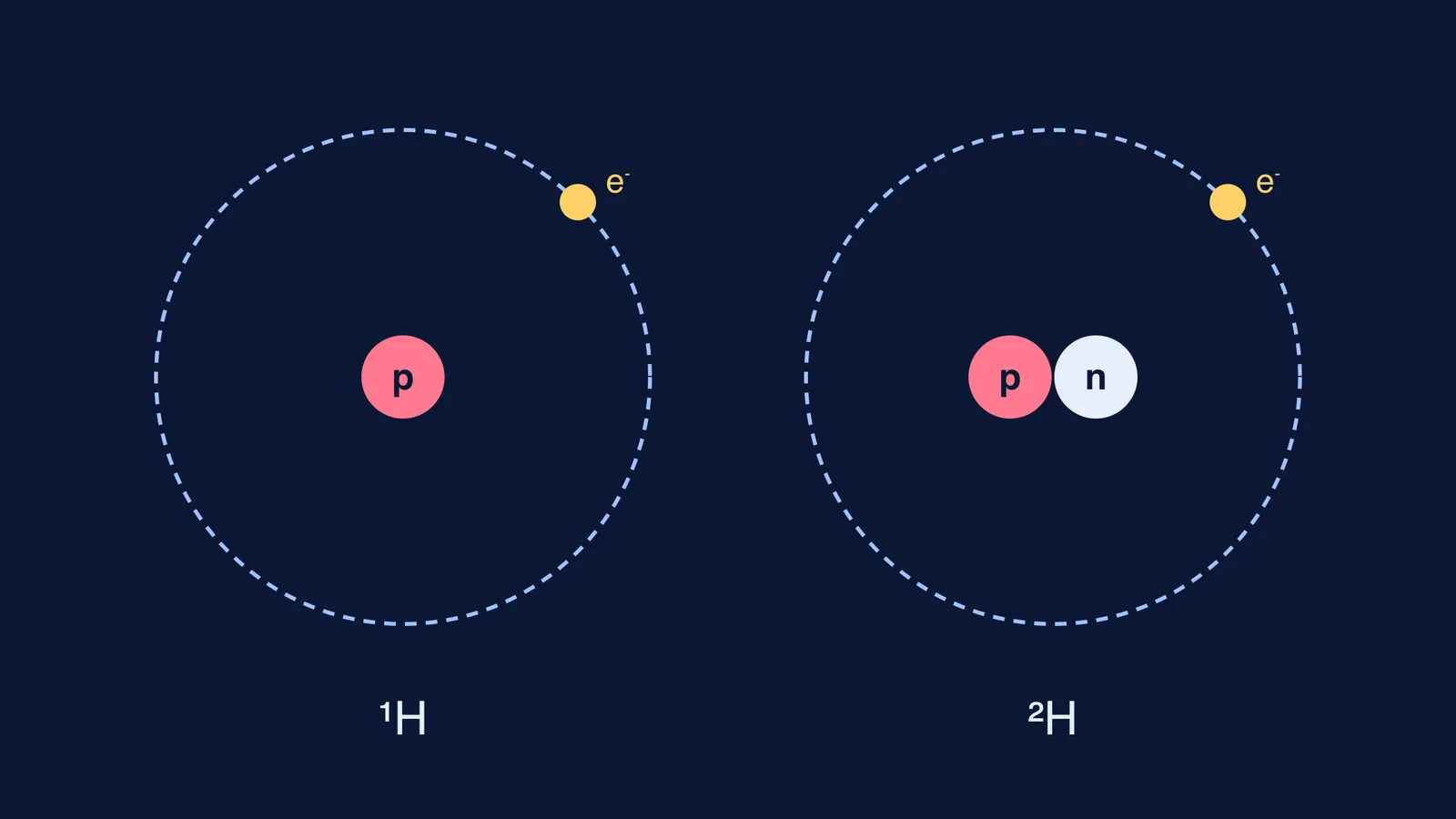
Anything that depends on the mass of the atom can change. Heavy water, D₂O, shows this best, because deuterium has a proton and a neutron in its nucleus while ordinary hydrogen has only a proton. Here are the figures from PubChem's deuterium oxide record, PubChem's water record and the NIST Chemistry WebBook:
Molar mass: 20.028 g/mol for D₂O against 18.015 g/mol for H₂O.
Maximum density: 1.1059 g/cm³ for D₂O (at 11.23 °C) against 1.000000 g/mL for ordinary water (at 3.98 °C).
Boiling point: 101.42 °C for D₂O.
Melting point: 276.97 K, which is 3.82 °C, for D₂O.
Same electrons and same bonds, yet a heavier, denser liquid. For the history, read how Harold Urey found deuterium.
Can you predict the density of heavy water?
You can, with the PubChem figures above.
Assume a D₂O molecule takes up about the same space as an H₂O molecule. That is reasonable, because a molecule's size is set by its electron cloud, and the electrons are the same.
Then a litre of each holds about the same number of molecules, so density should scale with molar mass: 20.028 ÷ 18.015 = 1.112.
Multiply by ordinary water's maximum density of 1.000 g/cm³. The prediction is about 1.11 g/cm³.
The measured maximum density of D₂O is 1.1059 g/cm³, so the prediction is within about half a percent.
The small gap tells you the starting assumption is close but not exact.
Are isotopes' chemical properties exactly identical?
Nearly, not exactly. Heavier isotopes tend to react somewhat more slowly than lighter ones, an effect called the kinetic isotope effect (Kinetic isotope effect, Wikipedia). It is largest for hydrogen: a reaction that breaks a C–H bond is typically 6 to 10 times faster than the same reaction breaking a C–D bond, because swapping hydrogen for deuterium doubles the mass, while carbon-13 is only 8% heavier than carbon-12.
This is still mass at work: the products are the same; what changes is mainly the speed. In a school answer, write that isotopes have the same chemical properties and different physical properties. Bring in the isotope effect only when the question is about reaction rates.
A two-question test for any isotope question
Run each option through two checks:
Does it depend on electrons? Number of electrons, electron configuration, valency, ion charge, the type of bond and the products of a reaction stay the same.
Does it depend on mass or the nucleus? Mass of one atom, density, melting and boiling points, rate of diffusion, reaction rate (mainly for hydrogen) and radioactivity can differ.
Try it: for ³⁵Cl and ³⁷Cl, which is the same: the mass of one atom, the number of electrons in the chloride ion, or the density of chlorine gas? Only the second passes the electron test.
If electron configuration is the shaky part, the Fermi Concept Library gives every chemistry concept its own lesson and its place in the map, so you can step back to atomic structure and come forward again. For practice, the Fermi Problem Library has worked problems with a step-by-step solver that explains the reasoning rather than printing an answer.
Next time an isotope question appears, ask one thing first: electrons or mass?


