

On this page
The three words differ by a letter or two, and each one keeps a different number in the nucleus the same. Once you know which number is shared, the rest is arithmetic.
Every nucleus is described by three numbers: the atomic number Z (protons), the neutron number N, and the mass number A. The NCERT Class 11 Chemistry chapter on the structure of the atom defines mass number as the number of protons plus the number of neutrons, so A = Z + N.
What is the difference between isotopes, isobars and isotones?
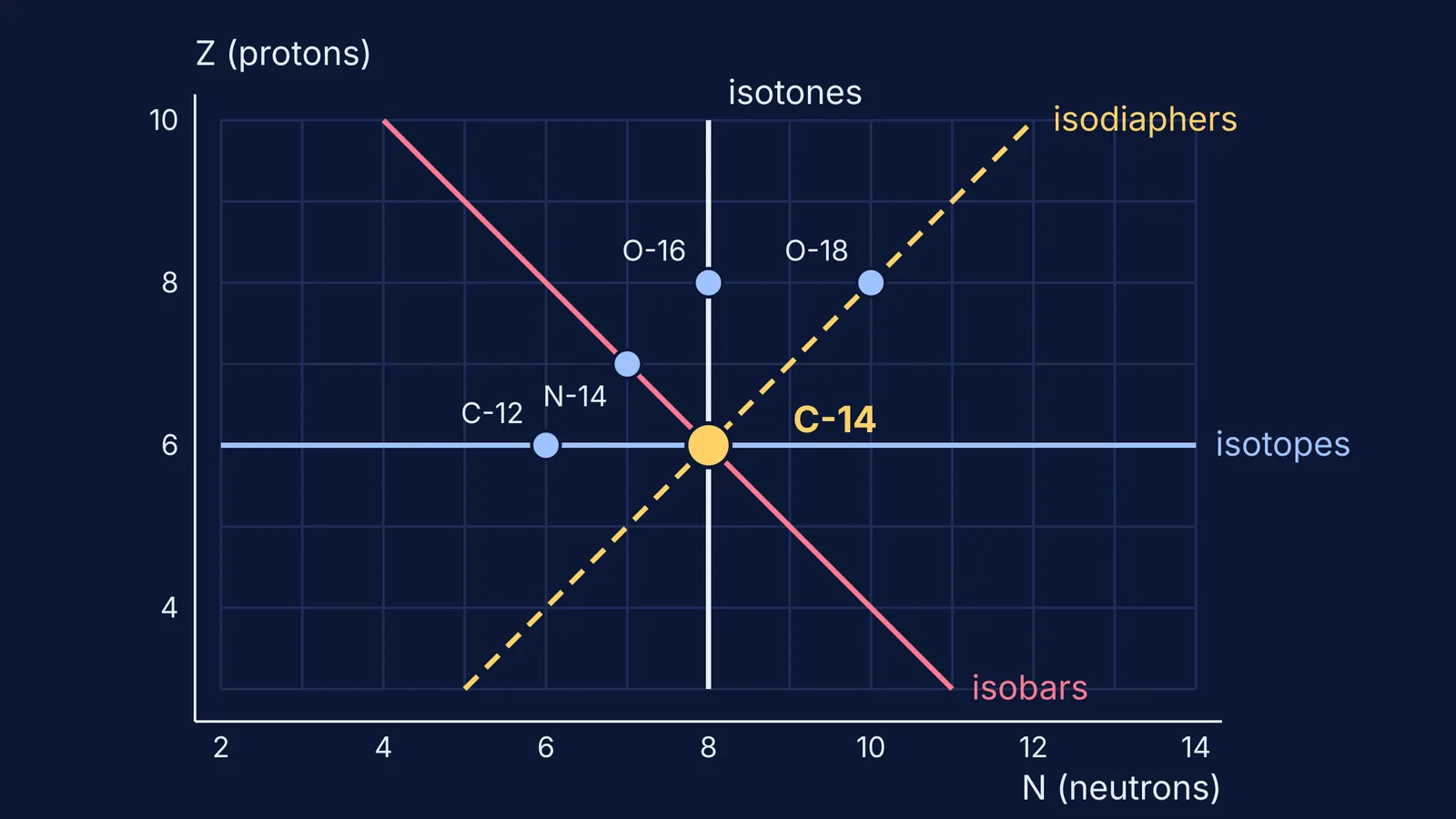
Isotopes have the same atomic number but different mass numbers, so they differ only in neutrons. NCERT gives C-12, C-13 and C-14: carbon atoms with 6, 7 and 8 neutrons besides 6 protons.
Isobars have the same mass number but different atomic numbers. NCERT gives C-14 and N-14. Ar-40 (Z = 18) and Ca-40 (Z = 20) are another pair.
Isotones have the same number of neutrons but different atomic numbers. Lecture slides by Luca Doria (SFU and TRIUMF) list Ca-40, Ti-42 and Cr-44 as isotones; each has 20 neutrons.
Why does the difference matter? NCERT explains that chemical properties are controlled by the number of electrons, which is set by the number of protons, so all isotopes of an element show the same chemical behaviour. Isobars are different elements: argon is a noble gas, calcium a reactive metal, even though both Ar-40 and Ca-40 have 40 nucleons.
Nature links these pairs through radioactive decay. Potassium-40 decays to both Ca-40 and Ar-40, with a combined half-life of 1.25 billion years, and 89.52% of its decays produce Ca-40, according to a US Geological Survey publication on the potassium-calcium decay system. Carbon-14 decays to nitrogen-14 with a half-life of 5,730 years, as the LibreTexts radiocarbon dating module shows. In both cases the mass number stays the same while the element changes: parent and daughter are isobars.
How do you remember isotopes, isobars and isotones?
Look for the letter that gives the shared number away.
Isotopes: same protons (same Z, same element).
Isobars: same A (mass number).
Isotones: same neutrons (same N).
Isodiaphers: read "dia" as "difference": same N minus Z.
What are isodiaphers, and why do they come up in JEE?
Isodiaphers are nuclides with the same neutron excess, the difference between neutron number and proton number; Doria's radiochemistry lecture slides list them by this property. NCERT's section 2.2.4 covers only isobars and isotopes, so isotones and isodiaphers are the extensions you are likely to meet in JEE-style questions on radioactive decay.
The link is alpha decay. NCERT describes alpha particles as helium nuclei carrying two units of positive charge and four units of mass, so each one takes away 2 protons and 2 neutrons. N and Z both drop by 2, and N minus Z does not change.
U-238: Z = 92, N = 146, N minus Z = 54.
After one alpha decay: Z = 90 (thorium), A = 234, N = 144, N minus Z = 54.
So U-238 and Th-234 are isodiaphers. Beta-minus decay works the other way: a neutron becomes a proton, A stays fixed, and parent and daughter are isobars, as in C-14 to N-14. If you want the full method for writing these equations, see our guide on how to balance nuclear reaction equations step by step, and for why A is conserved while the actual mass is not, read why mass number is conserved but mass is not.
How do you classify a pair in under a minute?
Cover the answers and try each one first.
C-12 and C-14: Z is 6 and 6. Isotopes.
C-14 and N-14: A is 14 and 14, Z is 6 and 7. Isobars.
C-14 and O-16: N is 8 and 8. Isotones.
Ar-40 and Ca-40: A is 40 and 40. Isobars. N minus Z is 4 and 0, so they are not isodiaphers.
K-39 and Ca-40: N is 20 and 20. Isotones.
U-238 and Th-234: N minus Z is 54 and 54. Isodiaphers.
One trap to watch: two different nuclides can share only one of Z, N, A and N minus Z. If any two matched, the rest would follow, and you would have the same nuclide twice. So once you find the shared number, you are done: Ar-40 and Ca-40 are isobars and nothing else.
That mass difference is the whole idea behind how a magnetic field separates isotopes.
If you can classify pairs but are shaky on why Z alone fixes chemistry, the Fermi Concept Library gives every concept in chemistry and physics its own lesson and its place in the map. For mixed decay numericals, the Fermi Problem Library has worked problems with a step-by-step solver that explains the reasoning rather than printing an answer.
Next time you see two nuclides, write Z, N and A first; the name follows.


