

On this page
In chemical reactions, atoms rearrange electron bonds while nuclei remain untouched. In nuclear reactions, the nuclei themselves transform: elements transmute, particles are ejected, and binding energies shift. Despite these dramatic changes, nuclear processes follow strict conservation laws. Balancing a nuclear reaction equation simply requires tracking two quantities: mass number and electric charge.
What conservation laws govern nuclear reactions?
Every nuclear reaction must satisfy two arithmetic conservation principles. According to OpenStax Chemistry, the two foundational rules are:
Conservation of mass number (A): The total number of nucleons (protons plus neutrons) remains constant. The sum of mass numbers on the reactant side must equal the sum on the product side.
Conservation of atomic number (Z): Total electric charge remains constant. The sum of atomic numbers (nuclear charges) on the reactant side must equal the sum on the product side.
In standard notation ᴬ_Z X, superscript A represents the nucleon count and subscript Z represents charge. While tiny mass defects account for released energy via E = mc², integer nucleon numbers remain strictly conserved, just as in counting alpha and beta decays in a radioactive decay series.
How do you balance a nuclear reaction equation step by step?
To identify an unknown reactant or product, follow four steps:
Write standard notation: Assign superscripts and subscripts to every known species: alpha particle (⁴₂He), proton (¹₁p), neutron (¹₀n), electron (⁰₋₁e), positron (⁰₊₁e), and gamma photon (⁰₀γ).
Balance mass numbers (A): Set the sum of reactant superscripts equal to product superscripts: Σ A(reactants) = Σ A(products). Solve for the missing A.
Balance charge numbers (Z): Set the sum of reactant subscripts equal to product subscripts: Σ Z(reactants) = Σ Z(products). Solve for the missing Z.
Identify the unknown: Use the solved Z to find the chemical element on the periodic table, or match the (A, Z) pair to a subatomic particle.
When checking multi-step decay chains, the Fermi Problem Library provides worked problems with a step-by-step solver that explains the reasoning rather than printing an answer.
How do alpha, beta, and neutron reactions balance in practice?
Three classic examples, catalogued in OpenStax University Physics, show how these conservation rules apply across decay and transmutation:
In alpha decay, a nucleus emits a helium-4 nucleus (⁴₂He). For uranium-238 decay: ²³⁸₉₂U → ᴬ_Z X + ⁴₂He
The mass balance gives 238 = A + 4 (A = 234), and the charge balance gives 92 = Z + 2 (Z = 90). Atomic number 90 is thorium, yielding ²³⁸₉₂U → ²³⁴₉₀Th + ⁴₂He. Energy distribution during this emission is explored in our guide on the recoil of the daughter nucleus in alpha decay.
In beta-minus decay, a neutron converts to a proton, emitting an electron (⁰₋₁e). For carbon-14: ¹⁴₆C → ᴬ_Z X + ⁰₋₁e
The mass balance gives 14 = A + 0 (A = 14). The charge balance gives 6 = Z + (-1), so Z = 7. Element 7 is nitrogen: ¹⁴₆C → ¹⁴₇N + ⁰₋₁e.
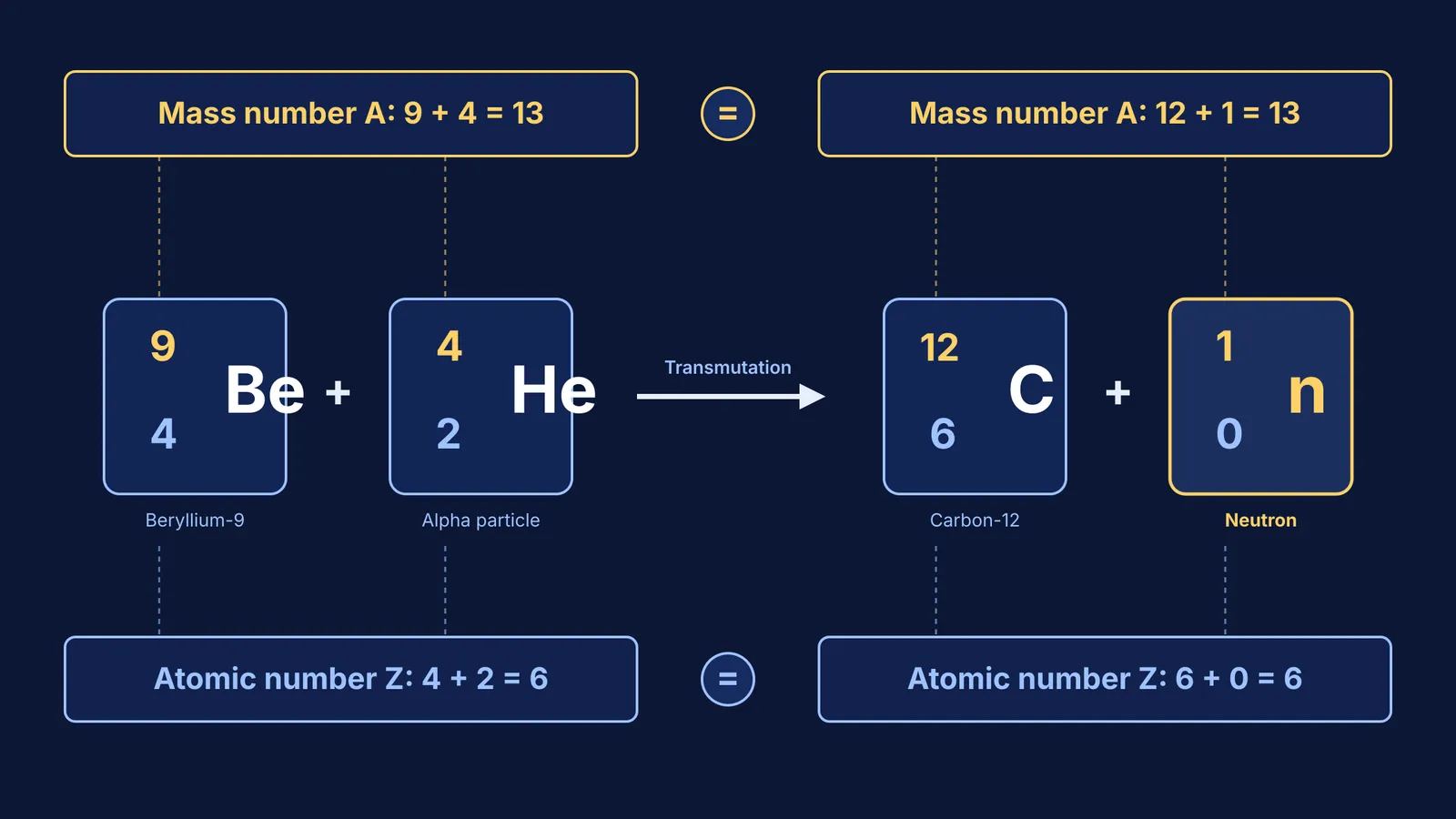
In neutron reactions, bombarding particles trigger transmutation. In 1932, James Chadwick discovered the neutron by bombarding beryllium with alpha particles, published in the Proceedings of the Royal Society: ⁹₄Be + ⁴₂He → ¹²₆C + ᴬ_Z X
The mass balance gives 9 + 4 = 12 + A (A = 1). The charge balance gives 4 + 2 = 6 + Z (Z = 0). A mass of 1 and charge of 0 defines a neutron (¹₀n). Ernest Rutherford observed a similar balance in 1919 in the Philosophical Magazine, transmuting nitrogen into oxygen: ¹⁴₇N + ⁴₂He → ¹⁷₈O + ¹₁p.
For students connecting decay equations to nuclear binding energies, the Fermi Concept Library organizes every concept in physics, chemistry, biology, mathematics and computing, each with its own lesson and its place in the map, complementing related topics such as mass defect and binding energy problems.
What are the most common exam traps when balancing nuclear equations?
On competitive tests conducted by the National Testing Agency, students most often slip on three details:
Beta decay sign errors: Because the electron carries Z = -1, the daughter nucleus has Z = Z(parent) + 1. Subtracting 1 instead of adding is the single most common mistake.
Missing coefficients: In fission reactions like ²³⁵₉₂U + ¹₀n → ¹⁴¹₅₆Ba + ⁹²₃₆Kr + 3 ¹₀n, the 3 emitted neutrons contribute 3 × 1 = 3 nucleons. Forgetting the multiplier breaks the balance.
Decimal atomic weights: Mass numbers are integers. Never plug fractional atomic weights from the periodic table into nuclear equations.
When practicing these multi-step equations, Fermi's AI tutor works out what you already know, builds a plan for the session, and checks understanding as you work through each reaction.


