On this page
Debentures sit inside Unit 2, Accounting for Companies, which the CBSE Accountancy curriculum for 2026-27 prints at 24 marks. The chapter you study from is "Issue and Redemption of Debentures" in NCERT Accountancy Part II (Reprint 2026-27).
What does the 2026-27 syllabus include on debentures?
The 2026-27 curriculum keeps:
Meaning and types of debentures.
Issue at par, premium or discount, for consideration other than cash, and with terms of redemption.
Debentures as collateral security.
Interest on debentures, with the concept of TDS excluded.
Writing off discount or loss on issue.
For redemption, the learning outcome is only to state its meaning. Redemption methods and the Debenture Redemption Reserve rules are in NCERT but not in the curriculum's topic list.
Its note says discount or loss is written off in the year of allotment: first from Securities Premium Reserve, if it exists, then from the Statement of Profit and Loss as a finance cost.
The CBSE 2026-27 sample paper gives a 6-mark question to issue terms and collateral security, and a 3-mark question to debentures issued to a vendor.
How do you record issue at par, premium or discount?
A debenture is a written instrument acknowledging a debt, which carries a fixed rate of interest on its nominal value (NCERT). Three accounts matter:
Securities Premium Reserve is credited with any premium on issue.
Discount on Issue of Debentures is debited when debentures are issued below face value and redeemed at par.
Premium on Redemption of Debentures is credited when the company promises to repay more than face value. It is a liability shown under long-term borrowings until redemption.
When redemption is at a premium, NCERT debits that premium to Loss on Issue of Debentures, and adds any discount on issue to the same account.
Worked example: discount on issue, premium on redemption
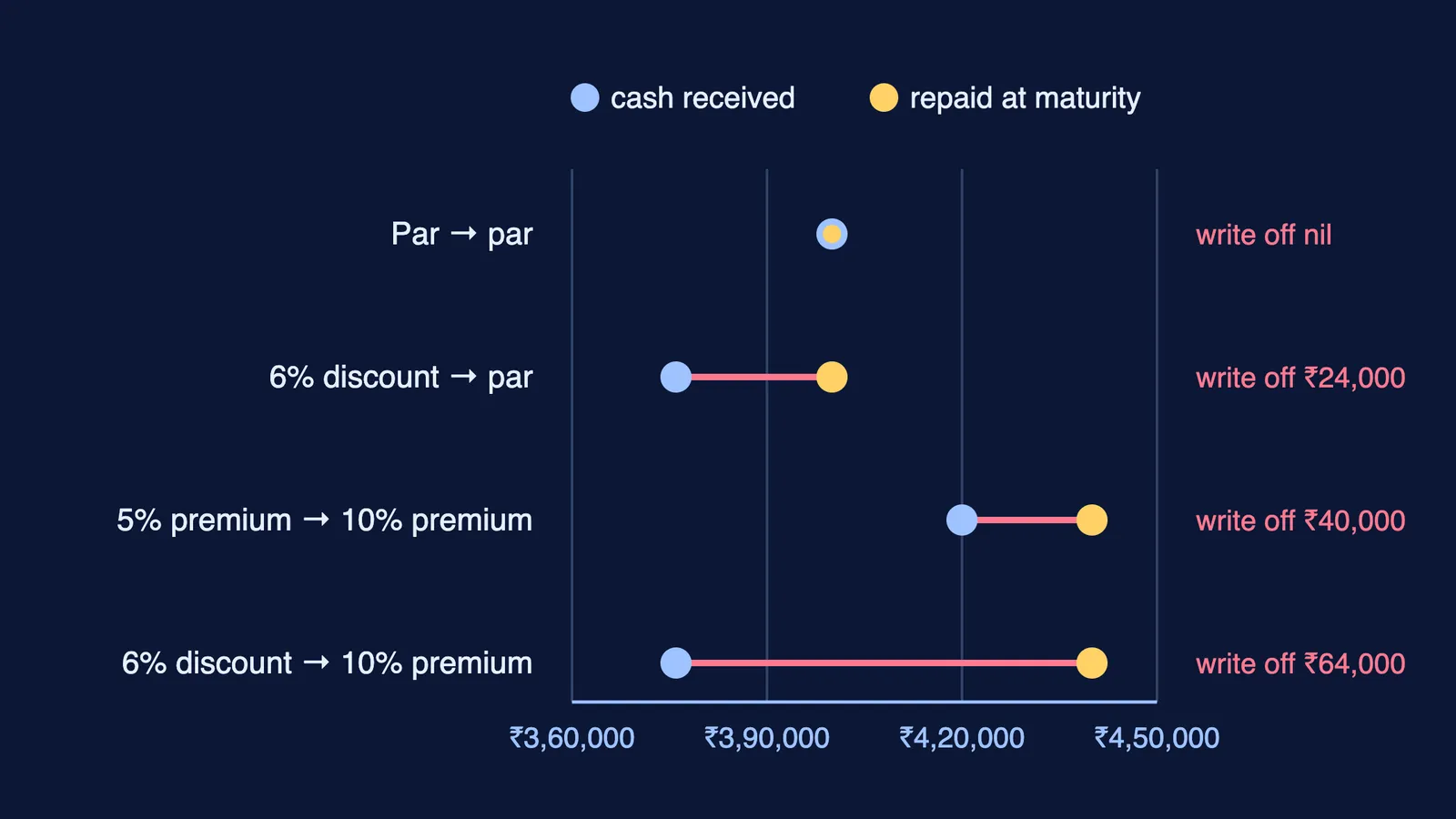
On 1 April 2026, Tarang Ltd issued 4,000, 8% debentures of ₹100 each at a 6% discount, redeemable at a 10% premium after five years. The full amount was payable on application. Its Securities Premium Reserve stood at ₹20,000. Interest is paid on 30 September and 31 March, and the books close on 31 March.
Face value: 4,000 × ₹100 = ₹4,00,000.
Discount: 6% × ₹4,00,000 = ₹24,000, so cash received = ₹3,76,000.
Premium on redemption: 10% × ₹4,00,000 = ₹40,000.
Loss on issue: ₹24,000 + ₹40,000 = ₹64,000.
The entries:
Bank A/c Dr ₹3,76,000; To Debenture Application and Allotment A/c ₹3,76,000.
Debenture Application and Allotment A/c Dr ₹3,76,000; Loss on Issue of Debentures A/c Dr ₹64,000; To 8% Debentures A/c ₹4,00,000; To Premium on Redemption of Debentures A/c ₹40,000.
Each half-year: Debenture Interest A/c Dr ₹16,000; To Debentureholders A/c ₹16,000. Then pay: Debentureholders A/c Dr; To Bank A/c. Interest is on face value: ₹4,00,000 × 8% × 6/12. There is no TDS line, since the curriculum excludes TDS.
On 31 March 2027: Statement of Profit and Loss Dr ₹32,000; To Debenture Interest A/c ₹32,000.
On 31 March 2027: Securities Premium Reserve A/c Dr ₹20,000; Statement of Profit and Loss Dr ₹44,000; To Loss on Issue of Debentures A/c ₹64,000.
Entry 2 balances: ₹3,76,000 + ₹64,000 = ₹4,00,000 + ₹40,000 = ₹4,40,000.
The 2026-27 marking scheme shows the discount and the redemption premium on separate debit lines (Discount on Issue and Loss on Issue). NCERT puts both in Loss on Issue. Either way, the total debit is the same.
How are debentures issued as collateral security recorded?
Collateral security is extra security a lender asks for besides the primary security on a loan (NCERT).
Say Tarang Ltd also took a bank loan of ₹2,50,000 and issued 3,000, 9% debentures of ₹100 each as collateral. By journal entry: Debenture Suspense A/c Dr ₹3,00,000; To 9% Debentures A/c ₹3,00,000. In the note on long-term borrowings, show 9% Debentures ₹3,00,000 less Debenture Suspense ₹3,00,000 (net nil), and the bank loan at ₹2,50,000. When the loan is repaid, reverse it. The alternative is no entry, just a note under the loan.
Which mistakes cost marks in debenture questions?
Interest on the issue price. Interest is always on face value.
Forgetting Premium on Redemption. It belongs in the allotment entry, not at maturity.
Writing off over five years. For 2026-27, write it all off in the year of allotment, from Securities Premium Reserve first.
Recording collateral debentures as borrowed money. The suspense account cancels them.
Counting debentures at face value for a vendor. Divide the purchase consideration by the issue price, as the sample paper's vendor question does.
The same application-and-allotment pattern runs through our guide to issue of shares journal entries. Debentures also feed the debt-equity ratio in ratio analysis for Class 12.
If you are not sure which part to fix first, Fermi's AI tutor can work out what you already know and build a plan for the session, so you sit down to a clear next step. Then rework Tarang Ltd with your own numbers.