On this page
Inverse trigonometric functions is Chapter 2 of the NCERT Class 12 Mathematics textbook (reprint 2026-27). The CBSE 2026-27 Mathematics syllabus lists its content as definition, range, domain, principal value branch and graphs of inverse trigonometric functions. Not here: the 2026-27 reprint does not list sum formulas such as tan⁻¹x + tan⁻¹y, the 2tan⁻¹x forms, or separate rules for negative and reciprocal inputs such as sin⁻¹(−x) or cosec⁻¹x = sin⁻¹(1/x). Its properties section keeps sin(sin⁻¹x) = x and sin⁻¹(sin x) = x, plus substitution examples, covered below. Derivatives belong to the continuity and differentiability chapter.
What are the domain and range of each inverse trig function?
x is the input, y the output angle in radians; no branch named means the principal branch.
Definition: y = sin⁻¹x means sin y = x, with y in the principal range.
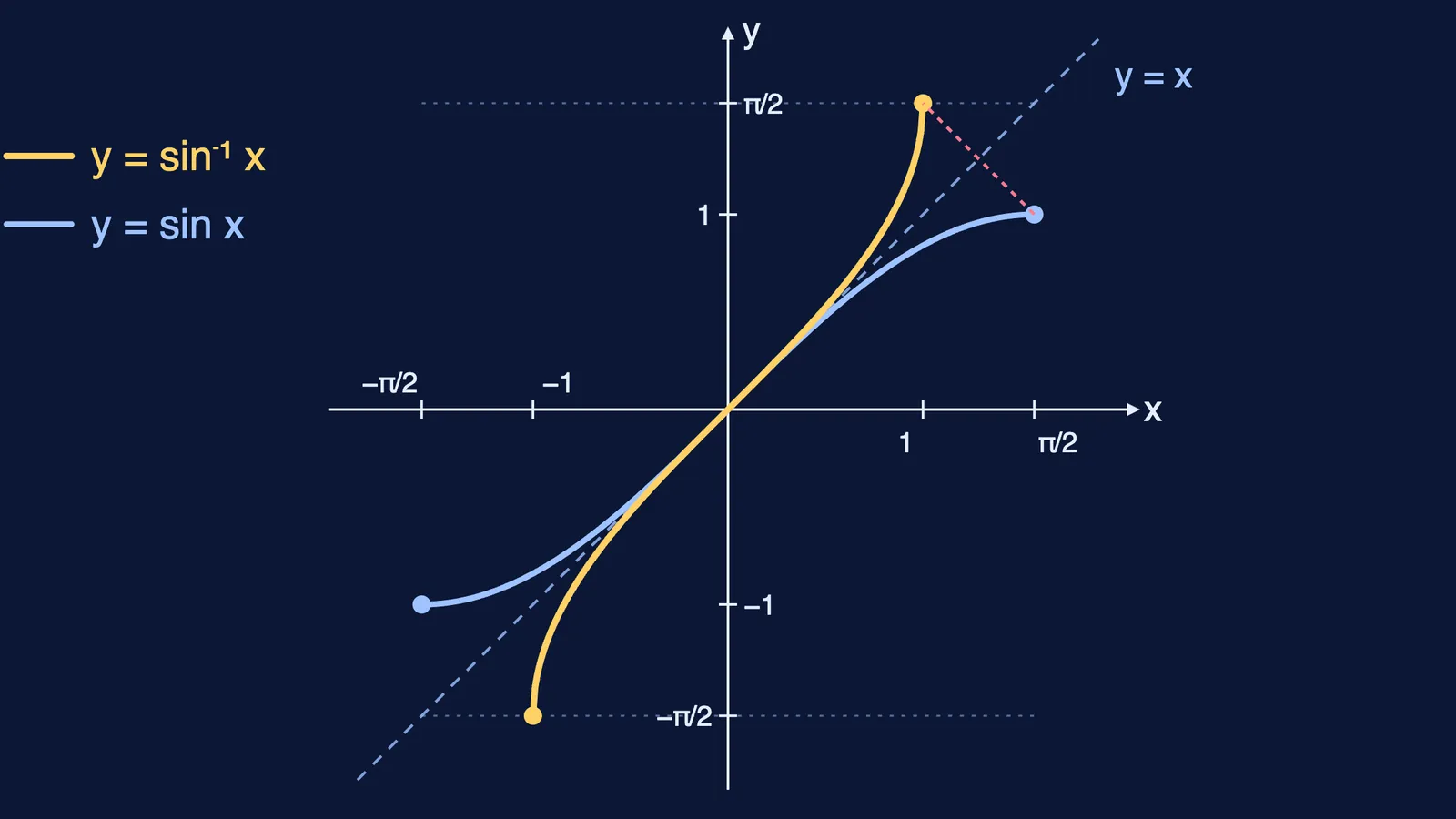
sin⁻¹: domain [−1, 1], range [−π/2, π/2]
cos⁻¹: domain [−1, 1], range [0, π]
tan⁻¹: domain R, range (−π/2, π/2)
cot⁻¹: domain R, range (0, π)
sec⁻¹: domain R − (−1, 1), that is x ≤ −1 or x ≥ 1, range [0, π] − {π/2}
cosec⁻¹: domain R − (−1, 1), range [−π/2, π/2] − {0}
Notation: sin⁻¹x is not (sin x)⁻¹. In fact (sin x)⁻¹ = 1/sin x = cosec x.
Graph: the graph of y = sin⁻¹x is the reflection of y = sin x (restricted to [−π/2, π/2]) in the line y = x.
Worked example. Find the domain of f(x) = sin⁻¹(3x − 2). Need −1 ≤ 3x − 2 ≤ 1, so 1 ≤ 3x ≤ 3 and the domain is [1/3, 1].
Watch for: the domain of sec⁻¹ and cosec⁻¹ includes x = 1 and x = −1. Only the open interval (−1, 1) is removed.
How do you find the principal value of an inverse trig function?
The chapter's method (Examples 1 and 2): find the one angle inside the principal range whose ratio equals x.
Write y = cos⁻¹x, so cos y = x with y in [0, π].
For a negative x, take the standard angle for |x| (π/6 for √3/2) and move it into the range with a Class 11 identity such as cos(π − θ) = −cos θ.
Worked example. Evaluate tan⁻¹(−1/√3) + cos⁻¹(−√3/2) + cot⁻¹(−1).
tan(−π/6) = −1/√3 and −π/6 is in (−π/2, π/2), so tan⁻¹(−1/√3) = −π/6
cos(5π/6) = −cos(π/6) = −√3/2 and 5π/6 is in [0, π], so cos⁻¹(−√3/2) = 5π/6
cot(3π/4) = −cot(π/4) = −1 and 3π/4 is in (0, π), so cot⁻¹(−1) = 3π/4
Total: −π/6 + 5π/6 + 3π/4 = 2π/3 + 3π/4 = 17π/12
Watch for: cot⁻¹(−1) is 3π/4, not −π/4. A negative answer is impossible for cos⁻¹, sec⁻¹ or cot⁻¹.
When does sin⁻¹(sin x) equal x?
The chapter states these results hold "for suitable values of domain". The conditions:
sin(sin⁻¹x) = x for x in [−1, 1]; sin⁻¹(sin x) = x for x in [−π/2, π/2]
cos(cos⁻¹x) = x for x in [−1, 1]; cos⁻¹(cos x) = x for x in [0, π]
tan(tan⁻¹x) = x for all real x; tan⁻¹(tan x) = x for x in (−π/2, π/2)
cot(cot⁻¹x) = x for all real x; cot⁻¹(cot x) = x for x in (0, π)
sec⁻¹(sec x) = x for x in [0, π], x ≠ π/2; cosec⁻¹(cosec x) = x for x in [−π/2, π/2], x ≠ 0
Outside the range, rewrite with an angle inside it, e.g. sin(π − θ) = sin θ.
Worked example. Find sin⁻¹(sin 4), with 4 in radians. Since 4 > π/2 ≈ 1.571, the answer is not 4. But sin 4 = sin(π − 4), and π − 4 ≈ −0.858 lies in [−π/2, π/2]. So sin⁻¹(sin 4) = π − 4.
Watch for: an angle written without π, such as 4, is in radians; compare it with π/2 ≈ 1.571 first.
Which substitutions simplify inverse trig expressions?
Pick the substitution from the expression's shape, then check θ's interval.
√(1 − x²) or √(a² − x²): put x = sin θ (or x = a sin θ)
1 + x² or √(a² + x²): put x = tan θ (or x = a tan θ)
√(x² − 1): put x = sec θ
sin⁻¹(2x√(1 − x²)) = 2 sin⁻¹x for −1/√2 ≤ x ≤ 1/√2, and = 2 cos⁻¹x for 1/√2 ≤ x ≤ 1
3 sin⁻¹x = sin⁻¹(3x − 4x³) for −1/2 ≤ x ≤ 1/2
3 cos⁻¹x = cos⁻¹(4x³ − 3x) for 1/2 ≤ x ≤ 1
cot⁻¹(1/√(x² − 1)) = sec⁻¹x for x > 1
tan⁻¹(x/√(1 − x²)) = sin⁻¹x for |x| < 1
Right-triangle conversions: sin(tan⁻¹x) = x/√(1 + x²) and cos(tan⁻¹x) = 1/√(1 + x²) for all real x; cos(sin⁻¹x) = sin(cos⁻¹x) = √(1 − x²) for |x| ≤ 1; tan(sin⁻¹x) = x/√(1 − x²) for |x| < 1
Worked example. Simplify tan⁻¹(√(1 − x²)/x) for 0 < |x| ≤ 1. Put x = cos θ with θ in [0, π], so √(1 − x²) = sin θ and the expression is tan⁻¹(tan θ). For 0 < x ≤ 1, θ is in [0, π/2), inside the range of tan⁻¹, so the answer is θ = cos⁻¹x. Check at x = 1/2: tan⁻¹(√3) = π/3 = cos⁻¹(1/2).
Watch for: for −1 ≤ x < 0, θ is in (π/2, π], outside (−π/2, π/2). Since tan θ = tan(θ − π), the answer is cos⁻¹x − π. At x = −1/2 the value is −π/3, not 2π/3.
If you set up a substitution and the algebra still does not close, the Fermi Problem Library has worked problems with a step-by-step solver that explains the reasoning rather than printing an answer.
How to revise this formula sheet
Draw the six principal ranges from memory, then check them against the first section.
Practise sin⁻¹(sin x) and cos⁻¹(cos x) with angles outside the range, including plain radian values like 2, 4 and 6.
Write the interval of x next to every substitution identity.
Then move to full questions: our guide to inverse trigonometric functions board answers and traps works through question types, and the relations and functions board exam guide covers the one-one and onto ideas that make these inverses exist.