On this page
The first chapter of NCERT's Introductory Microeconomics is short, but the rest of the Class 11 book rests on it. It asks: when resources are limited, how does a society decide what to make and who gets it? Below: what the chapter covers, a worked production possibility example and practice questions.
What does the Introduction chapter cover in 2026-27?
The CBSE Economics curriculum for 2026-27 lists this as Unit 4 of Part B: meaning of microeconomics and macroeconomics, positive and normative economics, what an economy is, the central problems of what, how and for whom to produce, and the concepts of production possibility frontier and opportunity cost. The same document prints the Introduction unit's weight as 04 marks, out of 40 for Introductory Microeconomics.
The NCERT chapter (Reprint 2026-27) also has a section on how economic activity is organised: centrally planned, market and mixed economies. Its exercises test it, so read that section too. The curriculum's Class 11 question typology sets 40% of marks for remembering and understanding, 30% for applying and 30% for analysing, evaluating and creating, so expect definitions, numericals and reasoning questions.
What are the central problems of an economy?
NCERT starts with scarcity: every society wants more than its resources can produce, and because resources have competing uses, scarcity creates the problem of choice. It comes down to three questions:
What to produce, and how much? Food or luxury goods, consumption goods or machines that raise output tomorrow.
How to produce? More labour or more machines, and which technology.
For whom to produce? Who gets how much, and whether everyone should be assured a minimum of consumption, education or health care.
Put simply, every economy must decide how to share out its limited resources among goods and then how to divide what gets made among its people.
What is a production possibility frontier?
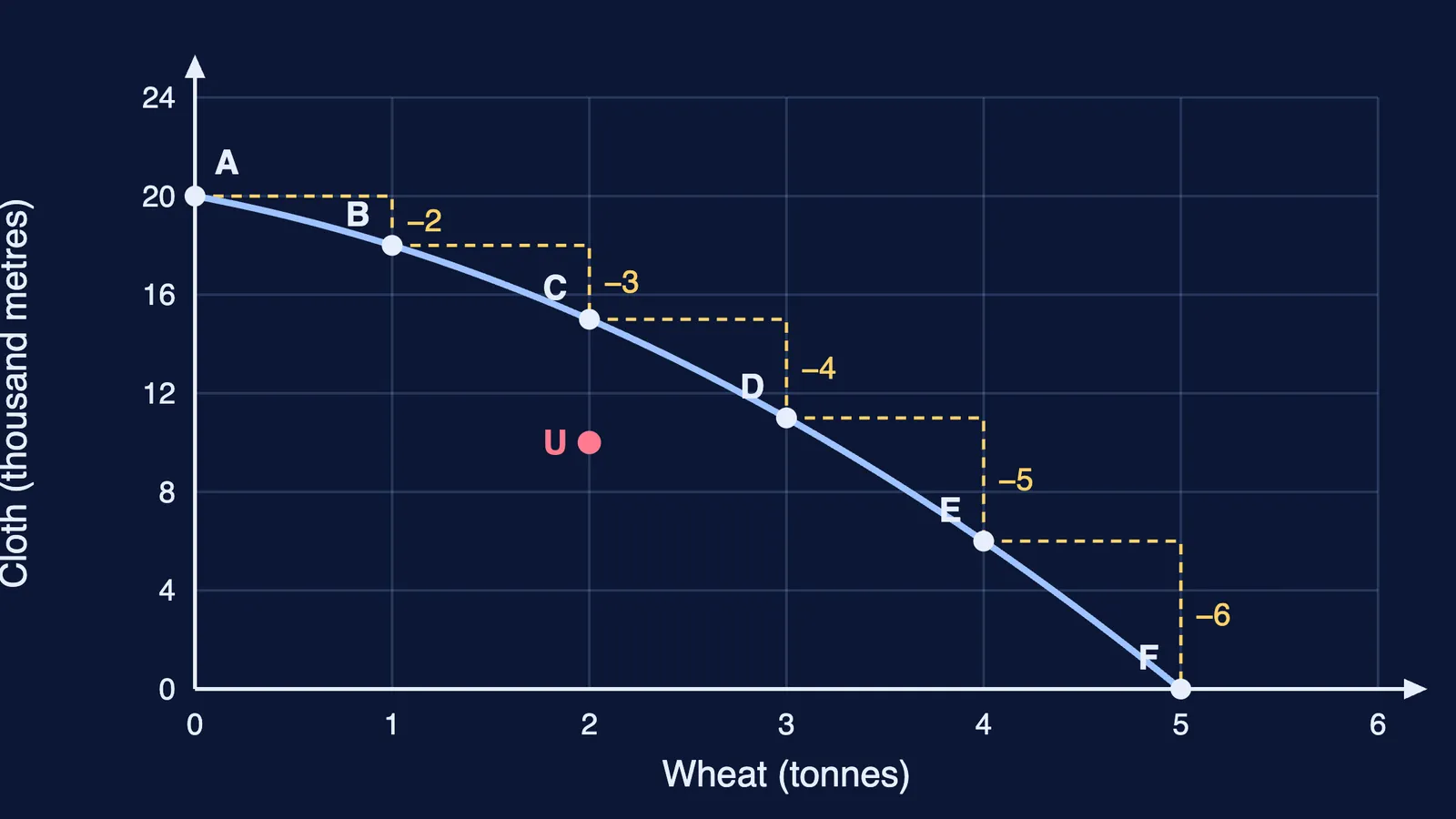
A production possibility frontier (PPF) shows the largest combinations of two goods an economy can produce when its resources are fully used, with given technology. A point strictly below it means some resources are idle or wasted. NCERT says any point on or below the curve can be produced; a point beyond it is out of reach.
Opportunity cost is how much of the second good you must sacrifice to make one more unit of the first. NCERT notes it is also sometimes called economic cost.
Worked example: how do you find opportunity cost on a PPF?
A made-up economy makes only wheat (tonnes) and cloth (thousand metres). Its full-employment combinations:
A: 0 wheat, 20 cloth
B: 1 wheat, 18 cloth
C: 2 wheat, 15 cloth
D: 3 wheat, 11 cloth
E: 4 wheat, 6 cloth
F: 5 wheat, 0 cloth
Step 1. Opportunity cost of each extra tonne of wheat. Subtract cloth at each step: 20 − 18 = 2, 18 − 15 = 3, 15 − 11 = 4, 11 − 6 = 5, 6 − 0 = 6 thousand metres.
Step 2. Read the pattern. Each extra tonne of wheat costs more cloth than the last, which is why the frontier in the diagram bows outward.
Step 3. Test two points. U = (2 wheat, 10 cloth) lies below C, which gives 15 cloth with the same wheat, so 5 thousand metres of cloth are lost to idle resources. The point (4 wheat, 11 cloth) needs more cloth than E's 6, so it cannot be produced.
Positive vs normative and micro vs macro
Positive analysis studies how a mechanism works; normative analysis asks whether its outcome is desirable. NCERT adds that the line between them is not sharp. Quick test: checkable against facts means positive; saying what ought to happen means normative.
Microeconomics studies individual consumers, producers and markets, and how a single good's price and quantity are set. Macroeconomics studies the economy as a whole through aggregates such as total output, employment and the general price level.
How should you practise this chapter?
Try these questions we wrote.
(1 mark) A point inside the PPF shows: (a) full employment, (b) unemployed or wasted resources, (c) a combination that is out of reach, (d) new technology.
(1 mark) Classify: "The government ought to provide free basic health care to everyone." Positive or normative?
(3 marks) Using the wheat and cloth table, find the opportunity cost of moving from B to D, and say what it means.
(4 marks) Explain the "for whom to produce" problem with an example from your own town.
Answers: 1 (b); 2 normative; 3 the economy gives up 18 − 11 = 7 thousand metres of cloth for 2 more tonnes of wheat.
Next in the book is how one consumer chooses: see our guide to consumer equilibrium and utility analysis, then production function and returns to a factor.
If you are not sure where to begin revising, Fermi's AI tutor can work out what you already know and build a plan for the session, so you sit down to a clear next step.