On this page
Introduction to Agricultural Practices is Chapter 1 of Kaushal Vikas, the new NCERT Class 9 skill education textbook (book code 0916, First Edition, April 2026). It opens Unit I, Work with Life Forms, and is mandatory whichever agricultural vocation your group picks later. These notes follow the NCERT chapter.
What does Chapter 1 of Kaushal Vikas cover?
The chapter has four parts, each with a task or portfolio activity:
Why agriculture matters: the livelihood ecosystem and the value chain, where price rises with each step of storage, processing and transport.
The agro-climatic relationship: climate decides what grows where.
Soil and seed quality: sampling soil, a mason jar texture test, a pH test, and the salt-water floating test for seeds.
Choosing a vocation: mapping what work you can finish in school in three months.
The book cites the Economic Survey of India 2024–25 for two figures: agriculture's share was 16 per cent of GDP, and it gave work to 46.1 per cent of workers (NCERT chapter). Its crop calendar links to Atmosphere and Climate in Class 9 Social Science.
How do you set up a school meteorological observatory?
A caselet on farming in cold-desert Ladakh shows why weather data matters. Your task: build three instruments and record readings for three months.
Rain gauge: a clear bottle, its top third flipped in as a funnel, with a ruler taped outside.
Dry-wet bulb thermometer: two thermometers, one bulb wrapped in wet cotton gauze. Evaporation cools the wet bulb, so a small gap between the readings means humid air and a large gap means dry air. A psychrometric chart gives an accurate humidity value.
Wind vane: a cardboard disc marked with directions, with a freely turning arrow.
The chapter also names IMD forecasts and the Gramin Krishi Mausam Sewa (GKMS) platform.
How do you test and improve soil, step by step?
Sample soil in a zig-zag across the field from V-shaped holes 15–20 cm deep, avoiding shade and fertiliser stores. Mix, quarter it down to a small sample, then dry and sieve.
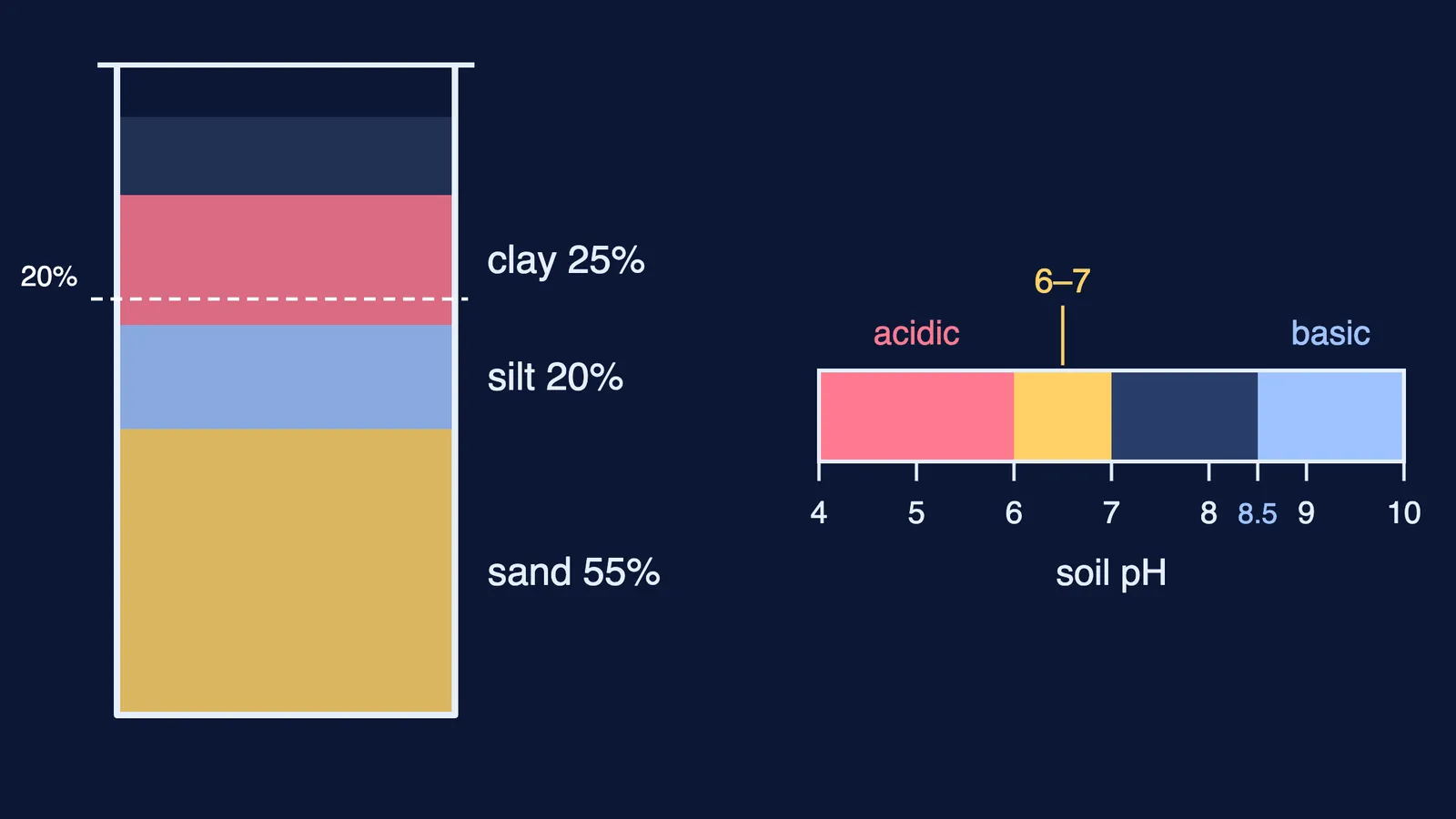
Mason jar test. Half-fill a jar with soil, add water and a little dish soap, shake, and leave it 24–48 hours. The layers form with sand lowest, then silt, with clay uppermost. The book's action rules: above 20 per cent clay, add river sand or red garden soil for drainage; above 80 per cent sand, add compost or garden soil to hold water.
Worked example (our numbers). Jar A settles into 5.5 cm sand, 2.0 cm silt and 2.5 cm clay, 10.0 cm in all. Clay = 2.5 ÷ 10.0 × 100 = 25 per cent, which is above 20, so the soil needs sand. Jar B has 7.2 cm sand in 8.0 cm of soil: 7.2 ÷ 8.0 × 100 = 90 per cent sand, so it needs compost.
pH test. Make a slurry with distilled water and read it with a pH strip or meter (the book prints "metre"; the instrument is a pH meter). Most plants prefer pH 6–7. Below 6, the book lists compost, wood ash, or lime or dolomite. Above 8.5, it lists washing the soil with extra water, compost, or gypsum or a sulphur fertiliser. Never taste chemicals; handle glass carefully.
How does the salt-water seed test work?
In the book's floating method, 100 g of salt goes into 1 L of water, then 250 g of wheat seeds. Salt makes the water denser, so damaged or hollow seeds float within 3–5 minutes; discard them, rinse the rest and dry in shade. Worked example (our numbers): to scale it for 3 L of water, keep the same ratio: 3 × 100 = 300 g salt and 3 × 250 = 750 g seeds.
The chapter also covers seed dormancy, vermicompost and the organic pesticide Daśhaparṇī arka. For the science of soil and water cycles, see Earth as a System in Class 9 Exploration.
How is Kaushal Vikas assessed in Class 9?
Kaushal Vikas is assessed in school; neither source describes a board exam. The CBSE assessment guidelines for 2026-27 split the whole subject as: paper-pencil test 40 per cent, demonstration and viva 20 per cent, site visit report 10 per cent, portfolio 20 per cent and teacher observation 10 per cent. The 40-mark test has objective (8), short answer (12), case-based (16) and reflective (4) sections. These marks are for the whole subject; no chapter has its own figure.
The CBSE 2026-27 curriculum does not name the textbook; this chapter maps to its "Introduction to Vocational Area" theme for Work with Life Forms (suggested 10 hours).
Practice questions (mark labels are our suggestion):
Why does the wet bulb read lower than the dry bulb? What does a large gap tell you? (2 marks)
A jar shows 2.5 cm sand, 1.0 cm silt and 1.5 cm clay. Find the clay percentage and suggest an action. (3 marks)
Your village has strong winds and patchy rain. Which two observatory readings would you share with a farmer first, and why? (4 marks)
Stuck turning jar layers into percentages? Fermi's AI tutor works out what you already know and builds a plan for the session.