On this page
This guide follows Chapter 7 of NCERT's *An Introduction to Indian Art* Part I (the chapter; Reprint 2026-27 per the prelims) and maps it onto the CBSE 2026-27 Fine Arts theory unit.
What does the Class 11 curriculum ask from this chapter?
The CBSE Fine Arts curriculum 2026-27 sets the same 30-mark, 2-hour Class 11 History of Indian Art theory paper for Painting, Graphics, Sculpture and Applied Art. Unit 2, which covers temple sculpture, bronzes and Indo-Islamic architecture, carries 15 marks shared across all three parts; there is no separate figure for bronzes.
Part (B) lists an introduction to Indian bronzes, the method of casting (solid and hollow), and the Chola Nataraja, circa 12th century CE, Thanjavur District, National Museum, New Delhi.
Unit 1 also lists the Mohenjo-daro Dancing Girl and an introduction to bronze casting. The curriculum names no textbook. One gap: the NCERT chapter explains only the lost-wax steps and never compares solid with hollow casting, so take that from your class notes.
How did bronze casting develop across India?
The chapter says lost-wax (cire-perdu) casting was known in the Indus Valley Culture, and describes bronze as an alloy made by mixing copper, zinc and tin. NCERT's Class 10 Science chapter Metals and Non-metals defines bronze as copper and tin, and brass as copper and zinc (our alloys guide); recipes for cast images vary. Key points, in the book's order:
Mohenjodaro, c. 2500 BCE: the Dancing Girl, perhaps the earliest bronze sculpture, with tube-like limbs.
Daimabad, Maharashtra, c. 1500 BCE: a chariot with plain circular wheels and sturdy bulls.
Chausa, Bihar, Kushana period, 2nd century CE: Jain tirthankaras; Adinath has long locks reaching his shoulders.
Akota, near Vadodara: a hoard of Jain bronzes, often inlaid with silver and copper, including Shasanadevis such as Chakreshvari and Ambika.
Gupta and post-Gupta North India, 5th to 7th centuries: standing Buddhas in abhaya mudra; Mathura-style folds at Dhanesar Khera, foldless Sarnath-style robes, a monumental Buddha at Sultanganj.
Phophnar, Maharashtra (Vakataka): Buddhas showing Amaravati influence. Being portable, Gupta and Vakataka bronzes spread the style.
Himachal Pradesh and Kashmir, 8th to 10th centuries: including the four-headed Vaikuntha Vishnu.
Pala school at Nalanda and Kurkihar, from about the 9th century: Avalokitesvara in tribhanga and many images of Tara.
South India: Pallava bronzes in the 8th and 9th centuries, then Chola works from the 10th to 12th; queen Sembiyan Maha Devi was a 10th-century patron.
Vijayanagar, 16th century: life-size bronze portraits at Tirupati of Krishnadevaraya with queens Tirumalamba and Chinnadevi.
How does the lost-wax process work?
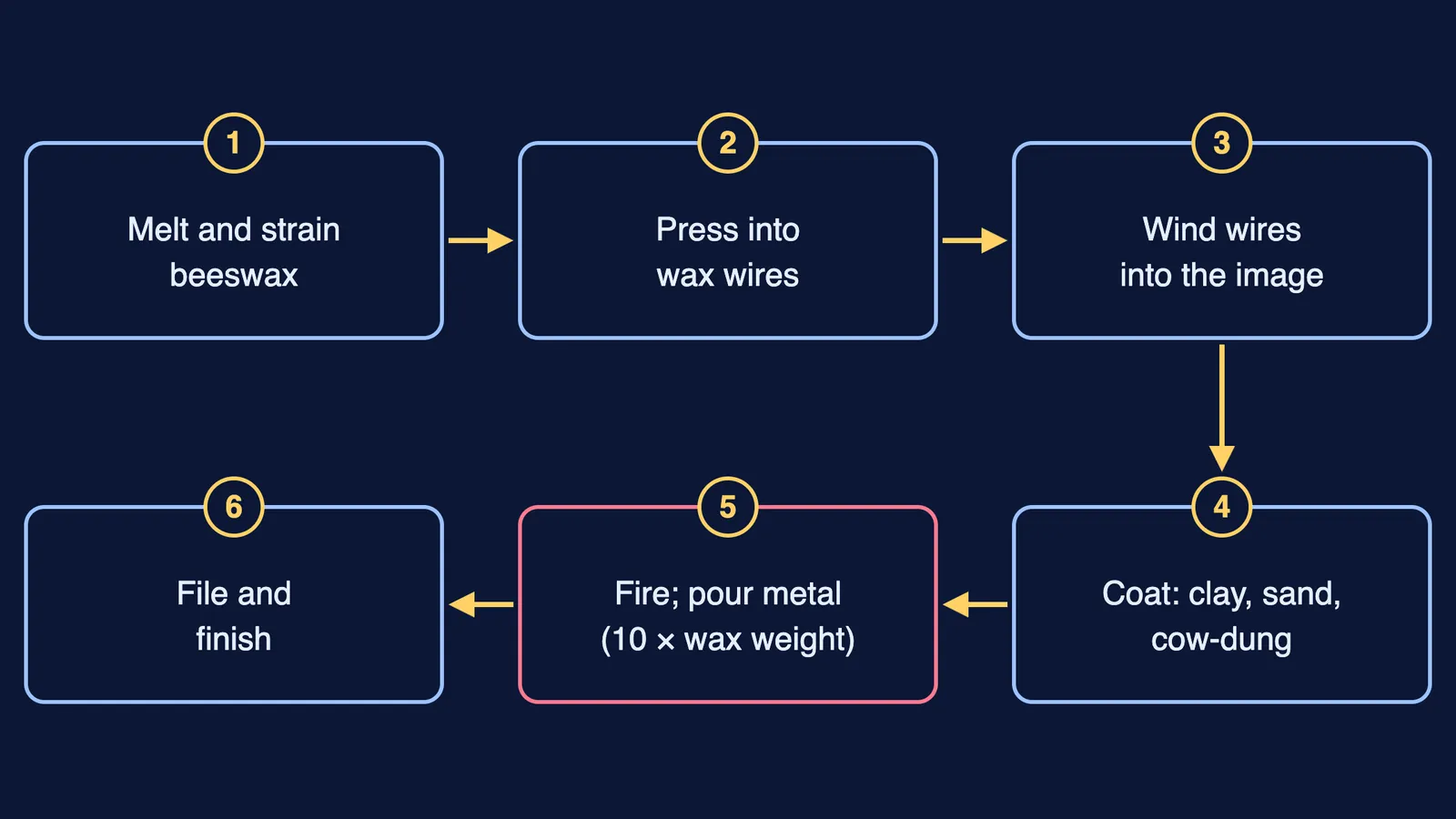
A box in the chapter describes the method as used in Himachal Pradesh, Odisha, Bihar, Madhya Pradesh and West Bengal:
Melt pure beeswax over a fire and strain it through cloth into cold water, where it sets.
Push the wax through a pichki or pharni to get noodle-like wires.
Wind the wires into the full image.
Coat it thickly with equal parts clay, sand and cow-dung, and fix a clay pot at one opening.
Pour molten metal, mostly scrap, into the pot while the model is fired; the wax melts and metal takes its shape.
Smooth and finish the image with files.
The book says the metal used weighs ten times the wax, and the wax is weighed before the process starts. Our own example: a 350 g wax model needs 350 × 10 = 3,500 g, or 3.5 kg, of metal.
Why is the Chola Nataraja studied so closely?
The book says Nataraja, the dancing Shiva, was evolved and fully developed in the Chola period. Learn it part by part, as the book describes it:
Right leg: bears the weight and presses on apasmara, the demon of ignorance or forgetfulness.
Left leg: raised in bhujangatrasita, which the book links to tirobhava, removing the veil of maya.
Upper hands: damaru on the right, keeping the tala; a flame on the left.
Main hands: abhaya hasta (right), dola hasta (left).
Hair: flying locks touch the jvala mala, the garland of flames around the figure.
How should you revise and practise?
Chart the ten stages; label a Nataraja sketch from memory. Not sure where to begin? Fermi's AI tutor works out what you already know and builds a plan for the session.
Practice questions (marks are our suggestion):
(2 marks) Give the Dancing Girl's site, its date in the chapter, and one feature of its form.
(3 marks) A wax model weighs 0.6 kg. Using the book's ratio, how much metal is needed, and why is the wax weighed first? (Answer: 6 kg.)
(4 marks) Explain the lost-wax process step by step, in order.
(6 marks) Describe the Chola Nataraja's posture and attributes, and what the raised leg and the figure underfoot signify in the book.
(3 marks) How did portable Gupta and Vakataka bronzes help their style travel?
See also our Class 9 introduction to the history of arts and mediums and techniques in visual art.