On this page
Hydrocarbons is Unit 9 of the NCERT Class 11 Chemistry textbook, Part 2 (reprint 2026-27). The CBSE Chemistry curriculum for 2026-27 lists its scope as "Classification, Alkanes, Alkenes, Alkynes, Aromatic Hydrocarbon, Carcinogenic and Toxicity". Definitions are our own, checked against the chapter. For the full chapter, see our Hydrocarbons Class 11 chemistry guide.
What are the main types of hydrocarbons?
Hydrocarbon: a compound of carbon and hydrogen only. Example: methane, CH4.
Alkane: an open-chain hydrocarbon with only C–C single bonds, general formula CnH2n+2.
Cycloalkane: a saturated hydrocarbon whose carbons close into a ring.
Alkene: a hydrocarbon with at least one C=C double bond, general formula CnH2n; also called an olefin. Example: ethene, C2H4.
Alkyne: a hydrocarbon with at least one C≡C triple bond, general formula CnH2n–2. Example: ethyne (acetylene).
Arene (aromatic hydrocarbon): a ring compound with a special, delocalised set of π electrons. Benzenoids contain a benzene ring; non-benzenoids do not.
Primary, secondary, tertiary, quaternary carbon: a carbon bonded to one, two, three or four other carbons.
Chain isomers and position isomers: chain isomers differ in how the carbon skeleton branches (butane and 2-methylpropane); position isomers differ in where the multiple bond sits (but-1-yne and but-2-yne).
How are alkanes made, and how do they react?
Hydrogenation: adding H2 across a double or triple bond over finely divided Pt, Pd or Ni.
Wurtz reaction: an alkyl halide heated with sodium in dry ether joins two alkyl groups. Example: CH3Br gives ethane. With one alkyl halide, the product has an even number of carbons.
Decarboxylation: heating the sodium salt of a carboxylic acid with soda lime removes CO2, giving an alkane with one carbon fewer. Example: sodium ethanoate gives methane.
Kolbe's electrolytic method: electrolysing a sodium or potassium carboxylate solution gives an alkane at the anode.
Free radical substitution: a halogen replaces hydrogen in light or heat in three steps: initiation, propagation, termination. Two methyl radicals combining explains the ethane by-product in methane chlorination.
Aromatization (reforming): n-alkanes with six or more carbons, heated over oxides of vanadium, molybdenum or chromium on alumina, lose hydrogen and close into benzene rings. Example: n-hexane gives benzene.
Pyrolysis (cracking): heat splitting larger alkanes into smaller alkanes and alkenes.
What is the difference between conformations and cis-trans isomers?
Conformations (conformers): arrangements of a molecule that turn into one another just by rotating about a C–C single bond.
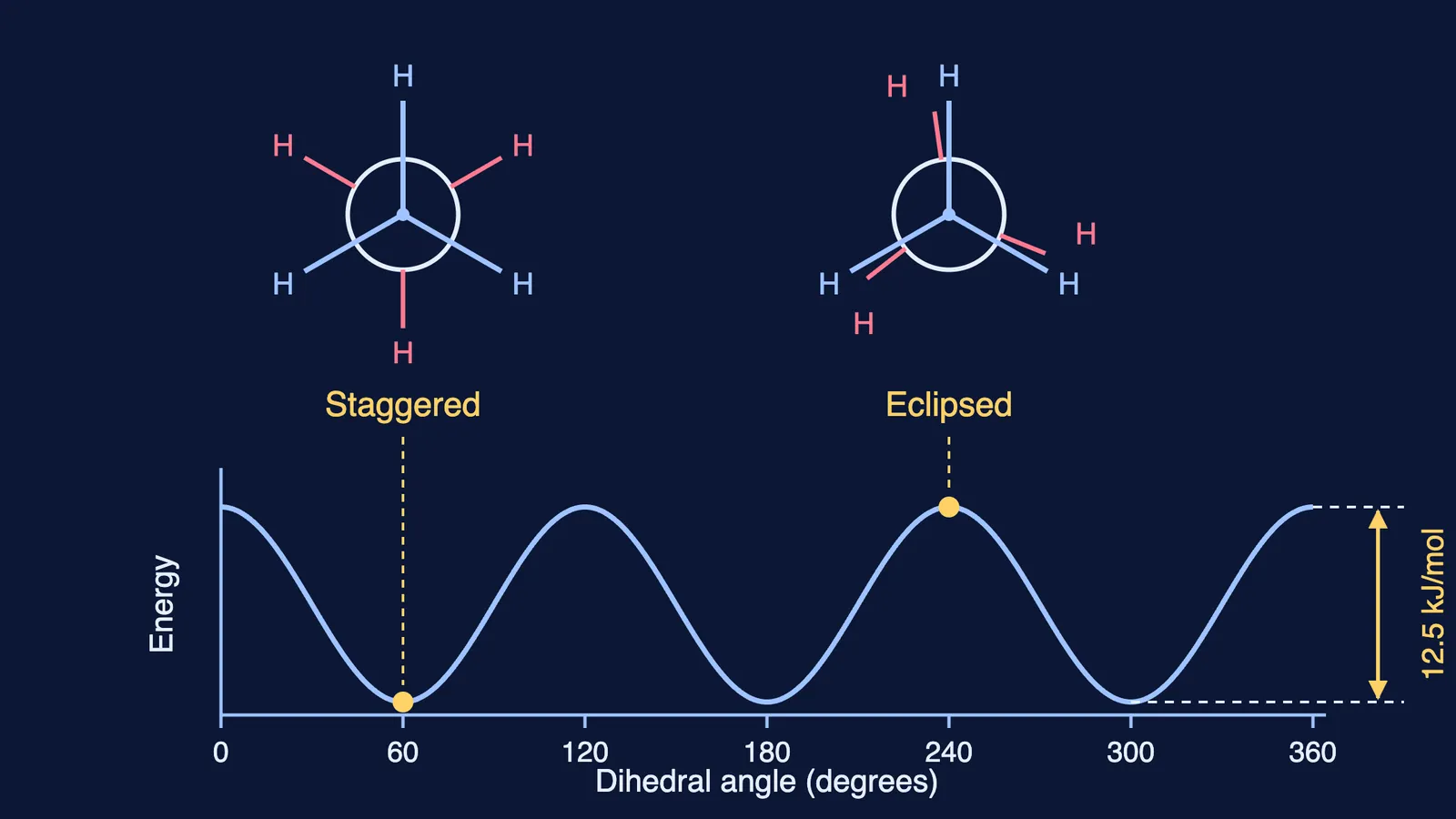
Torsional strain: the repulsion between bond electron clouds on neighbouring carbons. It depends on the dihedral angle, the angle of rotation about the C–C bond.
Staggered and eclipsed conformation: in staggered ethane the hydrogens on the two carbons are as far apart as possible; in eclipsed they line up. Staggered is more stable, by about 12.5 kJ mol–1 (NCERT).
Newman projection: a drawing that looks straight down the C–C bond: the front carbon is a point, the back carbon a circle. A Sawhorse projection shows the same bond from an angle.
Geometrical (cis-trans) isomers: because a C=C bond cannot rotate, groups can sit on the same side (cis) or opposite sides (trans). Example: cis-but-2-ene has a dipole moment of 0.33 D; trans-but-2-ene is almost non-polar. Don't confuse with: conformers, which interconvert so easily they cannot be isolated.
Which reactions of alkenes and alkynes have names?
Electrophilic addition: an electron-seeking reagent (an electrophile, such as H+ from HBr) attacks the loosely held π electrons and adds across the multiple bond.
Markovnikov rule: in adding HX to an unsymmetrical alkene, the negative part bonds to the carbon with fewer hydrogens. Example: propene and HBr give 2-bromopropane, through the more stable secondary carbocation.
Peroxide (Kharash) effect: with a peroxide present, HBr adds the opposite way by a free radical route, giving 1-bromopropane. Don't confuse with: HCl and HI, which show no peroxide effect.
Dehydrohalogenation: alcoholic KOH removes HX from an alkyl halide to form an alkene.
Lindlar's catalyst: palladised charcoal poisoned with sulphur compounds or quinoline; it stops alkyne reduction at the cis alkene. Don't confuse with: sodium in liquid ammonia, which gives the trans alkene.
Ozonolysis: ozone adds to the alkene, and Zn/H2O splits the ozonide into carbonyl compounds, showing where the double bond was.
Baeyer's reagent: cold, dilute aqueous KMnO4. Alkenes decolourise it, forming vicinal glycols, a test for unsaturation.
Acidic character of alkynes: hydrogen on a triply bonded carbon leaves as H+ because sp carbon (50% s character) holds electrons tightly (NCERT). Example: ethyne with sodium gives sodium acetylide; ethene does not react.
Polymerisation: many small monomer molecules joining into one large polymer. Example: ethene to polythene.
What makes benzene aromatic?
Resonance in benzene: benzene is a hybrid of two Kekulé structures, with six π electrons spread over the ring. All six C–C bonds measure 139 pm, between a single bond (154 pm) and a double bond (133 pm) (NCERT).
Hückel rule: a ring is aromatic if it is planar, its π electrons are fully delocalised, and it has (4n + 2) π electrons. Benzene has 6 (n = 1).
Electrophilic substitution: an electrophile replaces a ring hydrogen and the ring keeps its aromatic π system. Examples: nitration (nitronium ion, NO2+, from conc. HNO3 and H2SO4), halogenation, sulphonation.
Friedel-Crafts alkylation and acylation: benzene with an alkyl or acyl halide and anhydrous AlCl3 gives an alkylbenzene or acylbenzene.
Ortho/para and meta directing groups: a group already on the ring decides where the next one enters. –OH directs ortho/para and activates the ring; –NO2 directs meta and deactivates it. Don't confuse with: halogens, which deactivate yet still direct ortho/para.
Carcinogenic hydrocarbons: benzene, and hydrocarbons built from three or more fused benzene rings, are toxic and cancer-causing. The fused-ring ones come from incomplete burning of tobacco, coal or petroleum.
How to learn these terms
Learn the mix-ups as pairs: Markovnikov vs peroxide effect, Lindlar vs Na/liquid NH3, conformer vs cis-trans isomer, activating vs directing.
Draw ethane in Newman projection, staggered and eclipsed, and mark which one sits at the energy minimum.
Make one card per named reaction: reagent, conditions, product.
Then apply the terms in our Hydrocarbons case study questions for Class 11.
If a term feels abstract, the Fermi Concept Library covers every concept in chemistry, each with its own lesson and its place in the map.