On this page
These terms come from Chapters 12 (Atoms) and 13 (Nuclei) of the NCERT Class 12 Physics Part II textbook (Reprint 2026-27), Unit VIII of the CBSE 2026-27 Physics syllabus. Radioactivity appears briefly in NCERT section 13.6 but is not in the CBSE 2026-27 Chapter 13 list, so it is left out.
What did the alpha-particle scattering experiment show?
Source: NCERT sections 12.1 and 12.2.
Thomson (plum pudding) model: positive charge spread evenly through the atom, with electrons stuck inside. Don't confuse with: Rutherford's model, where the positive charge sits in a tiny centre.
Alpha particle: a helium nucleus, charge +2e.
Geiger–Marsden experiment: 5.5 MeV alpha particles fired at thin gold foil, counted by flashes on a zinc sulphide screen. Roughly 0.14% of them bent by more than 1°, and about one in 8000 by more than 90°.
Impact parameter (b): the perpendicular distance from the nucleus's centre to the alpha particle's starting line of motion. Small b means a large deflection; b = 0 sends it straight back. Don't confuse with: distance of closest approach.
Distance of closest approach: in a head-on hit, the distance from the nucleus's centre at which the alpha particle briefly stops, all its kinetic energy turned into electric potential energy. Example: about 30 fm for a 7.7 MeV alpha particle and gold.
Rutherford's nuclear model: all the positive charge and nearly all the mass in a nucleus about 10⁻¹⁵ to 10⁻¹⁴ m in size, with electrons orbiting in an atom about 10⁻¹⁰ m in size. Most of the atom is empty.
How does Bohr's model explain the hydrogen spectrum?
Source: NCERT sections 12.3 to 12.6. The syllabus treats hydrogen line spectra qualitatively only.
Stability problem: a circling electron is accelerating, so classical physics says it should radiate and spiral into the nucleus. Rutherford's model cannot avoid this.
Stationary state: an allowed orbit where the electron does not radiate and has a fixed energy.
Quantisation condition: angular momentum comes only in whole-number multiples of h/2π, L = nh/2π.
Principal quantum number (n): the whole number 1, 2, 3 ... labelling each state.
Bohr radius (a₀): the n = 1 orbit radius, about 5.3 × 10⁻¹¹ m; radii grow as n².
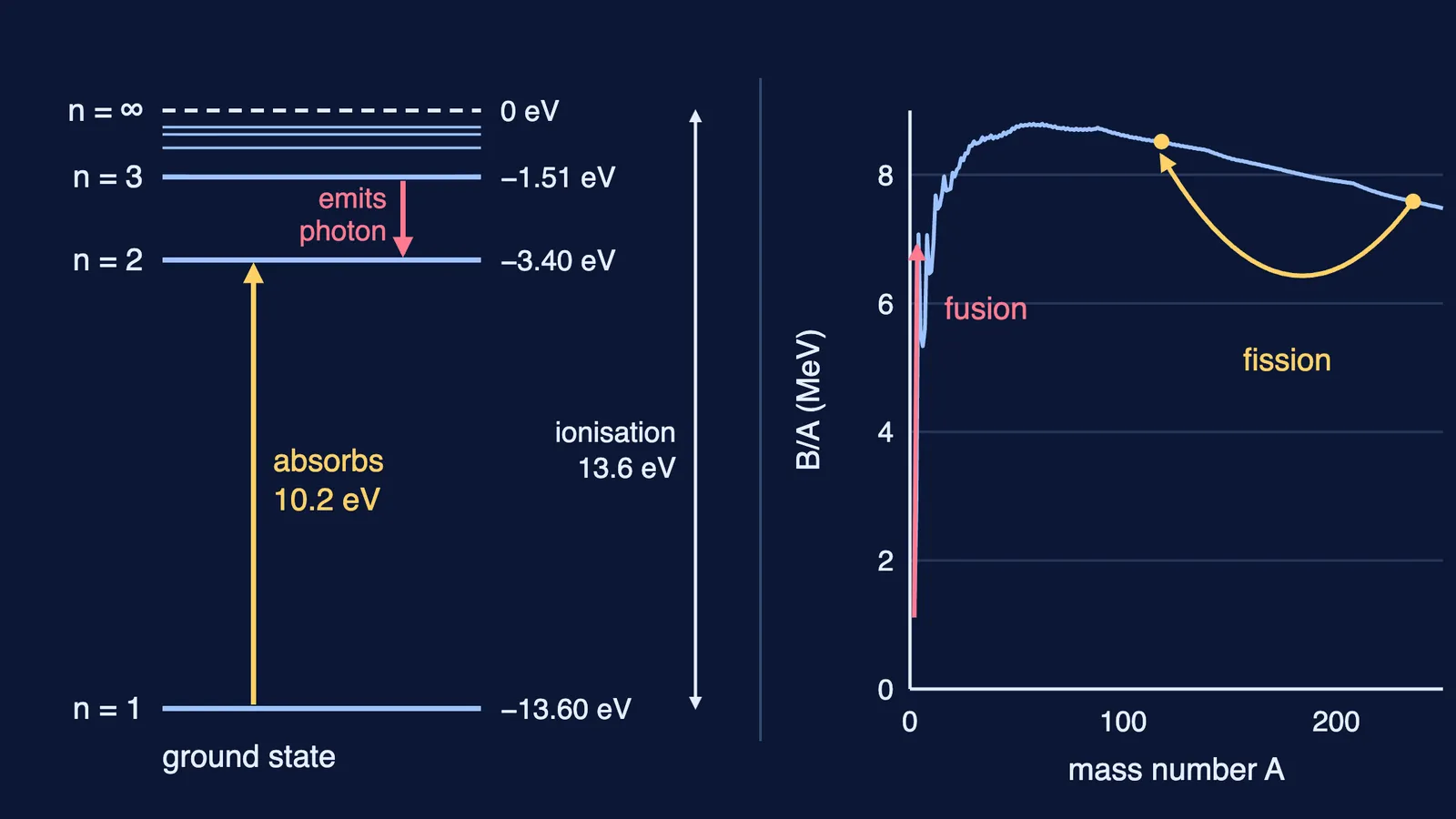
Energy levels: Eₙ = −13.6/n² eV; the minus sign means the electron is bound.
Ground state: n = 1, at −13.6 eV. Don't confuse with: excited state, any n > 1; reaching n = 2 (−3.40 eV) takes 10.2 eV.
Ionisation energy: the energy that frees the electron from the ground state, 13.6 eV. Don't confuse with: excitation energy, which only lifts it to a higher level.
Photon emission: an electron dropping to a lower level gives out one photon, hν = Eᵢ − E_f.
Emission line spectrum: bright lines at a few fixed wavelengths, an element's fingerprint. Don't confuse with: absorption spectrum, dark lines at the same wavelengths when white light passes through the gas.
De Broglie's explanation: a whole number of electron wavelengths must fit around the orbit, 2πrₙ = nλ, which gives L = nh/2π.
Hydrogenic atom: a nucleus with one electron, such as H, He⁺ or Li²⁺. Bohr's model works only for these, and cannot explain why some lines are brighter.
What is a nucleus made of, and how big is it?
Source: NCERT sections 13.2 and 13.3.
Atomic mass unit (u): one-twelfth of a carbon-12 atom's mass, 1.660539 × 10⁻²⁷ kg.
Nucleon: a proton or a neutron.
Atomic number (Z), neutron number (N), mass number (A): protons, neutrons, and A = Z + N. Example: gold-197 has Z = 79, N = 118.
Neutron: discovered by James Chadwick in 1932; stable inside a nucleus, but a free neutron decays with a mean life of about 1000 s.
Isotopes: same Z, different A. Example: chlorine-35 and chlorine-37.
Isobars: same A, different Z, such as hydrogen-3 and helium-3. Don't confuse with: isotones, same N, such as mercury-198 and gold-197.
Nuclear radius: R = R₀A^(1/3), with R₀ = 1.2 fm (1 fm = 10⁻¹⁵ m).
Nuclear density: about 2.3 × 10¹⁷ kg m⁻³, roughly the same for all nuclei.
What holds a nucleus together, and where does nuclear energy come from?
Source: NCERT sections 13.4, 13.5 and 13.7.
Mass-energy equivalence: E = mc²; 1 u is equivalent to 931.5 MeV.
Mass defect (ΔM): how much lighter a nucleus is than its separate nucleons. Example: 0.13691 u for oxygen-16.
Binding energy (E_b): the energy needed to pull a nucleus fully apart, E_b = ΔMc²; about 127.5 MeV for oxygen-16.
Binding energy per nucleon: E_b divided by A, a measure of how tightly each nucleon is held. It peaks at about 8.75 MeV near A = 56 and is 7.6 MeV at A = 238. Don't confuse with: total binding energy, which is larger for big nuclei simply because they have more nucleons.
Nuclear force: the attraction between nucleons; much stronger than the Coulomb force, about the same for any pair of nucleons, and gone beyond a few femtometres. Closer than about 0.8 fm it repels.
Nuclear fission: a heavy nucleus splitting into two middle-sized ones. Example: uranium-235 plus a neutron giving barium-144, krypton-89 and 3 neutrons, releasing about 200 MeV.
Nuclear fusion: light nuclei joining into a heavier one. Don't confuse with: fission; both release energy because the products are more tightly bound.
Thermonuclear fusion: fusion made possible by a temperature high enough to beat the Coulomb barrier. Example: the Sun's proton–proton cycle turns four hydrogen atoms into helium, releasing 26.7 MeV.
How to learn these terms
Learn the pairs together: impact parameter and closest approach, ionisation and excitation energy, isotopes, isobars and isotones.
Draw hydrogen's energy ladder from Eₙ = −13.6/n² (NCERT Eq. 12.10) and mark the 10.2 eV and 13.6 eV jumps; most Bohr terms sit on that sketch.
Sketch the binding energy per nucleon curve with fission and fusion arrows. The Fermi Simulation Lab has interactive simulations for the ideas that are easier to see than to read.
Then test yourself with the Nuclei Class 12 board exam guide and the Atoms Class 12 board exam guide.