On this page
Current Electricity is Chapter 3 of the NCERT Class 12 Physics textbook, Part I (reprint 2026-27). The CBSE Physics syllabus for 2026-27 lists its topics from electric current and drift velocity to Kirchhoff's rules and the Wheatstone bridge, and its marks table gives Units I and II (Electrostatics and Current Electricity) 16 of 70 theory marks together. For answer-writing, see our Current Electricity Class 12 board exam guide.
What is electric current, and why do electrons drift?
Electric current (I): the net charge crossing an area per unit time, I = q/t; for a changing current, the limit of ΔQ/Δt. Unit: ampere (A). A negative answer means the current runs the other way.
Steady current: a current that does not change with time, as in a torch.
Current density (j): current per unit area taken normal to the flow, in A/m². It is a vector along E. Don't confuse with: current itself, which NCERT calls a scalar even though we draw it with an arrow.
Charge carriers: free electrons in metals; positive and negative ions in electrolytes.
Relaxation time (τ): the mean interval between one collision of a free electron with the lattice ions and its next collision.
Drift velocity (vd): the small average velocity electrons settle at in a field, vd = −eEτ/m, directed opposite to E. Example: NCERT's Example 3.1 finds about 1.1 mm/s for 1.5 A in a copper wire of area 1.0 × 10⁻⁷ m². Don't confuse with: how fast the current starts, which depends on the field spreading through the circuit at about the speed of light.
Number density (n): free electrons per unit volume; NCERT estimates 8.5 × 10²⁸ m⁻³ for copper. It links current and drift: I = neAvd.
Mobility (μ): drift speed per unit electric field, μ = |vd|/E = eτ/m, in m²/Vs.
What does Ohm's law actually say?
Ohm's law: for many materials, the current is proportional to the potential difference, so the V-I graph is a straight line through the origin.
Resistance (R): the ratio V/I, in ohms (Ω). It depends on the material and on the conductor's shape: R = ρl/A. Don't confuse with: Ohm's law. V = IR defines resistance for any device; Ohm's law claims R stays constant.
Resistivity (ρ): the material's own resistance factor, independent of size, in Ω m. NCERT puts metals between 10⁻⁸ and 10⁻⁶ Ω m.
Conductivity (σ): the reciprocal of resistivity, σ = 1/ρ, in siemens per metre. Ohm's law in field form is j = σE.
Linear and non-linear V-I characteristics: a straight-line graph means ohmic behaviour; a curve means the device does not obey Ohm's law. Example: a diode conducts differently when V is reversed, and GaAs can show more than one V for the same I.
Conductors, semiconductors, insulators: three classes of material in order of increasing resistivity.
How do temperature and power fit in?
Temperature coefficient of resistivity (α): the fractional rise in resistivity per degree, from ρT = ρ0[1 + α(T − T0)]. It is positive for metals.
Why a metal's resistivity rises with temperature: hotter electrons move faster and collide more often, so τ falls while n stays nearly fixed. Don't confuse with: semiconductors, where n rises with temperature and resistivity falls.
Nichrome, manganin, constantan: alloys whose resistivity barely changes with temperature, used in standard resistors. Example: nichrome heating elements in toasters.
Electrical power: the energy per second turned into heat in a resistor, P = IV = I²R = V²/R ("ohmic loss").
Transmission loss: the power wasted in cables, Pc = P²Rc/V², which is why power lines run at high voltage.
What are emf and internal resistance?
Electromotive force (emf, ε): the potential difference between a cell's terminals when no current flows; equivalently, the work done per unit charge by the source. It is not a force, despite the name.
Internal resistance (r): the resistance of the electrolyte inside the cell.
Terminal voltage (V): the potential difference across the cell while current I is drawn, V = ε − Ir. Don't confuse with: emf, which equals V only on open circuit.
Maximum current: Imax = ε/r, when the terminals are shorted (R = 0).
Cells in series: emfs add and internal resistances add; a cell connected the wrong way round subtracts its emf.
Cells in parallel: 1/req = 1/r1 + 1/r2 and εeq/req = ε1/r1 + ε2/r2.
How do Kirchhoff's rules and the Wheatstone bridge work?
Junction rule: total current into a junction equals total current out, because charge does not pile up in a steady circuit.
Loop rule: the algebraic sum of potential changes around any closed loop is zero, because potential depends only on position. Don't confuse with: the junction rule, which is about charge, not potential.
Assumed current direction: label each branch with an arrow; a negative answer means the current flows against it.
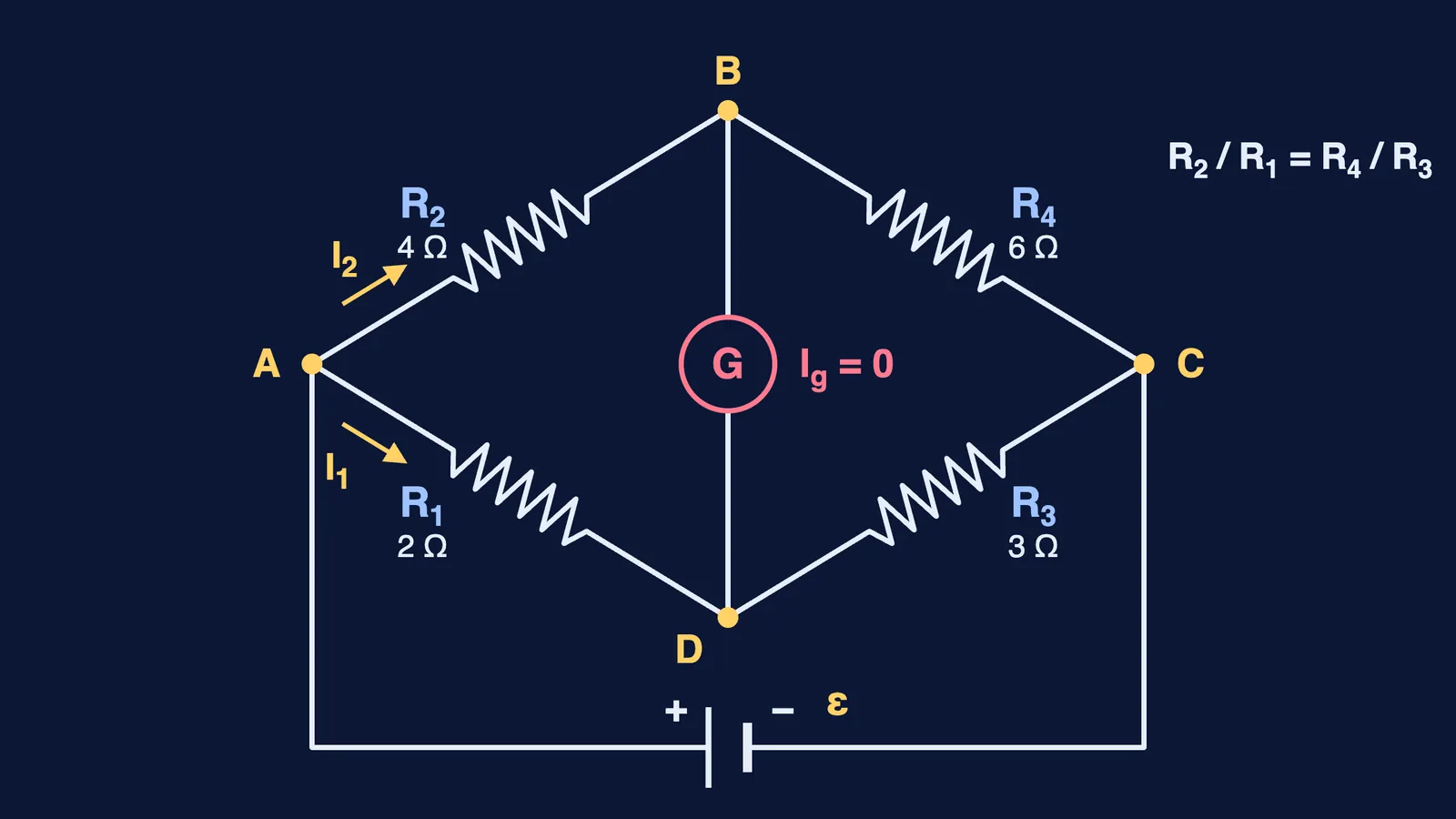
Wheatstone bridge: four resistors R1 to R4, with the cell across one diagonal (the battery arm) and a galvanometer across the other (the galvanometer arm).
Galvanometer: a sensitive meter showing whether current passes through it; here, the null detector.
Balanced bridge (null deflection): no current through the galvanometer, when R2/R1 = R4/R3. Example: with three resistances known, the fourth follows.
Meter bridge: NCERT names it in one line as the practical device built on the bridge principle.
The current NCERT chapter does not include the potentiometer or the colour code for resistors, so they are not in this list.
How to learn these terms
Pair the look-alikes and say the difference aloud: emf vs terminal voltage, current vs current density, resistance vs resistivity, Ohm's law vs V = IR.
Write the drift chain from memory: E gives a, collisions give τ, so vd = eEτ/m, then I = neAvd, then σ = ne²τ/m.
Redraw the bridge in the diagram above, label R1 to R4 and both arms, and derive the balance condition from the two loops.
Test yourself with our assertion-reason questions on current electricity and read our CBSE Class 12 physics paper guide.
If drift or a balanced bridge is hard to picture, the Fermi Simulation Lab has interactive simulations for the ideas that are easier to see than to read.